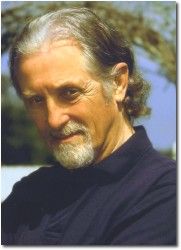
Saxon Wicca begins with Raymond Buckland, and we continue to honor him as the Father of our family-based practice of the religion. Born in London, England August 31, 1934 to Eileen and Stanley Buckland, Raymond, (along with his parents and older brother Gerard), moved to Nottingham to escape the bombing raids of London during WWII. A bookworm who would grow up to become a successful author of both fiction and non-fiction, he also developed an interest in acting and theatre as a teenager, and went on to study anthropology, play in a jazz band, and work as a draughtsman before meeting and marrying Rosemary Moss with whom he would father two sons, Robert and Regnauld. After serving a short service in the Royal Air Force between 1957-59 the Buckland family moved to the United States in 1962 where he would work for British Airways allowing an ability to travel. Shortly after arriving in the United States, Buckland found and read two books, The Witch-Cult in Western Europe by Margaret Murray (1921) and Witchcraft Today by Gerald Gardner (1954) that would help him to find the religion that he would practice, dispel misinformation about, and add to in meaningful ways for the rest of his life.
After contacting Gerald Gardner on the Isle of Man and corresponding with him long-distance, Buckland was able to travel to Perth, Scotland where Monique Wilson or “Olwen” initiated Raymond into Gardnerian Witchcraft in 1963. Raymond “Robat” and his wife Rosemary “Rowan” would subsequently bring what is now commonly known as Wicca to the United States in 1964 by founding a coven on Long Island, New York. This coven grew to about twelve members enabling other covens to hive off from the mother coven, and so this slow-growth initiatory religious tradition began to seed in American soil.
In 1965 and 1968 respectively, the American publications of Witchcraft, the Sixth Sense by Justine Glass and Witches by T.C. Lethbridge were beginning to provide a more accurate glimpse into the beliefs and practices of this new religious movement, but by 1971 the idea of religious Witchcraft (as it was still pretty much exclusively called) had really begun to enter the American conscious as something other than the stuff of mere horror novels and films, and in no small part due to Buckland’s own efforts with his Buckland Museum of Witchcraft and Magick, (opened in the basement of his home in Long Island), and his books Witchcraft…The Religion (1966), Witchcraft Ancient & Modern (1970) and Witchcraft from the Inside (1971).
About a decade after founding their Long Island coven, the marriage of Rowan and Robat ended in divorce, necessitating the need to pass the coven on to a new High Priestess and High Priest. After the divorce and his remarriage, Buckland found himself in the awkward position of being within a religion that no longer served his needs as it once had, and becoming aware of its inherent limitations for many sincere individuals who could not access the religion either through physical remoteness from other Wiccans, or equally, by sexual prejudice, or the egotism and power-plays enabled by the interpretation of “Initiation” as a matter of “degrees” in a religion bound by potentially abusive Oaths of Secrecy.
These limitations to Wicca as he experienced it, Buckland sought to solve by writing his own “Book of Shadows”, much as we know Gerald Gardner had himself done, but for Buckland, this book would now be based on both his previous first-hand experience of being in a Gardnerian coven as a High Priest for over a decade, combined with the inspiration he found in the Old English Gods as explored in Brian Branston’s The Lost Gods of England. First published in 1957, Branston wrote of the contemporary revival of paganism through Wicca within the context of his larger investigation of the pre-Christian English Gods, specifically in his chapter on Frey “Lord” and Freya “Lady”, the Names by which our own Coven worships the Wiccan God and Goddess. The names of some of the more explicitly “Anglo-Saxon” Gods still live on in the secular tongue of the English language, within the words that denote the days of the week: Tiw (Tuesday), Woden (Wednesday), Thunor (Thursday), Frig (Friday), Sun (Sunday), and Moon (Monday).
The Tree: The Complete Book of Saxon Witchcraft, which Buckland published in 1974 for any individual to use as the basis for their own practice of worshipping the primeval and pantheistic Gods of Wicca inspired by “Merrie Olde England”, emphasized the worship of a Pagan God and Goddess, and eliminated entirely Gardner’s ceremonial magic. Saxon Wicca is also distinguished by insisting upon a more democratic method of governance in which anyone can Self-Dedicate themselves as a Wiccan, and can, if desired, form their own covens based on a pragmatic method of ritual practice similar to that which the Gardnerian covens had been working for the previous twenty years. While Buckland’s Tree simplified some things, it would add others, in particular, a more genuinely fertility religion feel by openly adding Rites of Passage for all the important events of human life that Gardner’s Book did not originally possess. Rites for Birth, Death, Hand-Fasting, and (with Saxon Wicca’s lack of stigmatization of the right of Free Individuals to dissolve their unions as they will), a rite of Hand-Parting as well. That the emphasis in a Saxon Wiccan coven is always on the Individuality, Autonomy, and Freedom of each Wiccan to Self-Dedicate to the Gods and practice alone, or to seek Initiation into a Coven family which they may leave at will, combined with the lack of secrecy regarding The Tree itself, still makes Saxon Wicca a unique tradition to this day.
That each individual or coven may also adapt their personal copy of The Tree as needed, and bring to it their own artistic style and spiritual insights, did, (and continues to do), much to open Wicca to anyone and everyone to whom it may be a suitable experience and expression of a Life and Love venerating modern Pagan religion. Saxon Wicca’s emphasis on the Individuality of each Wiccan both as a Self-Dedicated Solitary and as a Coven Member (rather than as one half of a male-female working pair as in a historical American Gardnerian coven), both removes any religious prejudice against same-sex lovers that may be members of a Saxon Wicca coven family, as well as any sex-based discrimination against a Priestess or Priest’s (or Solitary Witch’s) ability to lead the Rites alone. An overlooked Wiccan tradition by many seekers, (presumably for the very reason that it does not reward egotism), Raymond Buckland did for pantheistic Pagans with an affinity for the Old English Gods, something truly worthwhile in the history of religion, and we feel he deserves remembrance for it.
As Raymond Buckland wrote in 2004 in regard to The Tree, “I urge you to adapt what I present to meet your own personal requirements. If you want to use the name Frig for your goddess, then do so. If you want to use entirely different names then – so long as they are Saxon – do so. Names, after all, are only labels to help us identify with the gods. If you approach this book with the above in mind, I think you will find it serves a very useful purpose. It allows those with no other connections to immediately become practitioners of the Old Religion. It allows those who have been in any way harmed by dictatorial group leaders to break away and create their own path. It allows for another choice among the now many available traditions of Wicca. Take this path, and may the Lord and Lady walk with you always.”
Raymond Buckland passed into Drëun on September 27, 2017 shortly after having wished Wiccans of all traditions everywhere a happy Mabon, a name which had not yet become attached to the Wiccan celebration of the Autumn Equinox back in 1974 when The Tree was published; itself a testimony to how much religious Witchcraft, now widely known as Wicca, (itself a specifically Anglo-Saxon word for Witchcraft), has grown in the years since “Scire” (Gerald Gardner) first hinted publicly at its existence in his 1949 novel, High Magic’s Aid. Always coming across to us as a good-natured and thoughtful gentleman, both in his books and in the many interviews he gave to explain and advocate for his religion that he so clearly and sincerely loved, we are honored to say that Raymond Buckland’s life’s work for the advancement of Wicca has so significantly, and positively, influenced our own lives and spiritual practice. And although we never had the privilege to meet him in this life, we would be honored if ever stopped to visit us for Cakes and Ale on Samhain on his way to the next, where we will continue to raise a horn in his honor. Love is the Law, and Love is the Bond. To the Gods!
 Lincoln Green