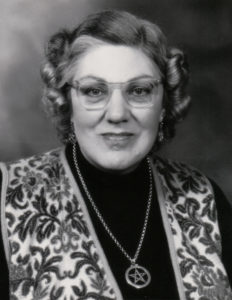
Now widely known as “The Mother of Modern Witchcraft”, Doreen Valiente’s life and legacy has had almost as much influence on our coven’s theology and philosophy as our tradition’s founder, despite the somewhat rocky history between the two figures historically. Part of the historical divide is simply one of geography, as Doreen Valiente’s Witchcraft was intimately tied to her land as an Englishwoman, a land from which Raymond Buckland would emigrate in the 1960s, bringing to the Americas his own understanding of Gerald Gardner’s Witchcraft—a tradition with which Valiente had a complicated relationship, not gaining widespread recognition for her major contributions to its development as an early High Priestess and co-creator with Gardner until the 1980s. Valiente’s story is one that runs parallel in Witchcraft history to Buckland’s as “The Father of American Wicca”, and we strive to marry in our own coven what we see as a common philosophy of Witchcraft between these two extremely influential Witches that they may not have recognized in one another in this life, but which have greatly effected our own theory and practice.
Doreen Valiente, whose Craft name was Ameth, was born Doreen Edith Dominy on January 4, 1922 in Colliers Wood, Mitcham Surray to Edith and Harry Dominy. She took the surname which she would keep until her death in 1999 after her marriage to the Spanish Civil War veteran Casimiro Valiente in 1944. Although he did not choose to initiate and practice with her, Casimiro was tolerant, and Valiente’s Witch friends who met him all remembered him fondly. Casimiro passed away shortly before the publication of Doreen’s second book, An ABC of Witchcraft in 1973. Her first book, published over a decade before, Where Witchcraft Lives (1962) is particularly important for understanding the ethical development of Witchcraft (or Wicca) as a distinct religion from other Western esoteric ritual magic systems to which it is closely related historically, in particular the religio-magical system of Aleister Crowley, known by him as “Thelema”.
Doreen’s first husband, Joanis Vlachopoulo, was a Greek sailor who drowned when his ship the Pandias was sunk by a German U-boat on June 13, 1941. Her third love, Ron Cooke, would be initiated into Witchcraft by Valiente in 1976 and they would remain together for the rest of their lives—and she would not long survive his death in 1997, passing bravely into the Summerland after planning her own thoroughly Pagan funeral service, much as Aleister Crowley had done 50 years before.
Doreen Valiente: Witch by Philip Heselton, published in 2016, seventeen years after her death, is pretty much required reading for anyone trying to understand the development of the modern religion of Witchcraft/Wicca- as is Valiente’s own memoir The Rebirth of Witchcraft (1989), but what we would like to address in this space is the degree to which her work, in particular her creation of the piece of Wiccan liturgy know as The Charge of the Goddess, has become the touchstone of our own theology.
Recited by the Priestess in our coven at the Full Moon, Valiente’s prose version of The Charge is based in the late antiquity Great Goddess worship and witchcraft described in the 2nd Century Latin novel The Metamorphoses of Apuleius, combined with elements of the later Italian Vangelo, as attested to by American folklorist Charles Godfrey Leland in his 1899 work Aradia, or the Gospel of the Witches. A third literary element is the influence of Aleister Crowley’s 1917 essay The Law of Liberty written in America during World War I. Valiente intentionally rewrote Gardner’s rituals to decrease their reliance on Crowley’s poetry, which Valiente admired, but did think suitable for Witchcraft, for reasons best understood when one is familiar with the life and work of the historically overlooked Pagan poet Victor B. Neuburg.
Valiente did not see Crowley’s “Aeon of Horus” as in conflict with the more widely understood in esoteric circles “Age of Aquarius” and let the poetic allusion to Crowley’s Law remain in her version of The Charge. Of particular interest and relevance to Wiccans, however, is the Goddess-emphasis in Neuburg’s work. As that history is a book unto itself, it is mainly mentioned here only because there seems to be widespread misunderstanding among many that Wicca derives significantly, even primarily, from the work of Aleister Crowley via Gardner, and that Wiccans are somehow misinformed about this, when the reality is that Witchcraft is genuinely philosophically and theologically distinct from what Crowley taught, and that the Paganism of one of the people closest to him also predated any relationship to him, as Victor B. Neuburg was writing and publishing about his Pagan philosophy as early as 1903.
Valiente herself, who was very knowledgable about Crowley, and what about his work she admired and what needed to be pruned for the growth and flourishing of Witchcraft–and female Witches and Priestesses in particular, has yet to be taken seriously by the material inheritors of Crowley’s infamously loud legacy, and as her eyes wide-open and honest assessment is often awkward and embarrassing to those who regard Crowley as more prophet than man–we feel a need to draw attention to these unaddressed complications of interpretation in modern Pagan history.
Doreen Valiente’s take-down of Aleister Crowley’s “sex magick” and his Ordo Templi Orientis and its “secrets” in her books Natural Magic (1975) and Witchcraft for Tomorrow (1978) has had immense impact as far as female self-assertion in Witchcraft and the revival of Paganism more broadly, and her publication of Witchcraft for Tomorrow in particular, sent a shockwave through what had previously been an insular, and all-too-often exploitative subculture by stating that a Witch could self-initiate, even including a Rite of “Self-Initiation” as part of the Liber Umbrarum in her book. And who can really argue with the woman whom Gerald Gardner himself gave his original “Book of Shadows” and challenged to rewrite its core liturgy if she thought she could do it better?
Similarly, Raymond Buckland as a High Priest of Witchcraft in America had the audacity to publish his own “Book of Shadows” in the form of The Tree in 1974 which included a Rite of “Self-Dedication”. As the High Priest to whom the vast majority of American “Gardnerian” Witches trace their lineage, this created a serious problem for High Priestesses and Priests who may have valued Witchcraft primarily for its exclusivity, and the ability to easily be a snob toward genuine seekers “out in the boonies” or abusive dictators in the coven system. It is our belief that American Wiccan history, when it comes through the throes of whatever “progressive” political fad is in vogue at the moment, will realize how equanimous and in alignment with classical paganism, (without shying from Witchcraft’s frank emphasis on the sacredness of human sexuality anymore than Valiente did), Buckland strove to be, and how supportive he was of the sincere feminism of his time by giving a platform to a controversial Witch like Z. Budapest in the 1995 edition of his Witchcraft from the Inside, which he dedicated to his wife Tara Buckland, and to “Doreen Valiente, for all her work in establishing the Wica we know today”.
Doreen Valiente, while she never set foot on the shores of North America, shared her legitimacy and authority with the Wiccan movement in these lands by joining the Covenant of the Goddess, the oldest and largest Wiccan organization in America, an organization that has been defending the religious rights of Wiccans and Pagans since 1975. As an organization that helped achieve the major victory of getting the Pentacle approved as a religious marker with the United States Department of Veterans Affairs in 2007, and which continues to exist to defend the dignity and autonomy of covens who may face discrimination in their local communities by those who may not yet see Wicca as a legitimate religion, Doreen Valiente dedicated her life and good name to defending and furthering the revived worship of the Great Goddess and the Old Gods, and for that we owe her whatever honor we can bestow.
 Lincoln Green