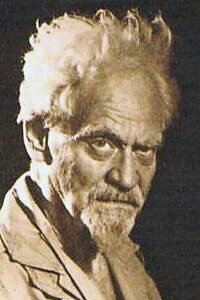
The religion of Wicca, or Modern Pagan Witchcraft, as we understand it, was founded by Gerald Gardner. Born June 13, 1884 in Blundellsands, Lancashire in England, Gerald Gardner spent not only most of his adult life, but much of his childhood, in lands outside of his native Britain. As a child, Gardner and his brothers were in large part raised by an Irish nanny, and spent many years in Madeira, Portugal. As an adult, he worked on tea and rubber plantations in Ceylon (Sri Lanka) and as a customs official in British Malaya. From boyhood, Gardner had a keen interest in two topics that would come to feature predominantly in the Wiccan religion: ritual knives and swords (Gardner would publish Keris and Other Malay Weapons in 1936 upon his retirement to England), and Reincarnation, a term coined by Theosophists for what in English works on classical paganism at the time referred to as “metempsychosis” or “transmigration of souls”, a core doctrine of the Witchcraft religion.
In his biography by J.L. Bracelin, (or possibly ghostwritten by the famous Sufi Idris Shah, according to Bricket Wood covener Frederic Lamond), Gerald Gardner: Witch (1960) Gardner recounts how the Christian religion of his parents had never made any sense to him, and that he had always been more drawn to the idea of a world of many gods. In understanding the history of Wicca and the modern Paganism that it helped to give a structure and voice to, it is crucial to understand how the term “witch” was used in anthropological and popular journalistic writing during the late 19th, and early and mid-20th, centuries. “Witches” were not only those historical victims of perceived heresy, unpopularity, and social non-conformity who were executed in Christian Europe and European colonies in other lands, but it was a catch-all term applied to whatever tribal or indigenous beliefs and practices fell outside of whatever was considered to be the acceptable Christian social mores in Europe, or a European colony, at a specific place and time. This certainly included many of the indigenous cultural practices Gerald Gardner had observed first-hand as an Englishman working in Asia. The charge of “witchcraft” historically, also easily had nothing necessarily to do with a person’s perceived non-Christianity at all, but within a Christian hegemonic society, the charge could easily be used as a lucrative way of getting rid of, and stealing property from, a neighbor with whom one had personal grievances, and their descendants. Additionally, charges of witchcraft very often included a blatant sexual component that maintained a culture of sexual control and authoritarianism over individuals in the community, with women accused of witchcraft in Old Connecticut, (for one specific example here in North America), having their genitals examined by the other women of the community for “the Devil’s mark” as proof of their alleged socially unsanctioned sexual behavior, along with reports of these targeted women being seen dancing around trees in the woods with “strange creatures” similar to “Indians”. Given this entirely negative, bigoted, and abusive use of the word “witch” in most English language works until Witchcraft Today in 1954, Gerald Gardner, believing himself a descendent of a Scotswoman executed as a witch, made a significant and utterly unique contribution to religious history when he used the term “witch” to mean what it had originally meant in the pre-Christian Old English language (a term denoting a “wise person” in the sense of a benevolent healer), and chose to say, based on his unconventional spiritual beliefs and worldview, “I am -That-.”
Besides Gardner’s own books and his 1960 biography, other primary sources of information on the founder of Wicca, or religious Witchcraft, his ideas and worldview, can be found in early High Priestess Doreen Valiente’s memoir The Rebirth of Witchcraft (1989), as well as the memoirs of other early Wiccan High Priestesses Lois Bourne in Dancing with Witches (1998) and Patricia Crowther in High Priestess (1998). Wiccan High Priest and Saxon Wicca founder Raymond Buckland also published his own short biography and homage to Gerald Gardner in Ray Buckland’s Magic Cauldron (1995).
 Lincoln Green