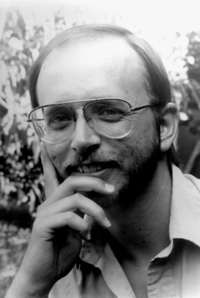
Scott Cunningham was my introduction to the modern Pagan religion of Wicca, and his core philosophy continues to inform my understanding of Wicca to this day.
I first read Wicca: A Guide for the Solitary Practitioner (1988) when I was about fifteen. To set the scene, this was back when Borders Books and Music was still in business, WitchVox was there for the lurking, The Mists of Avalon (2001) was playing on TV, and Loreena McKennitt was easily my favorite musician. With recipes for incenses I wouldn’t have been able to burn in my bedroom, (let alone in our backyard in view of the neighbors), and essential oil blends I maybe couldn’t afford back then with names like “Full Moon” and “Horned God”, I nevertheless loved the sensuality of the book and imagining all the Sabbat feasts I would prepare for a coven when I was out in the world someday. Until then, Cunningham’s book was hidden behind a row of fiction on my bookcase and I only surreptitiously placed items representing the classical elements of earth, air, fire, and water and the Wiccan God and Goddess on an inconspicuous bedroom altar that was as easy to hide as The Book.
Like many of my generation, my first Wiccan ritual practice was right out of Cunningham’s book, and also like many of my generation, (despite Cunningham’s reassurances to the contrary), the articles on WitchVox and the Angelfire websites of those early days of the World Wide Web filled me with doubt that I would ever be a “real” Wiccan, no matter how sincerely I felt I had found something so beautiful, personally meaningful, and fulfilling.
Revisiting Wicca after over twenty years, I am struck by how very well-researched it was, and how little credit and respect Cunningham seems to receive among many Wiccans these days. Philosophically, he recommended the work of Edward Carpenter as a “renegade scholar”, Carpenter himself a long underemphasized influence on the 20th Century Pagan revival.
Scott Douglas Cunningham was born June 27, 1956 in Royal Oak Michigan, but spent most of his adult and working life in San Diego, California, and was well-known among his friends for his deep love for, and as-frequent-as-possible trips to, the 50th state of the U.S.—Hawaii. In San Diego, he would even befriend Raymond Buckland and his wife Tara, often sharing meals with them and collaborating with Buckland on his educational documentary on Wicca, Witchcraft: Yesterday and Today (1989), of which there are amusing anecdotes in Whispers of the Moon (1996). A very private man, I think his wide-ranging influence in emphasizing Wicca as a religion of Love, and in his personal love for the Goddess as Great Mother and Grandmother, has done immense good for a generation (or two or three) of Wiccan women and girls in particular that has yet to be realized.
I am now older than Cunningham was when he died, and yet his cultural impact on what is now a World Religion is staggering. His Wicca is still in-print, still available at our local Barnes and Noble, and still introducing countless readers to the possibilities of a truly personal and holistic (and as just as importantly for a free-thinker like me, non-supernatural) approach to magic and Wicca based in a fundamental understanding of the importance of both male and female in religion. Cunningham gave a way for anyone to practice and worship the God and Goddess, no matter how alone they may currently feel, and did so in a religion that up until that point, (with perhaps Saxon Wicca as the sole exception), was all too often shrouded in secrecy in a way which allows abuse and egotism to thrive, and intentionally aspired to make it more accessible to people of whatever ethnic background.
For anyone else who was introduced to Wicca/Witchcraft by Scott Cunningham’s Wicca, or who was touched by any of his other books on natural magic more generally (many of which have been as widely translated as Spanish, Japanese, Dutch, Czech, French, Slovenian, Italian, and German), I would encourage them to read Whispers of the Moon: The Life of Scott Cunningham by David Harrington and deTraci Regula (1996) to get a glimpse of the sincere and passionate Pagan this hugely influential author really was.
 Lincoln Green