One of the great mysteries of what is now widely called Wicca, or sometimes Modern Pagan Witchcraft, is how it started. Ever since retired British civil servant Gerald Gardner announced the existence of the religion with his publication of Witchcraft Today in 1954, thereby being the first person to publicly identify themselves as a Witch in a religious sense since the 1951 repeal of the Witchcraft Act in Britain, people have been fascinated by his claims of initiation into a witch cult in 1939 in the New Forest, evocative of those described in Margaret Murray’s witch-cult hypothesis. Murray herself contributed a sympathetic introduction to Witchcraft Today, comparing this religious movement favorably with the religiosity of sincere Christianity, the only religion with which the majority of her readers were very familiar. As Murray wrote in 1954:
Dr. Gardner has shown in his book how much of the so-called “witchcraft” is descended from ancient rituals, and has nothing to do with spell-casting and other evil practices, but is the sincere expression of that feeling towards God which is expressed, perhaps more decorously though not more sincerely, by modern Christianity in church services. But the processional dances of the drunken Bacchantes, the wild prancing round the Holy Sepulchre as recorded by Maundrell at the end of the seventeenth century, the jumping dance of the mediaeval “witches” the solemn zikr of the Egyptian peasant, the whirling of the dancing dervishes, all have their origin in the desire to be “Nearer, my God, to Thee”, and to show by their actions that intense gratitude which the worshippers find themselves incapable of expressing in words.
From the beginning, Murray’s witch-cult hypothesis was controversial in academic circles and while Gardner’s claims of initiation into a surviving cult based in the New Forest were no less so, historians were immediately interested in the phenomena. Brian Branston’s The Lost Gods of England, a historical exploration of pre-Christian Anglo-Saxon religion was first published in 1957, even before Gardner’s second non-fiction book on his religion The Meaning of Witchcraft (1959), and it is still one of the definitive texts on a subject on which so little is able to be known. A second edition was published in 1974, a year which also saw the publication of Raymond Buckland’s The Tree, and Branston’s exploration of these Old English Gods was to form the basis of Buckland’s Saxon Wicca as a distinct means of worshipping the forces of Life and Love in a manner recognizable to other Wiccans, and anyone interested in modern Paganism who through circumstances or inclination had heretofore been unable to find a coherent body of theory and practice for solitary or social Pagan worship. The modern Pagan religion of Wicca, is explicitly mentioned in Chapter Nine of Branston’s book, “Frey and Freya”:
That the cult of the Great Goddess did not end with the Middle Ages but still flourishes today is indicated by the resurgence of ‘white’ witchcraft, ‘wicca’, in Great Britain in the last few years. The aim of modern covens appears to be to tap psychic power through the witches’ Magic Circle. Once a circle has been cast, the coven ‘draws down the moon’ said to be the inducing of the ‘Goddess’ to descend into the body of the High Priestess who personifies the Goddess until the circle is broken. In the old days, the business of the coven was mainly concerned with ensuring fertility in field, farm animals and man. Nowadays, according to a modern witch, with fertility under control of scientists, chemists and the family planning associations, covens concentrate more and more on healing. Be that as it may, there are certain modern wiccan rites which are traditional with roots going back to the Middle East of at least 2,500 years ago: such rites I take to include dancing naked, the fivefold kiss, (on the feet, knees, genitals, breast and mouth) and the Great Rite or ceremonial copulation.
In our coven, Branston’s next observation is particularly pertinent, as it addresses one of the core differences between our version of The Tree and what might be thought of as the “Text A Book of Shadows” of Saxon Wicca, or Raymond Buckland’s The Tree itself, republished in 2005 as Buckland’s Book of Saxon Witchcraft, which is to say, the Names to whom we give worship during the Rites:
The conclusion I reach, then, is that there is more than enough native evidence remaining for us to agree as a fact that the Old English knew of a cult of Mother Earth together with the god Frey and his sister Freya. The cult made its way from the Near East and the eastern Mediterranean (probably with the Dacians as the intermediate link); the Asiatic origin is proved not only by the basic insistence on the supremacy of the mother, but also by such rites of known Asiatic origin as the weeping for a lost lover and the religious prostitution attached in Sweden to the name of Frey, as well as to the brother and sister marriage of Frey and Freya in the Prose Edda; and lastly the very names of the god and goddess meaning Lord and Lady which identify the two with the cults of Adonis, Attis, Baal, and Tammuz.
Our coven’s worship of Freya as the Name of the Wiccan Goddess is of course in keeping with Buckland, it is also well-supported by Gerald Gardner in The Meaning of Witchcraft (1959):
Frey was the god of peace and plenty, and Adam of Bremen tells us that he was depicted ‘cum ingenti priapo.’ Carl Clemen in his Religions of the World illustrates a phallic statue of Frey; and he was sometimes called Fricco. Freya was also called Frigg; and the names of these two ancient deities are the obvious origin of a number of words of a sexual connotation which are not usually considered printable. It is evident that Frey was originally the mate of Freya; but in later times she was ‘married’ to Woden, and Frey became her ‘brother.’ Like Ishtar, one of Freya’s attributes was her wonderful necklace, and in this she resembles the witch-goddess also. She is, in fact, the aboriginal Great Mother, and Frey is her phallic consort. The father-god Woden and his fierce followers are the gods of the patriarchal Aryan invaders.
Frey and Freya may be the Gods invoked in our Temple, in The Tree however, the Father of Saxon Wicca chose Woden as the principle male deity of worship, a God deeply associated not only with magic, but with the mysteries of Death, a prominent theme in Wiccan theology. As Buckland notes in The Tree, “the books [i.e. the ritual books copied by hand descending from Gerald Gardner, or what has come to be known as “The Book of Shadows”] are generally sadly incomplete so far as theological thoughts are concerned”. This observation from a High Priest of Wicca, let alone the one largely credited with bringing the religion to the Americas in the first place, is in fact no small part of the motivation behind this blog! In the chapter of The Tree on our Goddess Freya, Buckland presents the mythic framework in which the Seax Wica operate, and ties it directly to the Grandfather tradition by referring the reader to “The Myth of the Goddess” of Gardnerian Witchcraft, which Gardner published in Witchcraft Today in 1954. To quote the beginning of The Myth:
Now G. had never loved, but she would solve all mysteries, even the mystery of Death, and so she journeyed to the nether lands. The guardians of the portals challenged her. “Strip off thy garments, lay aside thy jewels, for nought may ye bring with you into this our land.” So she laid down her garments and her jewels and was bound as are all who enter the realms of Death, the mighty one.
As Gardner observes after recounting the myth, it bears a striking resemblance to that of the Assyrian Ishtar (known to the Sumerians as Inanna and later to the Phoenicians and Canaanites as Astarte), whose descent into the underworld and sacred marriage to the shepherd Tammuz constituted a seasonal fertility religion. The ritual binding and scourging found in Gardner’s Witchcraft, are, as Buckland explains in The Tree, themselves symbolic of death, and the purification which encourages fertility, which in the spiritual life of a Wiccan leads to a rebirth and renaming in the sight of the Old Gods among their Brothers and Sisters of the Craft. In “The Myth of the Goddess of Saxon Witchcraft”, there is no mention of Woden, instead the Gods in question are Hearhden (a Heimdall-Wayland the Smith composite specific to a “Saxon” framework, and the Norse Adversary-God Loki), a literary choice which already expands the Saxon Wiccan pantheon of Old Gods beyond Woden. This choice makes Saxon Wicca a natural “home base” for a North American Pagan revival of the worship of the Old Gods of Love and Life in which the Mother-tongue which unites so many individuals within the continent is the linchpin of the tradition more than individual ethnic ancestry. Within the context of Witchcraft as taught by Gerald Gardner, Buckland’s Myth is a natural derivation on this central theme of the Goddess as a figure not only of the fertility of the land and the people, but as a source of comfort to those of us who have yet to make the descent into Drëun, the peaceful Saxon Wiccan Underworld (which may alternatively be known as the Summerland of other Wiccan traditions, or as a particular esoteric understanding of the Norse Hel, there being no concept of a separate “Heaven” in Wicca.) As Buckland writes:
“…Brisingamen represents fertility, or the spirit of vegetation. Its loss leads to the Fall and Winter months; its retrieval to the Spring and Summer. Similar myths are found elsewhere: Sif’s loss of her golden tresses; Idunn’s loss of her golden apples; variations on the theme of Ishtar’s descent into the Underworld in her search for Tammuz…The worship of a God and a Goddess ties in Saxon Witchcraft with other traditions of the Craft as being essentially a Nature religion. Everywhere in Nature is found a system of male and female; because that is the way of the Gods – a God and a Goddess – believe the Witches. … With man’s original belief in many deities the two most important to his existence were a (horned) God of Hunting – later to become a (foliate) God of Nature generally – and a Goddess of Fertility. To the Seax-Wica these are now Woden and Freya.”
Since in the formation of our own coven we have done as Buckland advised in 2005, and chosen Freya’s brother Frey as our God within the Temple Rites, “I urge you to adapt what I present to meet your own personal requirements…If you want to use entirely different names then-so long as they are Saxon-do so.” What then is the role of Woden in Saxon Witchcraft for our coven? Perhaps the most pervasive God to have survived among the English even after Christianization, (a tribute to Woden’s legacy as a god of kings and conquerors, as well as poets, healers, and magicians), it is the very act of writing and literacy itself. For with the ability to express and record our deepest thoughts, we can share with others some of the meaning of the Circle made possible by Woden’s self-to-self sacrifice for the Wisdom of the Runes. Our Seax Wica Runes, with which we engrave our silver hand-fasting rings that solemnize the oaths we have taken, and bear witness to our bonds to the Old Gods and to one another. One of the oldest Pagan folk charms, recorded in the Orkney Isles and shared by Theda Kenyon in her 1929 publication Witches Still Live, remembers Woden’s (or Odin’s) role as a god of healing, recalling that the spiritual purpose of a Saxon Wiccan coven is primarily the healing magic to be found in the simple fellowship of being one’s natural self without shame, in the sharing of cakes and ale, and perhaps a kiss, with a true friend.
Balder rade. The foal slade. Set bone to bone, Sinew to sinew, Heal, in Odin’s name!
A modern Saxon Witch is practicing healing magic whenever they make a humble cup of chamomile (or “Balder’s brow”) tea to aid in sleep, or apply a little plantain salve to a child’s wound. These simple acts recall Woden the Wise, of whom J.R.R. Tolkien’s Gandalf the Grey is an obvious and well-known homage. Branston paints the iconic image of Woden in The Lost Gods of England when he writes:
If a West Saxon farmer in pagan times had walked out of his bury or ton above the Vale of Pewsey some autumn day, and looking up to the hills had caught sight of a bearded stranger seeming in long cloak larger than life as he stalked the skyline through low cloud; and if they had met at the gallows by the cross-roads where a body still dangled; and if the farmer had noticed the old wanderer glancing up from a shadowy hood or floppy brimmed hat with a gleam of recognition out of his one piercing eye as though acclaiming a more than ordinary interest, a possessive interest, in the corpse; and if a pair of ravens had tumbled out of the mist at that moment, and a couple of wolves howled one to the other in some near-by wood; and if the stranger had been helping himself along with a massive spear larger by far than normal; and if all this had induced in the beholder a feeling of awe; then he would have been justified in believing that he was in the presence of Woden tramping the world of men over his own Wansdyke.
And what about that New Forest coven that Gardner claimed to have been initiated into in 1939 that has been the source of so much speculation in Wiccan history? Many hypotheses exist, but perhaps the most interesting was the story recounted by Francis King in his Ritual Magic in England 1887 to the Present Day published in 1970. In Chapter 21 “The Contemporary Witch-Cult”, King recounts a conversation with the late Louis Wilkinson who had recently passed in 1966. A friend of the infamous magician Aleister Crowley, Wilkinson famously read Crowley’s “Hymn to Pan” outside the Brighton crematorium as part of Crowley’s self-authored funeral service in 1947, The Last Ritual. According to King, in 1953 Wilkinson corroborated Gardner’s claim, saying that in the “late ‘thirties or early ‘forties”, that he himself had become aware of a witch coven operating in the New Forest. According to King, Wilkinson said of this coven:
The social composition of this group, he told me, was a peculiar amalgam of middle-class intellectuals with the local peasantry, and, while the foundation of the group might have dated from after the 1921 publication of Margaret Murray’s Witch Cult in Western Europe, he was himself reasonably confident that there had been a fusion of an authentic surviving folk-tradition with a more intellectual middle-class occultism. … The New Forest coven, on the other hand, also used an ointment, but it was simply a heavy grease, largely consisting of bears’ fat, rather similar to that used by channel-swimmers and having a similar purpose, for it was simply designed to protect their naked bodies from cold at open-air gatherings. They also used a hallucinogen, but this was fly-agaric, a common British fungi, which they took orally in small doses. Fly-agaric and similar fungi have been used all over the world from time immemorial. It was used by the Vikings when they wished to go berserk and, at the other end of the Euro-Asian land mass, by Siberian shamans to achieve trance. … On at least one occasion the Hampshire witches indulged in human sacrifice – but done in such a way that there could not possibly be any legal unpleasantness. This was done in May 1940, when Hitler’s invasion was felt to be imminent. The witches felt that it was essential that he should be deterred from invasion plans by a powerful ritual, the central point of which was to be the death of a (volunteer) sacrificial victim. The oldest and frailest member volunteered for sacrifice and left off his protective grease so that he might die of the effects of exposure. Unfortunately enough, it was the coldest May night for many years, and not only the volunteer but two other members of the coven died from pneumonia within the next fortnight.
Given all the speculation regarding Gerald Gardner and Aleister Crowley’s brief friendship (Philip Heselton’s Gerald Gardner and the Cauldron of Inspiration, 2003 covers what is known from the evidence recorded in Crowley’s diary and correspondence of 1947), and King’s claim that Wilkinson said that Crowley had also mentioned a “witch cult” but said something about how he “didn’t want to be bossed around by women,” one of the more intriguing, (if unlikely), speculations is that this human sacrifice was the Pagan poet and publisher Victor B. Neuburg who had been a part of Crowley’s magical order until the outbreak of World War I in 1914. Neuburg, a publicly professed Pagan as far back as 1903, is another important inspirational figure for our coven of whom more will be written, but the synchronicity of the sacrifice story, and Neuburg’s death on May 31, 1940 after a long battle with tuberculosis are hard to ignore. Neuburg had himself published poetry about Woden (or Odin) back in 1921, the same year as the publication of Margaret Murray’s Witch Cult in Western Europe, to quote Neuburg’s “Cliffs in Winter” from Swift Wings: Songs in Sussex.:
Oh, short is the daytime/That leads on to maytime;/Intense is the hour of the reign of the wind:/The Norland is Lord of flood and the ford,/Unleashed are the snow-hounds, with Odin behind./He rules the wild lurching/Where wolves have their searchings/For flesh in the snow in the pine-forest-land;/Valhalla is here/As the death of the year/Lies over the seas and the grass and the sand.
The truth of Gardner’s claims about the origins of what is now known as Wicca are unlikely to ever emerge from the mists of the historical record, and ultimately, for those who have found inspiration and liberation from works like Gardner’s High Magic’s Aid and Buckland’s The Tree, they are as unimportant as the idea of Murray’s witch-cult theory being “discredited”. Religious mythos and history have never been one and the same, and the time for dismissing Wicca as a historically insignificant religious movement by holding it to “historical” standards to which no other world religion is held is well past.
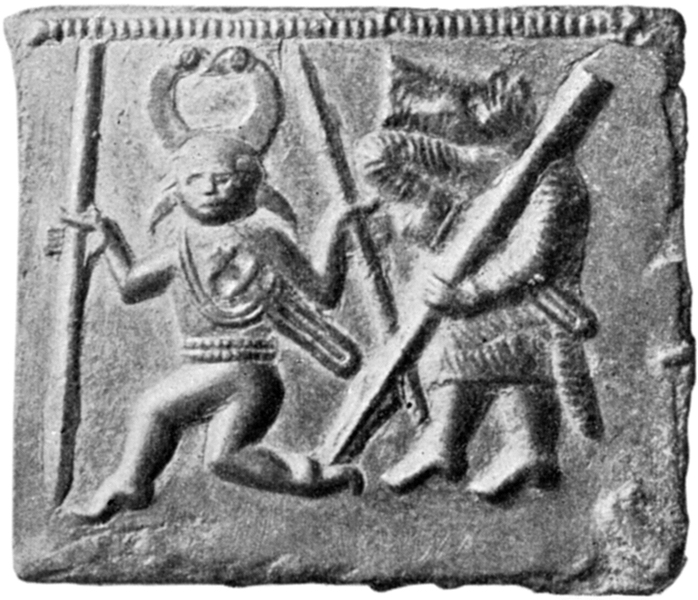
(Image of warriors from a helmet found in a 7th century ship burial in Vendel, Sweden. The figure on the left is identical in style to the “dancing warriors” found on the 7th century Sutton Hoo helmet in England. The figure in the “horned helmet” found in Sweden appears to be missing an eye and has been speculated by scholars to be Odin. The “horned” figure on the helmet found in England was speculated by Brian Branston in the 1950s to be Heimdall.)
 Lincoln Green