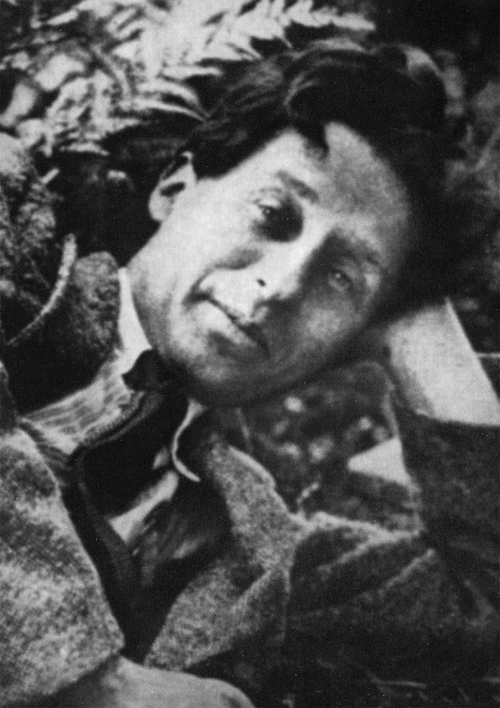
In writing here in remembrance of Doreen Valiente, now widely known as “The Mother of Modern Witchcraft”, and on the mythical origins of our own tradition of Paganism, the authors of this blog find ourselves needing to introduce a far less well-known individual, whose life and work has for far too long languished in obscurity considering his particular importance within the history of modern Paganism. This is an error of the historical record that we actively seek to correct in this space. The work of Victor B. Neuburg, and the philosophical foundation it provides for the contemporary Pagan revival, is work that has been overlooked, largely due to grander egos and poorly-informed prejudices ill-becoming a 21st century revival of Paganism.
Born May 6, 1883 in the Islington district of London, England, Victor Benjamin Neuburg was an Englishman of the same generation as Gerald Gardner, who would himself be born in June of the following year. His father left wife and son shortly after the boy’s birth, and Neuburg was raised by his mother, aunts, and uncles.
Growing up in a Jewish family, Neuburg publicly declared himself free of the religion in the pages of The Freethinker, founded in 1881 by George William Foote, with the poem “Vale Jehovah!” inspired by the style of one of his favorite English poets, Algernon Swinburne. An intensely philosophical poet and German translator (his father had been from Bohemia), Neuburg was not only reading Friedrich Nietzsche (also a poet) before his works were widely translated into English, but translating the works of German poet Heinrich Heine in The Agnostic Journal of William Stewart Ross (a.k.a. “Saladin”), before either attending Cambridge University (where he would found his own “Pan Society” for other mystically-inclined freethinkers), or meeting the currently vastly more famous in contemporary Paganism, Aleister Crowley, a man upon whom he would have an immense influence, an influence that would last for the rest of Crowley’s life.
From 1909 until 1913, Victor B. Neuburg was sub-editor (with Aleister Crowley as editor-in-chief) of the esoteric journal The Equinox, which included many anonymous writings, some of them probably penned by Neuburg. Sometime after 1914, with the onset of World War I, Neuburg ended his professional and personal relationship with Crowley, and from 1916 until 1919 he served as a soldier in the British Army.
After the War, and the end of his military service, a new phase of Neuburg’s life began with his founding of his Vine Press based in the country village of Steyning, Sussex. In these years he would also marry and have a son, Victor E. Neuburg, publish in Pine Cone (the publication of the Order of Woodcraft Chivalry) while it was run by fellow Pagan Dion Byngham, and continue to publish mystical poetry in periodicals such as The Occult Review and The Bookman’s Journal.
Neuburg would also write a play for the theatre of The Sanctuary, an experimental community founded by Vera Pragnell, a Christian inspired by the philosophy of Edward Carpenter (a mutual hero of Neuburg’s whom he would praise in 1928 as a “Master”), a community which towards the end of the ’20s would suffer negative press for “free love” and nudism, and eventually disintegrate lacking a unified spiritual and/or political focus.
In the ’30s Neuburg would move to London to live with his lover and her family, and would continue to publish in periodicals such as Freedom and The Freethinker while also working for The Sunday Referee running a “Poet’s Corner” where he would “discover” and encourage younger poets such as Pamela Hansford Johnson and Dylan Thomas.
Victor B. Neuburg died May 31, 1940 of tuberculosis. One excellent book for learning more about this man’s life and work is The Magic of My Youth by Arthur Calder-Marshall, published in 1951 and read by both Gerald Gardner (who also, apparently, possessed a copy of Neuburg’s 1921 collection of Pagan poetry Songs of the Groves in his much-discussed library), and Doreen Valiente (see her first book Where Witchcraft Lives, 1962). A second is the beautifully written biography The Magical Dilemma of Victor Neuburg by Jean Overton Fuller, first published in 1965.
 Lincoln Green