In 1971, the core liturgical material of the new religion of Witchcraft which had for the most part previously been passed down secretly within covens since the 1950s saw widespread publication both in the United Kingdom and in the United States, effectively simultaneously. In the U.K. and other regions of the Anglo-sphere, this book was What Witches Do by Stewart Farrar published by Phoenix, which featured adaptations to the religion that brought in even more ceremonial magic than Gardner originally had, (and in High Priest Raymond Buckland’s opinion, therefore a potential re-Christianization of a nascent Pagan religion, which Buckland consciously strove to avoid), and in the U.S., the equivalent book was The Book of Shadows by Lady Sheba and her publisher Carl L. Weschcke (1930-2015) who had bought Llewellyn Publications in 1961.
On the one hand, Farrar’s book was highly acclaimed. “At last, a really intelligent, well-written and informative book on present-day witchcraft” wrote the reviewer for The Australian, and its publication coincided with the release of both Witchcraft ’70 which features scenes of “Matriarch of British Witchcraft” Eleanor Bone, whose coven (aside from the wine consecration and necklace-style) could easily be Saxon, scenes of Alex and Maxine Sanders’ ceremonial magic-inclined coven, as well as the published audio recording of Janet Owen’s initiation with the record A Witch is Born.
On the other hand, The Book of Shadows, although “letting the cat out of the bag” in pretty much the same way, was not nearly so well received, at least not among initiated Witches, as while Farrar contextualized the material from the “Book of Shadows” he was sharing, “Lady Sheba” did not, nor did her book contain any genuinely original material. While selling well among the many interested seekers whom initiates considered “cowans”, with the various typos, confusion of the Sabbats, and all the uncredited material that the purported author had not herself written, some of this material under copyright to High Priestess Doreen Valiente in the U.K. in the short-lived Witchcraft periodical Pentagram (1964-65), this negative reaction was unsurprising and to some degree understandable, but seems particularly unbecoming these days to protest too much about, when many of these critics seem to take as much delight in ridiculing Gerald Gardner’s spelling or writing ability, (and I agree with Doreen Valiente that High Magic’s Aid, 1949, was a genuinely good novel, and certainly highly informative about the nature of religious Witchcraft).
What is particularly interesting about The Book of Shadows (1971), is that it is clear that the documents came directly from her publisher, who promoted her as an “authentic” High Priestess of an American-Celtic tradition of Witchcraft as she was a rural American woman, which I personally find troubling given the tendency for urbanites in the U.S. to harbor prejudice about the intellectual ability of country folk as it is. Regardless, Gerald Gardner himself told Carl L. Weschcke in a letter back in 1959, shortly after the American movie Bell, Book and Candle came out, that any Witches in America were most likely to be found in rural rather than urban communities, and Weschcke appears to have run with it, (see the letter between the men hosted at http://www.thewica.co.uk).
It was the myth of having been initiated into an underground American witch coven that was supposed to account for the book’s troubling similarity to the actual Gardnerian Book, (with allusion to the Great Rite in The Book of Shadows without recording the actual ritual liturgy, which in Gardner’s book was based on Aleister Crowley’s Liber XV), and thus the secrecy-bound tradition inherited in the Americas by Raymond and Rosemary Buckland. As the public mythos surrounding Witchcraft (a mythos created by Gerald Gardner), was that of a surviving underground witch cult, this publication of a version of the Gardnerian Ritual Book (of which there were already a variety of versions in private circulation), would have had to predate Margaret Murray’s 1921 publication of The Witch Cult in Western Europe if a country woman in rural America had also been capable of receiving a form of the tradition in the late 1930s.
As a man who had been a public Witch and High Priest in the United States from at least 1966 with his publication of Witchcraft…The Religion, and who was publicly interviewed and referenced by name in both Hans Holzer’s The Truth About Witchcraft (1969) and Susan Roberts’ Witches U.S.A. (1971), Raymond Buckland was acutely aware of not only the Oath of Secrecy which he had taken upon entrance into Gardner’s Witchcraft religion written about in his books Witchcraft Today (1954) and The Meaning of Witchcraft (1959), but by 1971 he was all-too-aware as someone looking at the religion with the eye of an anthropologist of how at-risk the religion was of being either entirely lost to rhetorical quibbling due to the common pre-Murrayite and pre-Gardnerian interpretations of the English language word “witch”, or to the complete appropriation of the term by noxious cult leaders who could use the religion’s tradition of secrecy which was meant as a form of protection for one’s Brothers and Sisters in the Craft at best, and linked to an of-itself innocuous thing, primarily the names of the God and Goddess— but in the hands of a cult leader was a lucrative way of pretending they had “secrets” with which they could exploit the naive, when Raymond Buckland knew as an Insider to the Craft since 1963 that there WERE NO SECRETS LEFT. Noxious cult leaders doing this to the religion would completely destroy it, and any credibility it had as a healthy alternative religion completely unlike any other while still in its infancy, (Buckland believing it to be only a little over twenty years old), if there wasn’t an attempt made to give it a more formal and intellectual backbone like what the vastly more public and seemingly accessible religions in the Americas (i.e. mostly a veritable multitude of denominations of Christianity), were perceived as having.
With all the liturgical material published, (and with the religion noticeably lacking in theology in the Ritual Book itself), Raymond Buckland, from the perspective of both a religious practitioner and as an anthropologist having an ethnographic view of his own religion, published The Tree giving it a theological introduction based on the religious interpretation of Witchcraft as outlined by Margaret Murray and Gerald Gardner, and completely unlike The Book of Shadows published by Llewellyn, cited his sources in a scholarly manner. This made it possible for those who came later to follow up on his research themselves to understand on a rational level the foundations of Witchcraft as a religion so that individuals were able to understand it enough to not only intentionally choose it as their religion, (originally in the case of Saxon Witchcraft in the context of a nation that recognizes Freedom of Religion as a Right), and with the inception of Saxon Witchcraft, take that process a step further by showing, as Buckland’s Complete Book of Witchcraft (1986), Wicca for Life (2001), and Wicca for One (2004) are all designed to do, how to form their own traditions while still being recognizable as a distinct religion called Witchcraft (in at least seventeen different languages for “Big Blue”!), rather than sliding unconsciously into one political movement or another, or being repeatedly confused as just another variety of anti-Christian heresy (which has always included other distinct religions with a wide variety of regional diversity, such as Judaism, or the indigenous religions that Christianity has so effectively supplanted all over the world).
If what makes Witchcraft a distinguishable religion where self-dedication is even possible by a literate Solitary (vs. a tradition only transmissible by directly received oral lore through a physical initiation with a “superior”, who is thereby in a position of power over the individual), it must be through the concept of the “Book of Shadows” itself, the tradition of common rites and prayers, magical songs, chants, ect. and a central mythology about the Gods that are preserved and can be passed down and re-referenced, as needed. For an in-depth look at the Ritual Book of the tradition Buckland received and formed his new tradition as a derivation of, see Crafting the Art of Magic by Aidan Kelly, 1991. Kelly’s speculations as a non-primary source for Gardner’s character aside, if Witchcraft is a religious tradition that emphasizes orthopraxy rather than orthodoxy, everything else a Witch (Gesith) or Coven may add to (or alter within) The Tree is Additional Material, (thus the designations of Galdra, Hwata, and Lacnunga) in Saxon Witchcraft, and that is where the regionalism of a religion devoted to a pantheistic Mother Goddess and a Horned God really shines and shows its practical utility and intrinsic holism. It is also where the confusion with “witchcraft” being defined as “magic”, “divination”, or “herbal lore”, rather than as various things an individual Witch might or might not do is a serious problem. The religious recognition of the concepts of God and Goddess, Reincarnation, Retribution in the Present Life, Initiation, and regular observance of Esbat and Sabbat, is still a point of contention among those who refuse to recognize Witchcraft as a real religion, but are often happy to award that designation to any other religion, (and all the practical respect such a designation affords in public life), no matter how personally repugnant some of those other religions’ doctrines might be when compared to Witchcraft’s extremely few core beliefs.
Lacnunga, an Old English word meaning “remedies” was the name given to a collection of Anglo-Saxon manuscripts from the eleventh century (keeping in mind that literacy among the Anglo-Saxons, or early English, begins in Christian monasteries), concerned with herbal medicine. What is particularly fascinating about the collection is that they show evidence of pagan Saxon culture prior to the conversion although heavily Christianized, as one of the main afflictions the scribes were concerned with was “elf-shot”, the attacks of elves as beings who, from the later Scandinavian manuscripts, appear to have originally been divine spirits particularly associated with the Old English “Frea” or “Lord” who was sacrificed to make way for the singularity of Christian monotheism and the subsequent demonization of all the Old Gods.
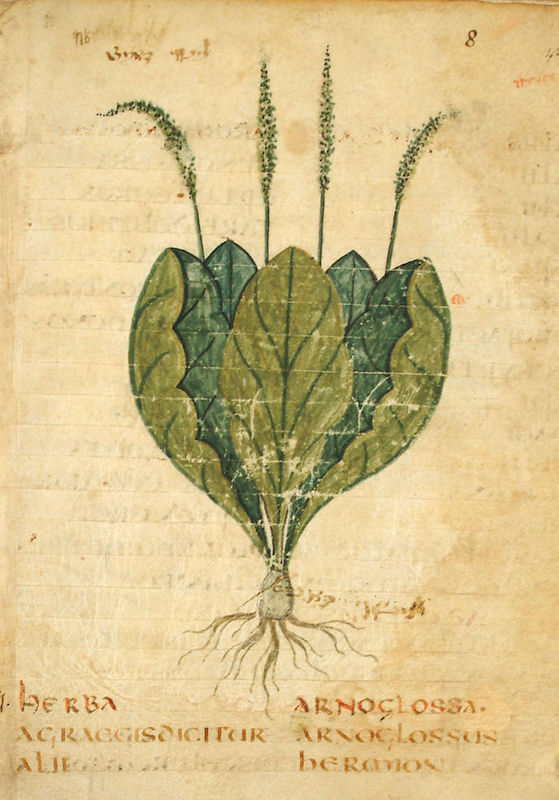
Woden, who the pagan Scandinavians of the Viking Age knew as Odin, and the appeal to him made most famously in the “Nine Herbs Charm” of the Lacnunga collection, is the indication that some of the herbal medicine recorded was tribal in nature, and as such, predated the English becoming Christians. Waybread (Plantago major), among many other herbs native and naturalized to the British Isles, would be included in Nicholas Culpeper’s (1616-1654) Complete Herbal (Culpeper, who notably emphasized the idea of Nature as his Mother and Experience as his Brother and Teacher, was himself accused of witchcraft), is celebrated as the “Mother of Herbs” in the Charm, hinting ever so slightly at a more egalitarian tribal social structure among the sexes, that appears to also be attested to by the many monuments to the Germano-Celtic “Mothers” of continental Europe whose memory was preserved by these tribal peoples who were also soldiers of the pagan Roman Empire.
Other herbs used by the ancient English, are still commonly in use in contemporary herbal medicine, the “magic” of the herbs having been well-proved. As C.J.S. Thompson wrote in Magic and Healing (1947): “The Anglo-Saxons drew their materia medica chiefly from the plants which grew around them and their knowledge of herb-lore, or wort-cunning as it has been called, which had come down to them from the earliest traditions of past ages, was considerable.”
Galdra, Buckland’s modern English standardization of “Gealdor”, as spelled by J.H.G. Grattan and Charles Singer in Anglo-Saxon Magic and Medicine (1952), a major source-text to Buckland in his creation of Saxon Witchcraft, and cited in the extended recommended reading list he included in Earth Religion News in 1974, is the Saxon conception of magic, which was based not only in the actual healing properties of medicinal herbalism, but in the emotional power of the human voice in the magic of singing. As Grattan and Singer wrote, “It is well rendered by the Anglo-Norman word enchantment in its original sense of incantatio. The corresponding Anglo-Norman word charm from the Latin carmen contains the same idea.”
To illustrate the antiquity of the veneration of Mother Nature among the English, Grattan and Singer also shared in Anglo-Saxon Magic and Medicine a modern English translation of a pagan Latin prayer recorded sometime between the 6th and 12th Centuries:
Earth, Divine Goddess, Mother Nature, who generatest all things and brings forth anew the sun which Thou has given to the peoples, Thou Guardian of Air and Sea and of gods and powers; through thy power all nature falls silent and then sinks in sleep. And it is Thou that again brings back the light and chasest away night, and yet again Thou covers us most securely with Thy shades. Thou dost contain chaos infinite, yea and winds and showers and storms. Thou sendest forth joyous day and gives the food of life with eternal surety. And when the soul departs to Thee we return. Thou art indeed called Great, Mother of the gods: Thou conquerest by Thy Divine Name. Goddess, I adore Thee as divine.
Finally, a word about Hwata. As Grattan and Singer addressed in Anglo-Saxon Magic and Medicine in 1952, “‘Augury and divination by lot’, wrote Tacitus of the German tribes, ‘no people practice more diligently. A little bough from a fruit-bearing tree is cut into slips; these are distinguished by certain marks and thrown at random over a white cloth.'” Buckland in The Tree touched on all the main forms of divination that were popular in the American Witchcraft movement circa 1973, and added his own “Saxon Wands” inspired by the Chinese I-Ching yarrow stalk divination (yarrow being a herb known for its medicinal properties as much among the Saxons as among many other peoples all over the world), and the “Nine Twigs of Woden” referred to in Lacnunga. The form of divination that Buckland notably did not address in The Tree given the widespread association of it with pre-Christian Germanic religions thanks to Tacitus, was divination utilizing one historical runic alphabet or another. The reason for this is quite simply that using runic alphabets in divination was simply not a widespread practice in Witchcraft until the 1980s when many authors started publishing books on divination with rune lots, with a variety of systems and methods of interpretation.
Buckland personally having far more affinity with Tarot, didn’t write about divination with runes as something some Witches did, until Wicca for One in 2004, where he gives some of the by-then “traditional” divinatory interpretations of the Anglo-Saxon runes. Buckland also, however, quotes in Wicca for One from P.M.H. Atwater’s Magical Language of Runes (1986), in which she gave her personal insights into a set of runes she received from the American Witch Dana Corby, perhaps most well-known as the female vocalist on Songs for the Old Religion (1975) recorded by Gwydion Pendderwen and the “California Wicca Blues Band”, making it to my mind an even more “Traditional to American Witchcraft” system of runic divination, rather than a divination system based on the medieval Anglo-Saxon rune poems, which as Marijane Osborn and Stella Longland observed in Rune Games (1982), are based in a very male-dominated and heavily Christianized worldview, (in seeming contrast to the particular importance of Priestesses in oracular tradition among the pre-Christian Germanic peoples), and despite their poetic reliance on Nature-based symbolism, too many of them, especially the “tree runes” feel distant to me personally, as they simply do not grow in my particular corner of the Americas, (although one of them beorc, amusingly the most “traditionally” feminine of the bunch in most runic divination systems,) absolutely thrives in the land of our covenstead.
“The Witches’ Runes”, as Corby teaches them, or “The Runes of Njord” as Atwater taught them, (based as they are on river stones rather than slips of wood), is therefore my chosen method of divination for myself and curious loved ones as a Saxon Witch, linked as they are to the history of American religious Witchcraft. Especially as, which Buckland also emphasized repeatedly, the practice of divination is not inherently “witchy”, and it really is not, given how absolutely ubiquitous the practice is nearly every culture, including American Christian cultures. The idea that there is something necessarily evil about the practice, (and therefore associated with the idea of “witchcraft” in an entirely negative sense), largely comes from very particular Christian perspectives, which as the practitioner of an entirely different religion, the Witch does not share.
(Image is just a pretty illustration of Waybread from another medieval manuscript, not from the Lacnunga collection.)
 Lincoln Green