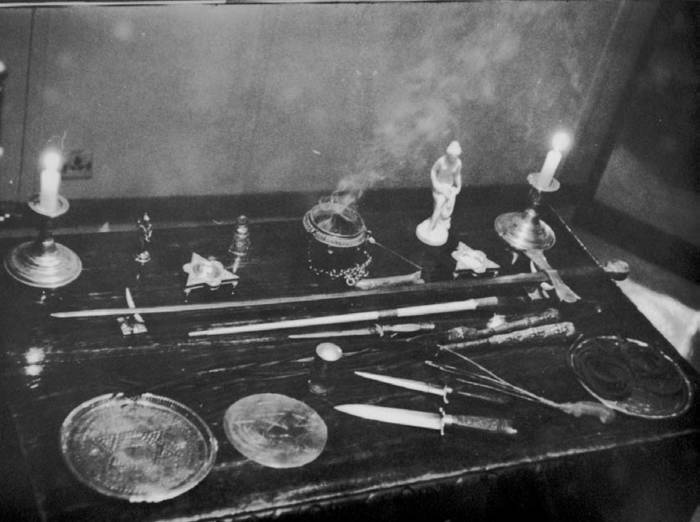
There are a lot of things that just at first glance would seemingly make Wicca a more attractive religion than it currently appears to be. It certainly was popular in the ‘60s and ‘70s when so many were looking to be initiated into a mysterious group of Goddess worshippers whose rituals featured the startling imagery of naked people drinking, dancing, kissing, and wielding ritual knives. Granted, well-known Witches of the time were also constantly having to clarify that their religious meetings weren’t actually “orgies” per say (at least not usually!), and that their God was a God of Hunting, and not the “Satan” of someone else’s religion.
For many in the countries where Wicca is most commonly practiced, whose only experience with any kind of religion is usually some form of Christianity, the idea of a religion so structurally different can be fairly inconceivable. Especially so if they find their assumptions about what a religion is are not supported, yet it is these very characteristics that make Wicca a great religion unlike any other.
The first of the “startling” things about Wicca that actually does makes it recognizably “religious” in the same way as Christianity, and a number of other major religions, is that it is theistic. The Witches have at least one God. What makes Witchcraft great is that it is actually polytheistic, and it always has at least one Goddess too, and it is the only well-established Western religion that does. Even the Witches who are such radically ardent Goddess-worshippers that the Witch God is for them a more distant figure, are henotheistic about it, and so an essential pantheism (in the sense of tolerance) gives Wicca a truly relevant pluralism in an increasingly “global” world.
However, the next core concepts are what balances out this tolerant and pluralistic sentiment in regard to theology, and makes Wicca a great religion that encourages and defends individual human liberty. These concepts have also permanently prevented the religion from being overrun by external political influences the way proselytizing religions seeking converts so often are. These two core interdependent concepts are decentralization and covens. Not only is there no Wiccan “pope”, there are no Wiccan “bishops”, and no Wiccan “vicars” either. What little leadership Wicca does have in a religion full of solitary worshippers, are founders (sometimes affectionately known as “Fathers” or “Mothers”) of specific “traditions” (which are comparable to Christian “denominations”, being to some extent similarly derived as they are from inter-religion tribal conflicts), High Priestesses, High Priests, and in some (but not all) traditions “Elders” who are High Priestesses and High Priests that more “green” High Priestesses and High Priests within the same tradition can turn to for guidance.
The Wiccan Priesthood is intrinsically tied to the religion’s form of organization, which is the Coven. The lofty titles of “High Priestess” and “High Priest” have nothing to do with how many worshippers this Priesthood is leading the rites for, but is a reference to the fact that every Witch is a Priestess or Priest of the Wiccan God and Goddess, which is yet another thing that makes Wicca great— there are no “laity” as there are in virtually every other Priesthood-based religion. The title of High Priestess and High Priest is an indicator of the respect an individual holds among other Wiccans of that particular coven only, or sometimes indicates the respect held for that individual among multiple covens of a Wiccan tradition more broadly. The title does therefore indicate a degree of authority to speak on behalf of one’s Coven, which, considering that every Wiccan is themselves a Priest or Priestess of the Wiccan God and Goddess, this is a High honor indeed— nothing more, nothing less.
Which brings us finally to the Coven itself, and what makes it great as a model of religious organization— and this is the thing that everyone has really forgotten: a coven is small. In comparison to most Christian churches, since they long ago left their agape feasts to the catacombs, the coven is positively minuscule, and any High Priest or High Priestess speaking on behalf of their coven is speaking with the enthusiastic consent of only an extremely few number of people other than simply themselves. Traditionally, a coven is a worship group based in a nine-foot Circle, consisting of no more than thirteen individual members, and thus fits comfortably inside the humblest of homes, traditionally the home of the Coven’s High Priestess. At the Summer Sabbats that might feature the outdoor gathering of two or more covens together, the Circle is temporarily made larger for this special occasion and the traditional meeting-dance, but this does not change the religion’s basis of organization from that nine-foot circle that is the Coven. This makes Wicca an inherently intimate religion, which is the very thing that keeps it not only emotionally relevant and accountable to its sistren and brethren, but keeps it honest and authentic to that individual Coven’s shared beliefs and values. And this is what really makes Wicca a “Nature-based” religion. For if Witches in a Coven do not remain accountable, honest, and authentic to the bonds of Love that bind them to one another, the Coven naturally disintegrates back into the Earth from which it came.
(Photo of a Wiccan altar provided by Wiccan High Priest, and Father of Saxon Wicca, Raymond Buckland.)
 Lincoln Green