By the time Wiccan High Priest Raymond Buckland published The Tree in 1974, there was no way of pretending that Witchcraft could be contained as a slow-growth religious movement given how quickly it was spreading with varying levels of coherency and recognizability in the U.S., as well-documented by Hans Holzer’s The Truth About Witchcraft (1969), The New Pagans (1972), The Witchcraft Report (1973), Susan Roberts’ Witches U.S.A. (1971), and David Farren’s The Return of Magic (1972). The very idea of containing a religion like Witchcraft, which was characterized by free love, and a mystical doctrine of reincarnation based in this love, in a landmass as vast and ethnically diverse as the Americas is fairly ludicrous, quite frankly. When seen as the “official” spokesman for Gardner’s Witchcraft in the U.S., Buckland was at some pains to explain that despite the secrecy regarding Gardner’s Witch God and Goddess Names, the widespread association of the religion with the British Isles, and with Buckland himself being a recent English immigrant to the U.S., that Witchcraft, (despite how it then currently appeared), was not in any way, shape, or form, a religion of ethnic separatism or a religious philosophy limited to Americans of English, British, or even primarily European, ancestry. This is still a misconception about the religion, and part of why Buckland founded the Saxon tradition, to openly honor the Witch God and Goddess with Names reflective of his maternal ancestry, and to show other Witches how this might honestly be done, when others were already forming Witchcraft traditions inspired by Celtic or Roman heritages, and claiming them to be “ancient” in a way Buckland with his openly modern Saxon Witchcraft, did not.
The Americas, their histories and conflicts, are such that what may, (or may not) work well for Witches in Great Britain, (or for American Gardnerians and Alexandrians who also consider their Witchcraft to be “British”), works far less well “across the pond” if Witchcraft really is a religion of Love, as Buckland taught it to be. The British idea that initiation must be from man to woman, woman to man, down from Gerald Gardner from whatever mysterious witch woman supposedly initiated him (among people who were largely childless anyway—at that time the Bucklands, and Robat’s initiating High Priestess Monique Wilson, being particularly high profile exceptions as Witches who were also parents of minor children), was proving itself to be an inadequate understanding of initiation not only for the self-assertion of homosexual Witches, who were at that time finding a public voice in the U.S., but was an equally inadequate way of addressing the idea of Witchcraft in an American context generally. As Gerald Gardner himself had said in 1959 to Carl Weschcke, American Witches were more likely to be living in remote and rural areas, and just as Gardner had predicted, family-based “non-lineaged” covens of Witches were popping up like mushrooms all over North America, and some of them, (such as the one Holzer documented in Anchorage, Alaska in The New Pagans and The Witchcraft Report) sounded far healthier and more life-affirming than the Wiccan covens in the Northeast that were waging “witch wars” on one another and refusing initiation to known homosexuals. The American Witch zeitgeist was complicated further by one of the most visible Witches and gay liberation activists at the time, Leo Martello, being quoted by Hans Holzer in The Witchcraft Report (1973) as saying in response to Holzer’s question: “Isn’t there a difference between a homosexual and a bisexual?” Martello: “Well, the difference between a homosexual and a bisexual is that the homosexual has guts to say so and the bisexual doesn’t.” To which Holzer wrote, “Rather than indicate my disagreement with that position I changed the subject.”
With all this chaos in the U.S. Craft scene, and with an “Elder” High Priestess in the U.K. and her family under scrutiny from a child protection agency simply for their very public association with a misunderstood religion, surely more understanding and compassion for the Wilsons’ decision to sell Gardner’s Museum, move to Spain, and distance themselves from a movement in which Olwen was already hated by other High Priestesses, can be shown by Wiccans with any empathy at all for Mothers and Fathers. Especially for a woman who died tragically young in only her 50s due to a car accident.
All this historical background does not even get into the contemporary history of many “lineaged” coven members these days, some of whom seem to delight in demonstrating how worthless their actual initiation was if all it brought into their life was a desire to complain to anyone they think might be intimidated enough to care, that no one else is a “real” Wiccan but them and theirs.
Hans Holzer, whom I like to think of as the “Herodotus of Modern Witchcraft”, of course also openly documented in his popular books a wide variety of eccentrics and self-made cult leaders of the kind that would set the religion and any public understanding for its sincere adherents back solidly into the “noxious” category from any positive public attention it had managed to garner, (if there wasn’t an effort to give Witchcraft a firm intellectual foundation that cited its sources), and so Buckland gave Wiccans The Tree as one possible manifestation of that religion among other equally valid possible manifestations, largely based in what felt like identifiable Names for the Witch God and Goddess for Buckland himself, when other Witch Names were already in open use by others, and certainly historically defensible based as they were on the history of witchcraft in different regions of Europe at different times. This also made it explicit that Americans whose ancestors may have also been accused of witchcraft for their indigenous or tribal traditions, be they American Native, African, Asian, or Middle Eastern, could form Witchcraft traditions based on countless other potential Names, if individuals and covens so desired, and if these were the Names with which they could more readily identify with the pantheistic Witch Gods of Love, Hunting, Vegetation, and Fertility. Buckland also did this without excluding anyone from his Saxon tradition based on ethnicity (or even more noxiously, perceived ethnicity), for any who sincerely love Woden or Freya (or another Saxon God or Goddess, see The Lost Gods of England by Brian Branston), are Welcome to Self-Dedicate.
Coven Initiation is “preferable” in Saxon Witchcraft only in the sense that Witchcraft is a religion of Love, and the vast majority of people do not really want to practice their religion entirely alone, even if this is sometimes the only way to practice without compromising one’s principles. With Buckland’s teaching that the Priestess consecrate the Sword when a Coven is formed, Buckland clearly expected more Witch Priestesses to take the initiative to Self-Dedicate rather than continue to seek out some “Witch High Priest” not of their own choosing. The Saxon tradition put power solidly in the hands of each individual, female or male, with self-dedication passing from Buckland the authority to initiate others of their own free will into the tradition within a coven setting. Buckland also read “The Myth of the Goddess of Saxon Witchcraft” to the Witch (Gesith) after their Initiation ceremony. Of course the ability to study for initiation into a coven is for most Seekers (Ceorls) preferable than study for self-dedication into a religion that one must then practice alone, but this is also why Buckland obviously thought this particular tradition might have had a strong appeal for a large number of American seekers— as many of the Americans physically isolated from big cities like New York who may have desired to form their own covens were, like Buckland, of heavily English, or Scotch-Irish (note the Sabbat names in The Tree), and/or German (or Dutch) ancestry, all of whom had spoken American-English for generations. This is significant, as the Goddess of Saxon Witchcraft, Freya, is directly compared by Gardner to his own “witch-goddess” in The Meaning of Witchcraft, and identified by him as the “aboriginal Great Mother” of the ancient, pre-Christian, Germanic tribes.
But human Nature being what it is, the glamour of “secrecy” in the “British” traditions has often prevailed over a tradition practically custom-made for individualistic Americans of significant Anglo-British-Germanic heritage. But this is how authentically inclusive Buckland’s understanding and teaching of Witchcraft (rooted in the Old English, Wicacraeft) in his new homeland, really was.
So due either to dislike for Buckland and his poetry, a dislike for Woden and/or Freya, or a dislike for Witchcraft that didn’t pretend there were any mysteries to the religion other than the natural ones of Love, it has never been a very “popular” Wiccan tradition. On the other hand, there is simply no way of knowing how many Self-Dedicated Seax Wicans or Seax Wican Covens are out there, and nothing is really more decentralized and in keeping with the original intent behind secrecy in Witchcraft than that.
With all the publishing on Witchcraft that led up to The Tree, Buckland was able to get a good pulse on the Witchcraft movement, who was being drawn to the religion, and what about it drew them. As someone particularly irked by his personal portrayal in Holzer’s books as a Witch who was fairly reticent to initiate, and certainly not at the rate of popular demand, by openly sharing his “Book of Shadows” through Weiser as an author with two professionally published books specifically on Witchcraft under his belt already, he could not only take some of the pressure to initiate sincere individuals off of himself as a very public Witch, but he could point out what he felt was the real heart of the religion, and demonstrate that what appeared to “outsiders” as snobbery or exclusivity was really a concern for one’s family and of being seriously misunderstood.
Witchcraft, based as it was for Buckland in man’s earliest animism, his reverence for the animals he hunted for food, and in a man’s love for a woman and a mother’s love for her children, he was able to demonstrate, was a religion of true Pagans, in its original sense of the Latin paganus or “country-dweller”. While most Witchcraft covens in those days ended their Esbat and Sabbat meetings with a ceremony known as “Cakes and Wine”, Buckland renamed this practice for his tradition as a ceremony of “Cakes and Ale” to emphasize that just like the peasant woman Morven, the British Witch of the Old Religion in Gardner’s novel High Magic’s Aid, Witchcraft is a religion of the common people, the ancestors of whom for the English and the colonial English of New England, were pagan Saxon subsistence farmers, who grew barley and brewed it into ale, and as Buckland notes in The Tree, they were happy to have it.
Special foods and drinks are a feature of every major religion and are a good way of tracing the transmission of cultural heritage from one’s ancestors of both blood and spirit, and in this Saxon Wicca is no different. Buckland included his own country-style home-brew recipes for fruit and flower wines and beers as communal drinking rituals are just about one of the most solidly known things not only about the pagan Saxons and other Germanic tribes, (the tradition continuing down to the present day in the form of “toasts” at formal events such as weddings), but was equally so among the Celtic cultures that the Saxons (and Angles and Jutes) would have encountered, and likely intermarried with, upon their arrival to that part of Albion now known as England. One way of keeping alive the memory of Raymond Buckland and other Witches who have passed on, is in preparing the recipes they have passed down to us, either at Samhain, or at another seasonally appropriate Sabbat on The Wheel of the Year. Unfortunately, Margot Adler all-too-famously derided Buckland’s creation of Saxon Wicca in her Drawing Down the Moon (1979), and did so in a way that made a naive, but genuine, seeker such as myself take Buckland’s tradition less seriously than I might have otherwise if I hadn’t been a very young women lacking context and experience, and thinking Adler’s working for NPR was the only way to get people not to just laugh at me for being interested in Wicca in the first place. As for those who spread the rumor that Buckland was “drunk” when he wrote The Tree—not sure which version of the Gardnerian “Book of Shadows” they received, but it must not have been the one that contained a recipe for “flying ointment” that included in its ingredients cannabis, belladonna, and hemlock— which surely must be the only reason they cast aspersions on Buckland’s tradition, and its inclusion of recipes for home-brew.
All well and good for the “ale” portion of the “Cakes and Ale” ceremony, but what of the cakes? I hate to admit it, but I have to agree with Scott Cunningham who wrote in Wicca: A Guide for the Solitary Practitioner back in 1988 that all the pre-’88 published recipes for Wiccan ritual cakes I have experimented with taste “foul”. Cunningham’s almond-based cakes for a Solitary “Simple Feast” certainly taste much better than the Scotch and Irish oat-based recipes Buckland published in his Complete Book of Witchcraft (1986), but almonds, delicious as they are, don’t quite seem suitable for a Saxon Wiccan ritual cake. For one thing, almonds, while available in medieval England, were like wine, a delicacy for courtly feasts, and seem a more natural pair for a “Cakes and Wine” rather than a “Cakes and Ale” ceremony. While our coven likes to get “fancy” for the Sabbats and drink mead, in those cases there is often a seasonal “cake” that pairs with the celebration, such as the pumpkin bread recipe for Samhain that comes down to us from my grandmother’s church cookbook. Fortunately, there was another published recipe for a basic “Esbat Cake” in 1988 by self-dedicated Witch, Gerina Dunwich in her first book Candlight Spells: The Modern Witch’s Book of Spellcasting, Feasting, and Natural Healing that I can heartily recommend to other Wiccans. I can’t really personally recommend any of Dunwich’s other books that I have flipped through, except for someone researching the cultural inspiration behind The Craft (1996), although to be fair, a lot of what passes for “Witchcraft” in the age of social media “influencers” that gives sincere Wiccans so much “content” to wade through with no actual substance anywhere to be seen, makes Dunwich’s books look deep and profound by comparison. And say what you will, the woman knows how to bake. The “Witches’ Honey Bread” for Beltane is also excellent.
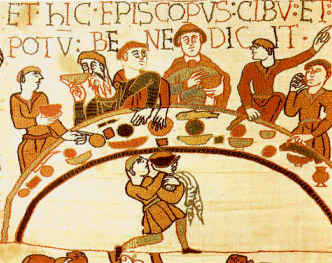
(“Old Time Religion” is a Protestant hymn that blissfully doesn’t mention Jesus, so it was easily and happily repurposed by American Witches for their Old Religion. The image of medieval English folk feasting in a Circle comes from the 11th century Bayeux Tapestry.)
 Lincoln Green