“There are no magical supply shops, so unless you are lucky enough to be given or sold tools a poor witch must extemporize. But when made you should be able to borrow or obtain an Athame. So having made your circle, erect an altar. Any small table or chest will do. There must be fire on it (a candle will suffice) and your book. For good results incense is best if you can get it, but coals in a chafing dish burning sweet-smelling herbs will do.”
Thus said the “Book of Shadows” received by Stewart and Janet Farrar. For some Witches this passage may seem a quaint anachronism from a by-gone era, when today there are of course numerous magical supply shops, mostly online (but still some brick and mortar), selling a myriad of products that unlike a candle, a Witch’s Athame or Seax, and some kind of incense, have nothing inherently to do with Witchcraft. Folk magic and divinatory practices of virtually any kind (that aren’t based in self-harm or malicious intent to harm to others) are, however, just as easily incorporated into a personal (or coven) Witchcraft practice as they are into Christianity, Judaism, or Islam. There is nothing (but social stigma) to prevent a Witch from creatively reframing any folk practice inherited from one’s ancestors into the intentionally chosen religion of Witchcraft.
During the 1970s the occult bookshop served the very real function of not only supplying the curious Seeker with relevant reading material for learning about the new religious movement of Witchcraft, but these shops also served as cultural hubs in urban areas offering in-person meeting spaces that served to create the “Pagan community” in the U.S. that people refer to today.
For those outside big cities, Hans Holzer’s journalistic “exposés” of the Witchcraft movement, (some of which gave names and P.O. Boxes for contacting particular covens all over the nation), might have been available at the local public library, or on the paperback racks of a particularly well-stocked grocery or drugstore. And that’s what today’s magical supply shop really is, and always has been, a drugstore.
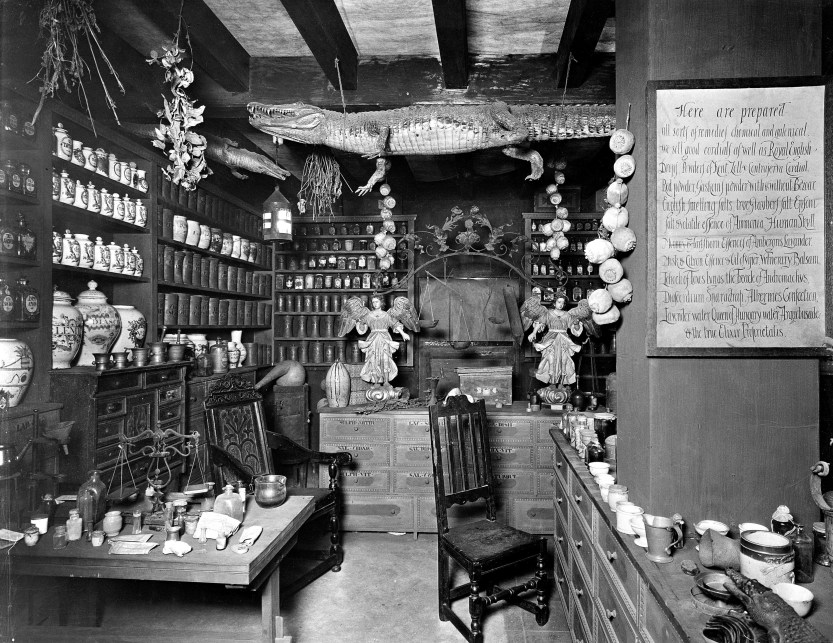
The romantic image of the witch’s cottage with its locally-gathered herbs drying from the rafters and a cauldron bubbling on the hearth, is only the more self-sufficient version of the urban apothecary, some of whom, like the beloved English apothecary Nicholas Culpeper, were also accused of witchcraft. Large cabinets and many-jarred shelves filled with herbs and spices from every corner of the known (to-the-apothecary’s) world, gems and minerals, various parts of various animals, astrological sigils painted on a lintel and statues of angels all might adorn the European, and colonial European, apothecary shop. The difference between a wizard and a pharmacist was pretty hard to determine in those days, and even as the American apothecary changed into the modern drugstore, it wasn’t just astrological almanacs that these locally-oriented drugstores would carry as customers made requests for preparations and products outside the modern pharmacist’s usual fare.
A really interesting and worthwhile read for those curious about modern apothecaries, and the religious magic associated with them, is Spiritual Merchants: Religion, Magic & Commerce by Carolyn Morrow Long (2001). It’s a particularly good read for those from a Witchcraft background who find themselves on the outside looking in, and wondering what relationship there might be to Witchcraft with its particular taboos in regard to money.
Traditional Wicca, or Witchcraft, including Seax and “Bucklandian” Witchcraft more broadly, is fairly well-known for having a taboo against charging for coven training or initiation, in contrast to the many fees associated with other initiatory religions. Buckland’s open teaching of the intimate nature of Witchcraft makes the reasoning behind this taboo quite clear, and should also make the resultant Witch ethic of “harming none” more obvious in its practical orientation than it often appears to be. As Buckland taught quite simply, “A coven is a family.” As a teacher of solitary Witches, in addition to coven-based Witchcraft, Buckland has often been characterized as overly paternalistic. However, I don’t think it’s unfair to say that those drawn to Witchcraft specifically, (an inherently emotional form of religio-magic), are particularly susceptible to the adverse side-effects of heavily negative magic (i.e. hexes and curses) which often intensify (rather than relieve) a distressed state, let alone achieve the just righting of a wrong that the Witch truly seeks. Emotions, being involuntary by nature, are the kind of thing that need to be intentionally channeled in a way that results in a positive outcome for the Witch and his or her loved ones, and when alone, without the support and safety-valve of a coven, a solitary Witch may have no one to check self-destructive behaviors. Similarly, Buckland’s advisement against controlled substance use for the solitary Witch, with the specialized magical product of most Witches being sold at the local liquor rather than another kind of drug store, comes from the ease of falling into substance abuse for personalities drawn to an emotionally-powered magical practice in the first place.
(Photo of a reconstructed 17th century English apothecary shop from the Wellcome Historical Medical Museum. 1938.)
 Lincoln Green