“The New England records are unfortunately not published in extenso; this is the more unfortunate as the extracts already given to the public occasionally throw light on some of the English practices.” – Margaret Murray, 1921.
There is a word sweeter than Mother, Home or Heaven. That word is Liberty.
On November 1, 1978, Scott Cunningham made note in his diary of an article he had submitted to the Witchcraft periodical Sign of the Pentagram that posed the question, “Is There an American Witchcraft?” While the article, and Cunningham’s answer to this question may be lost (if anyone has the issue of Sign of the Pentagram containing this article please let us know!) the question he posed is an important one. As a religion originating in Britain in the wake of WWII, there has been a concerted effort since the 1990s (and the rise of the World Wide Internet) to codify and demarcate the idea of a lineaged and “closed” family of religions now known as “British Traditional Wicca”, with any decidedly American-born traditions of Witchcraft kept solidly on the outside of the circle in some “eclectic” ghetto.
This process has unfortunately required a certain degree of willful self-delusion about the importance of Americans in Gerald Gardner’s Witchcraft from the beginning. From November 1947 until March 1948, after meeting Aleister Crowley that May, Gerald and his wife Donna lived with Gardner’s younger brother Douglas (who was going blind) and his wife Mimi in America (Tennessee, specifically). A photo of Gardner at four-and-a-half-years-old holding his little brother, with whom he was very close, is included in Gerald Gardner: Witch (1960). Doreen Valiente may not have written about Gardner’s brother, but she did remember Gardner recommending she read a particular American book published in 1947, (after she read his own 1949 occult novel High Magic’s Aid of course) namely, Vance Randolph’s Ozark Superstitions, a book in which the cultural differentiation between Christian conjurors or “power doctors” and female (or female-linked) “witches” is made particularly clear. As Randolph wrote in Chapter 12, “Ozark Witchcraft”:
Anybody is free to discuss the general principles of witchcraft, but the conjure words and old sayin’s must be learned from a member of the opposite sex. Another thing to be remembered is that the secret doctrines must pass only between blood relatives, or between persons who have been united in sexual intercourse. Thus it is that every witch obtains her unholy wisdom either from a lover or from a male relative…A mother can transmit the secret work to her son, and he could pass it on to his wife, and she might tell one of her male cousins and so on.
Further, in 1959, Gerald Gardner was in direct correspondence with American Carl Llewellyn Weschcke (future owner of Llewellyn Worldwide and publisher of Lady Sheba’s The Book of Shadows in 1971) about American writer William Seabrook’s Witchcraft: Its Power in the World Today (1940), and the American witchcraft movie Bell, Book and Candle (1958).
Gerald Gardner aside, Alexandrian Witchcraft would lose its authority to initiate entirely if it did not recognize the initiation of Hans Holzer by Maxine Sanders, as much of an embarrassment as his books may be to many Wiccans and Pagans who would prefer to have a less chaotic history than they do. As an Austrian-born American who immigrated to the United States with his brother as a very young man on the eve of WWII, his books on Witchcraft were written from the perspective of a grateful American who loved his new homeland, and it is also his early books on Witchcraft that described the religion of Alex and Maxine Sanders in the United Kingdom (and the large English and Scotch-Irish descended American population in the United States helping to propagate it “across the pond”) as an essentially “Celtic” and “Anglo-Saxon” religion. This is certainly an interpretation of Wicca that the proponents of “British Traditional Wicca” have run with—yet notably they have done so without crediting Holzer for this particular distillation, which was, (also notably) not Raymond Buckland’s.
Another American, a Civil War Veteran named Charles Godfrey Leland, was a man whose presentation of an unequivocally religious female “messiah” among Italian peasants in Aradia, or the Gospel of the Witches (1899), gave Witchcraft its core philosophy of Liberty for the common man and woman. It also gave (quite obviously to anyone already aware of it, as Buckland and Valiente were) the “secret” name of Witchcraft’s Goddess as she was known prior to Gardner’s death in 1964, (see Witches by T.C. Lethbridge, 1962 and Crafting the Art of Magic by Aidan Kelly, 1991).
Raymond Buckland, himself an English immigrant to the United States, not only founded the Seax tradition of Witchcraft in New Hampshire in 1973, (a state particularly proud of its history in the American Revolution against Great Britain) but with incredible equanimity, attempted to present Witchcraft as a religion potentially rooted in the ethnic backgrounds of all Americans, hinting in 1974 at the possibility of a Witchcraft tradition rooted in his own paternal ancestry through the Goddess name Gana. Buckland also attempted this without seeking to conflate with, or detract from, but rather to give a fair portrayal of (as an outsider), an African-based American religion, or family of religions, historically derided as “witchcraft” (namely “Voodoo”).
In the chapter on Witchcraft in Here Is the Occult (1974), Buckland wrote in response to the question “Are there different forms of Witchcraft?”:
Yes. In the United States, for example, may be found Celtic, Druidic, Gardnerian, Welsh, Irish, Saxon, ect., and various forms (dependent upon the origin of the coven members) of so-called “Traditional Witchcraft”. The rites will vary though there is a common basis to all…for example, all believe in the same deities.
Buckland also demonstrated his allegiance to the idea of a uniquely American Witchcraft in Here Is the Occult in his discussion of the beloved Irish and Scottish descended American holiday of Halloween:
Hallowe’en, or Samhain, is the most important Sabbat in the witch year…At Samhain witches think especially of those friends and relatives who have died in the previous year. It is believed that their spirits return to join in the coven celebrations. In the old days witches travelling to the Sabbat site (where all the covens of one Queen would be meeting) would carry a light with them symbolizing the departed spirit accompanying them. So that the light would not be blown out by the wind it would be carried in a hollowed-out pumpkin or turnip…from this came the now popular Jack-O’-Lantern.
Now, while the “old days” of a Witch Queen presiding over multiple covens to which Buckland was referring may have dated to no earlier than the 1960s, and while it may have been more aspirational than anything even then, every religion is in need of (and entitled to) its particular mythos. As self-dedicated American Witch Gerina Dunwich,—(Dunwich, as an aside, is fairly unique and honorable among Modern Witchcraft writers for her honest and transparent allusion to Buckland’s The Tree regarding her self-dedication in the first place, as evidenced by her “Herbal Sleep Potion” dedicated to Woden and Freya)—, so aptly put it in Candlelight Spells (1988):
There are two main deities honored and worshipped in the rites of the Old Religion: the Mother Goddess of Fertility and the Horned God. Their names vary from one Wiccan tradition to the next. Some traditions, such as the Gardnerians, use different deity names in both their higher and lower degrees.
The Goddess is the female principle and represents fertility and rebirth. The moon is her symbol and she is often depicted as having three faces, each representing a different lunar phase. She is the Virgin (or the Warrior Maid), the Mother and the Wise Crone—the new moon, the full moon and the waning moon.
The Goddess possesses many different names. She is often called Diana, Cerridwen, Freya, Isis, Ishtar, Kali, the Lady or any other name that a witch feels responds to her or his own mythopoeic vision.
And for men like Gardner and Buckland, the mythopoeic vision of a new religion called Witchcraft was linked to the Holocaust, and the devastation of Europe in the wake of World War II.
In the first chapter of Witchcraft Today (1954), “Living Witchcraft”, Gardner mentions a “Mr. Hughes” and his “most scholarly book on witchcraft”, who wrote in the last chapter of Witchcraft (1952):
As with the Druids and most early peoples, including the first Christians, the secret rites of the witches were not committed to paper…The fact means, however, that the record of witchcraft is that set down by its enemies. It is as though, in a world conquered by the Third Reich, all Jewish tradition and history had been destroyed—together with the Bible and all the Jews themselves—so that later generations knew of Jews only as portrayed by the men of Nuremberg. (In time, no doubt, sceptics would have asked whether such monsters existed at all.)
…and…
It is sometimes asked whether witchcraft will revive…witchcraft, as a cult-belief in Europe is dead. As a degenerate form of a primitive fertility belief, incorporating the earliest instructive wisdom, the practice is over. Conjurors, wisewomen, palmists, and perverts may be called witches, but it is using an old stick to beat a dead dog.
British historian Ronald Hutton, who published The Triumph of the Moon in 1999 right around the time Doreen Valiente’s ashes were being committed to an English forest, implied Americans were too “Holocaust conscious” when dismissing Gardner’s claim of “about nine millions” dead for witchcraft in the introduction to his occult novel High Magic’s Aid (1949). If that is the case (and if such a thing is possible), so then clearly was Gerald Gardner. But this is apparently immaterial to Hutton’s argument, if it enables the dismissal of an American woman who proposed this figure over fifty years before.
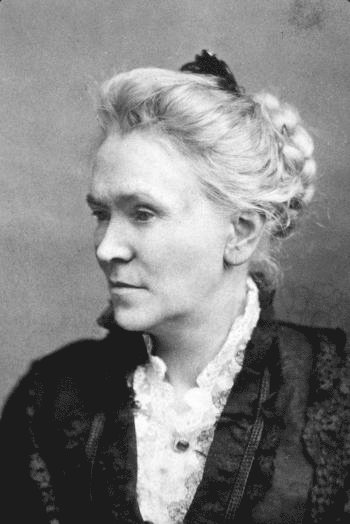
Belittled by Hutton as an “eccentric American” merely parroting what she had read in French historian Jules Michelet’s The Sorceress: Or, Satanism and Witchcraft (1863), the great American foremother of religious Witchcraft must surely be abolitionist, suffragist, free-thinker, theosophist, and initiate of the matriarchal Wolf Clan (Mohawk Nation) of the Haudenosaunee Confederacy: Karonienhawi, or Matilda Joslyn Gage.
The fifth chapter of Matilda Joslyn Gage’s Woman, Church and State: A Historical Account of the Status of Women Through the Christian Ages With Reminiscences of Matriarchate (1893) is devoted entirely to the subject of witchcraft and some of its most iconic symbolism:
Black cats were frequently burned with a witch at the stake; during the reign of Louis XV of France, sacks of condemned cats were burned upon the public square devoted to witch torture…as recently as 1867 a woman was publicly accused of witchcraft in the state of Pennsylvania on account of her administering three drops of a black cat’s blood to a child as a remedy for the croup.
For Gage, witchcraft was intrinsically tied to pre-Christian religion in Europe, and in particular the forced conversion of the continental Saxons to Christianity by Charlemagne. As Gage wrote:
A new era of persecution and increased priestly power dates to the reign of Charlemagne, who although holding himself superior to the pope, as regarded independent action, greatly enlarged the dominion of the church and power of the priesthood. He forced Christianity upon the Saxons at immense loss of life, added to the wealth and power of the clergy by tithe lands, recognized their judicial and canonical authority, made marriage illegal without priestly sanction and still further degraded womanhood through his own polygamy. Although himself of such wanton life, he yet caused a woman of the town to be dragged naked through the city streets, subject to all the cruel tortures of an accompanying mob.
Hardly limited to an Anglo-American interpretation of witchcraft, (i.e. Protestant Puritans in New England accusing one another of celebrating Christmas and having sexual intercourse with the Devil in the woods), Gage addressed the topic of witchcraft from the perspective of someone fully aware of the extensive impact of French and Spanish colonialism on the Americas, the tortures devised by the Jesuit Martin Delrio, and the religious terrors and murders of non-Christians and other perceived heretics wrought by the Inquisition in continental Europe. For Gage, these evils and their importation to the Americas by Christian missionaries, were fundamentally linked to the sexual oppression of women through the Church’s adoption of celibacy as a morally superior state for an exclusively male priesthood, with the marital rape of powerless wives but a necessary concession for the propagation of the species.
Gage in 1893, six years before Aradia, put forth her spiritual vision of witchcraft, which may sound commonplace to many since the success of Wicca in the mid-twentieth century, but was most assuredly not in Gage’s lifetime:
The Saxon festival “Eostre,” the christian Easter, was celebrated in April, each of these festivals at a time when winter having released its sway, smiling earth giving her life to healing herbs and leaves, once more welcomed her worshippers. In the south of Europe, the month of October peculiarly belonged to witches. (Of which the tricks of Halloween may be a memento.) The first of May, May-day, was especially devoted by those elementals known as fairies, whose special rites were dances upon the green sward, leaving curious mementos of their visits known as “Fairies Rings.”
…The women of ancient Germany, of Gaul and among the Celts were especially famous for their healing powers, possessing knowledge by which wounds and diseases that baffled the most expert male physicians were cured…Aside from women of superior intelligence who were almost invariably accused of witchcraft, the old, the insane, the bed-ridden, the idiotic, also fell under condemnation.
And, finally…
While man was connected with her in these ceremonies as father, husband, brother, yet all accounts show that to woman as the most deeply wronged, was accorded all authority. Without her, no man was admitted to this celebration, which took place in the seclusion of the forest and under the utmost secrecy…Women’s knowledge of herbs was made use of in a preparation of Solanae which mixed with mead, beer, cider, or farcy—the strong drink of the west—disposed the oppressed serfs to joyous dancing and partial forgetfulness of their wrongs during the night gatherings of the Sabbath… “The Sabbath” was evidently the secret protest of men and women whom church and state in combination had utterly depressed and degraded. …Among the “Papers of the Bastille,” a more extended account of woman officiating as her own altar, is to be found.
Perhaps, then, Wicca is not nearly so quintessentially British as Hutton claims. The translation of Buckland’s Complete Book of Witchcraft (1986) into seventeen languages has made Witchcraft a world religion, and the only essentially matriarchal one. And it was the United States of America that inadvertently, or otherwise, gave it to the world.
 Lincoln Green