“I am told, by women who claim to have experienced both, that the witch’s initiation is a much more moving spiritual crisis than that which the Christians call conversion.” – Vance Randolph, Ozark Superstitions
“It is considered ‘proper’ to consecrate the two main tools used in the rites: the Seax and the Sword. This consecration is, basically, a spiritual cleansing of the instrument. It is accomplished through ‘sprinkling (with the salted water) and censing (in the smoke of the incense)’. It is done once only. The Sword would be done when the coven is first formed…if Sword is to be consecrated this is done by the Priestess.” – Raymond Buckland, The Tree
One of the aspects of the Wiccan Goddess that seems little understood these days is that of a Sovereignty Goddess. Whatever Wikipedia may say about current academic opinions, it is a concept (like that of the Horned God) that is central to the Wiccan religion and its traditions regardless of “trend”. Before the Internet, from the 1960s-1980s it was widely understood that in Witchcraft, the Sword was the symbol of where the power resided within the coven hierarchy. Patricia Crowther (Craft name “Thelema”), in her memoir High Priestess (1998), recounted her own 1960 initiation into the Craft by Gerald Gardner where she made it clear that within his coven—the power resided with Gardner himself.
It is this Sovereignty aspect of the Wiccan Goddess, however, that explains why it is said in The Tree that the Sword is to be consecrated by the Priestess, rather than the Priest—as it is the Sword that will lead the invocation of the God and Goddess within the Temple. For the solitary Gesith, the Seax serves the same invocatory purpose. In Saxon Witchcraft there is no “Rite of Protection” and no “Circle Casting” as the latter is understood in Gardnerian Wicca. There is the potential for a coven officer known as a “Thegn” who may draw a physical nine-foot Circle in the Earth with a Spear, and the understanding that the Seax is also a weapon, and as such can be used by the solitary Gesith to draw a Circle in the Earth to aid in calming the mind.
As the human representative of the Earth Goddess, the Priestess consecrates the Temple simply by candle-lighting, asperging, and censing the nine-foot diameter Circle in which the coven meets, indoors or out. The Circle can also be physically demarcated with flowers, leaves, ect. While unlike other forms of Traditional Wicca there are provisions for forming a coven without a Priestess—perhaps in the case of a coven comprised entirely of gay men—it otherwise almost invariably means (as it did in Buckland’s New Hampshire coven) that the Earth upon which a Witchcraft covenstead resides is also the Home of a Witch Priestess.
For those who have read High Magic’s Aid (1949)—which Buckland always continued to recommend all Wiccans read—and are then trying to understand Buckland’s creation of the Saxon tradition in relation to Gardnerian Wicca, it is most succinctly explained as Gardnerian Wicca without monotheistic ceremonial magic. In The Witchcraft Report (1973) Holzer recounts one of the major misunderstandings in Witchcraft at that time (and this time), a misunderstanding fueled largely by Gardner’s inclusion of Christian ceremonial magic in his Witchcraft rituals (which the Saxon tradition removes): and this is that Witchcraft is not only polytheistic (i.e. “pagan”) theologically, but that it is unapologetically and unequivocally Goddess-worshipping. While most are at least somewhat familiar with Christianity, many have little knowledge of the Jewish religion beyond the Christian idea that Christianity is a derivation or fulfillment of it. Some of this is due to Christianity’s intentionally willed ignorance about their religion’s primordial roots in Roman paganism—as a crucial division between Judaism and Christianity is really a holdover from the pagan Roman Empire’s attempt to include the Jewish God in the Roman pantheon (which went very badly) and the resulting legacy of post-Christianization interpretatio romana that equates the Jewish God to the God Saturn. To anyone even vaguely familiar with the Christian ceremonial magic or astrology that permeates all of Western occultism, Saturn is well-known as the “heavenly body” to which the most negative and sinister (i.e. “Satanic”) of correspondences are made. The Christian Sabbath following on Sunday is seen as “redeeming” what Christians call the “Jewish Sabbath”. Likewise, when someone talks about the “Old Testament” this is an indication that they are talking from a Christian perspective, as from a Jewish perspective it is just “The Bible” and what came later with the invention of Christianity is a pagan Sun Cult that doesn’t even know itself.
It is this legacy of the Jewish God being equated by early Christianity with their Satan once the Roman empire was officially no longer pagan and therefore had no place for Saturn and his Saturnalia, and with the Sol Invictus of the pagan Roman pantheon being replaced with the Christian God (who Christians of course claim is the True Jewish God) that is the source of pretty severe religious differences between Judaism and Christianity that Neo-pagans really only used to actually “interfaithing” with Christians rather than with any actually practicing Jews have not even remotely prepared themselves for, as recent Neo-pagan blogosphere drama so amply demonstrates.
Similarly, the Neo-pagan avoidance of really understanding that the Muslim God IS ALSO claimed to be the True God of both Christianity and Judaism—encouraged by the uninformed tendency to call the Muslim God “Allah” to sound inclusive of what feels like spicy exoticism to the outsider (how Roman pagan!), really obscures the very serious interrelationship of these three faiths to one another. To cut a very long and very bloody never-ending story short, if you have ever wondered what the menorah represents beyond the miraculous light of the Jewish God—the Center Candle that is used simply as a lighting tool for the other candles, is actually named for a pre-Jewish Mesopotamian Sun God as an intentional Magical Act indicating how NOT PAGAN Judaism is, and the equation by Roman Christianity of the Jewish God with SATAN (a concept itself first manufactured by Christianity), and the history of European anti-semitism that went with it based on the idea that Jews-are-Satanists is what contemporary Jewish people (especially post the Holocaust) are usually really thinking about when they hear “paganism”—to give some desperately needed context to the clueless Neo-pagan blogosphere with its bizarre “but we’re standing for Jews and Muslims too!” savior complex rhetoric. How anyone who supposedly “proudly” proclaims themselves a “Pagan” was surprised, let alone offended, that a Jewish rabbi didn’t see being “Pagan” as a particularly “good” thing is just evidence of how little Neo-pagans know anything at all about Judaism, or Islam for that matter. Given this serious lack of basic knowledge, this passage by Holzer regarding a particular incident pertaining to Rosemary Buckland’s Long Island coven is really important to highlight:
Gene’s expectancy of admission to the craft was suddenly shattered when the high priest accused him of not being sincere in his interest. Unable to understand this severe criticism the young man was finally told that he wore jewelry with Jewish significance and that wasn’t very proper for a pagan. The item in question was a wedding ring with Hebrew script. Gene has never denied his Jewish background but felt that a sentimental attachment to a wedding band was not out of keeping with a sincere interest of becoming a witch.
This is probably the most clear explanation of why Buckland, (who had Holzer’s Witchcraft Report on his extended reading list for Saxon Witchcraft back in 1974), felt the necessity of getting rid of Gardner’s Christian ceremonial magic, and then founded the Saxon tradition of Witchcraft in open devotion to the Goddess Freya—but back to Gardner.
Central to the plot of High Magic’s Aid is the need to find a Witch. The initial reason essentially given for this is that the magician and the two brothers seeking her out need the aid of specific magical weapons she inherited from her mother to continue with their own Solomonic magic. This is crucial to note because while Judaism may be traditionally matrilineal, neither Judaism nor Christianity nor Islam—who all claim King Solomon as a beloved patriarch—are Goddess-worshipping religions. This should be obvious. Witchcraft was, however clumsily by Gardner, intended to be. This is what Buckland was referring to when he maintained (until the very end of his life), that he wanted to be remembered for trying to get “Gardnerian” going over “here” (i.e. in the United States), despite Buckland obviously not really caring about “lineage” at all, and certainly not in the way contemporary Gardnerian Wiccans attempting to retrofit and rebrand their religion post-9/11 and its socio-political fallout do.
While the deification of the character “Jan” through his initiation into Witchcraft is probably the most important theological takeaway from High Magic’s Aid, it is notable that the seeds of a truly matriarchal Witchcraft were present in Gardner’s vision even then. Tracing lineage through the mother, as Judaism traditionally does, does not inherently correspond to where the power actually resides within a tribal hierarchy any more than the survival of Goddess-worshipping in India indicates any kind of “feminism”, but it is notable that in Gardner’s imagination it was the witch Morven and not the magus Thur (the character who is very much a stand in for Gardner himself), that initiates the male characters into Witchcraft—a religion which is distinctly presented in the novel as something other than the Solomonic ceremonial magic the men perform with her aid. The witch cult of the novel is also shown to be its own independent brotherhood that ultimately provides the real aid in the end. In essence, the brothers in Gardner’s novel are presented as being unable to move forward in reclaiming their own land without being initiated into an underlying spiritual power that this disheveled and starving peasant woman in England (who the novel makes clear to us is not Jewish, by the way) is for some reason the central representative for. It is also important to note that the Murrayite witch cult of the novel is not presented as exclusive to the British Isles, as Thur is explicitly said to have previously encountered the cult in Spain (though not to have been initiated at that time).
The two essential weapons of Witchcraft belonging to the Witch Morven in High Magic’s Aid are two knives, the equivalent of which in the Saxon tradition are the consecrated Sword and the consecrated Seax. The word “Seax” itself is simply an Old English word meaning “knife” that was also used to identify one of the multiple pagan Germanic tribal groups that together would form what would become “England”, and whose continental brothers would later be forcibly converted by Charlemagne. However, in the modern religion of Witchcraft, the Seax was specifically designated by Buckland not to look like an archeological “seax”, but as an obvious cousin to Gardner’s “athamé”—yet, again, without any of the markers of Christian ceremonial magic that Gardnerian athames traditionally possess. In Buckland’s Complete Book of Witchcraft (1986) it is made clear that naming a personal Seax, and then engraving the wood or bone handle with runic letters would be appropriate, if a Witch so desires.
And as Hans Holzer observed in Wicca: The Way of the Witches (1979), gold jewelry is never worn at Witchcraft meetings. This is a taboo that is not based in any kind of superstition, as are the many taboos of secular “witchcraft” currently attempting to supplant Wicca in the public consciousness for some reason, but a reminder that Witchcraft is not Christianity with its gold gilt Sol Invictus imagery absolutely everywhere. Buckland in fact includes an entry on Silver in The Witch Book, as Silver is THE symbolic metal of the Wiccan Goddess, a religion formed in the mid-20th century, in the wake of World War II, with the understanding that Wiccans are fundamentally Goddess-Worshippers. Saxon Wicca in particular, with its historically aware ties to both pagan Rome and the history of anti-semitism post the empire’s conversion, self-consciously knows itself not to be a male-centric cult of pagan proto-Christianity where the Mother Goddess has been safely subordinated to the One God, for as it says in The Tree the Sun is a symbol of the Horned God, not the totality of what the Horned God means or represents theologically to Witches. This, and only this, is what makes a Priest wearing copper (or perhaps bronze) in a Saxon Witchcraft Circle appropriate. Hopefully these observations provide some aid toward explaining the why and how of Witchcraft as its own religion with its own unique symbolism.
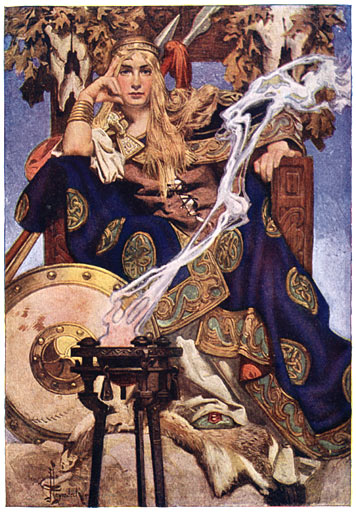
(“Queen Maeve” by German-born American illustrator J.C. Leyendecker, 1911.)
 Lincoln Green