“He harms not maids nor the wives of men, and the bound from their fetters he frees.” – Lokasenna
“In Uppsala, says Adam of Bremen, there is an idol of Frey with an exaggerated standing penis; he is called there Fricco or ‘Lover’, a name which appears to derive from an Indo-European root prij, ‘love’, the same to which Frig and the Roman Priapus are related.” – Brian Branston, The Lost Gods of England
“She will now be easily recognized as the May-eve aspect of the Love-and-Death goddess Freya, alias Frigg, Holda, Held, Hilde, Goda, or Ostara.” – Robert Graves, The White Goddess
In the year 1282, a Christian priest in Inverkeithing, Scotland was brought before his bishop for leading a fertility dance at Easter around the phallic figure of a God. He was forgiven. This may be the last historical record of the survival of Frey-worship in medieval Britain. At the very least it is definitely the inspiration behind the Priapic Wand in Saxon Witchcraft, for as Brian Branston wrote in Gods of the North (1955):
O.N. Frigg corresponds to O.H.G. Friia of the Origo Langobardorum. It is a doublet of the name Fricco applied to the Priapic god Frey; and Fricco may be referred to an Indo-European root *prij “love” from which Priapus’ name is derived too. It is more than probable that Frigg-Frey-Freya are directly derived from Priapus the god of Asia Minor.
Originally known in the Saxon tradition of Witchcraft simply as the “Spring Sabbat”, many American Witches in the late 20th century, including the Father of the Saxon tradition himself, adopted the name “Ostara” for the spring equinox as a homage to the Wiccan Goddess in Old High German. Some Brits, such as Gail Duff in The Wheel of the Wiccan Year (2002) also happily adopted this name. Effectively, this has served as a way of more openly integrating the German (and Dutch) ancestry of many Americans into the Witchcraft religion. The other spring Sabbat, (the Greater Sabbat of Beltane), which in Germany has historically been called “Walpurgisnacht” is a name that refers to a Christian Anglo-Saxon Saint who went on a mission to convert the Germans, so—particularly inappropriate in Saxon Witchcraft—whereas the name “Ostara”, does the double-duty of reclaiming the English name for the Christian “Easter” (Easter being another name for the same Saxon Goddess, also known as “Eostre”), and thereby helps to resolve artistically what are already ahistorical, and more significantly unnecessary, conflicts for many Witches. The name “Mabon” for the Autumn Sabbat (which was also adopted by British Wiccan Gail Duff, who herself received it from her local Wiccan teacher in England, and thus assumed at the time that it had derived from Alex Sanders rather than from the American Wiccan and Covenant of the Goddess co-founder Aidan Kelly), does something similar for many Witches in regard to their Welsh ancestry, although the constant complaints from some quarters of the so-called “Pagan community”— and a good reason to avoid it!—that the use of either of these names are “ahistorical” or “cultural appropriation” when no one outside of a particular Wiccan coven into which they have been initiated is expected to celebrate the Sabbats under these names to begin with, does little to help this practical integration process in nations where English (rather than Welsh or German or Dutch) is the Mother Tongue of the common man and woman.
In the Saxon tradition, where the Witch God is not sacrificed, but ever-present, (and particularly in the Far North), Ostara falls solidly in the Winter half of the Wheel of the Year, where the Priest takes the lead in the Sabbat rites. As such, the egg-coloring and chocolate rabbits associated with the secular Easter are fun traditions to continue with the Children of a Saxon Wiccan family, whereas the Sabbat Rite itself, (even in a coven that predominately practices robed), is the most adults-only and overtly sexual of the Wheel, acknowledging as it does the essential role of the Horned God in human reproduction.
Flowers for decorating the Altar and Circle will need to be procured from a local florist, but a ritual seed-planting indoors (a nasturtium seed is ideal) is no stranger to Northerners. In fact, Margaret Murray observed in The Witch Cult in Western Europe (1921) that the records regarding Swedish witches typically refer to their rites occurring indoors, which is unsurprising given the colder climate. High Priestess Doreen Valiente also noted the predominance of indoor working in the North, as did High Priestess Maxine Sanders when she quipped in a 2020 interview about how Northern Witches practice skyclad all the time.
In the Saxon tradition, the Spring Sabbat is also the only rite where Saxon Witches formally utter the ritual phrase of “Blessed be” in acknowledgement of the sexual union between male and female that creates all human Life. Otherwise, Saxon Witches traditionally just kiss their coven Brothers and Sisters in greeting as a more inclusive practice, as the phrase has very specific ritual connotations in Witchcraft. Buckland also went on record in Wicca for Life (2001) about his belief that the ritual enactment of the hieros gamos of the Wiccan God and Goddess was not something that should be performed “in token” (Witch magick not being a performance art for outsiders to begin with), and there is something to be said for the idea that a fundamental aversion to the practice on purely theoretical grounds, rather than the eminently practical ones Saxon Witchcraft addresses, (especially when it has already appeared as popular television entertainment—see both Rome 2005-2007 and Vikings 2020), is in reality a fundamental aversion to a fertility cult on principle, which is its own issue that falls well outside the theology of Saxon Witchcraft. For whether it is 1974, or 2024, fertility is still important for man’s existence and it is what in all societies Naturally integrates disparate peoples. Fertility is a Reality that human beings, as long as we shall endure, (and traditionally Witchcraft is unapologetically pro-humanity), will always be in living participation with, one way or another, and for the Witch, this must be in a way that harms none.
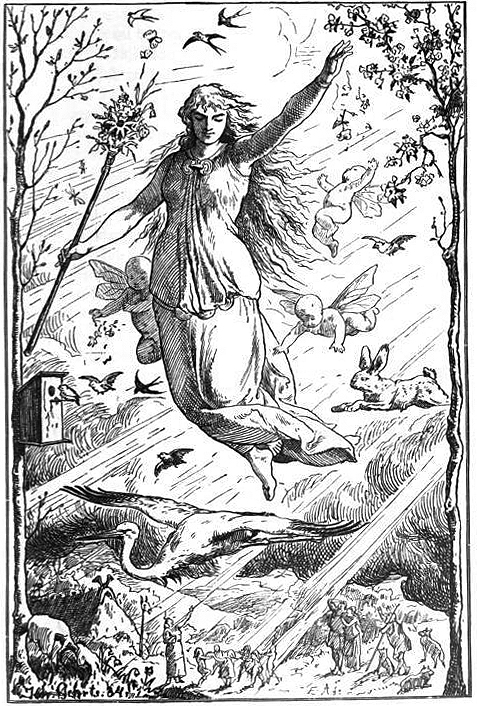
(“Ostara” by German illustrator Johannes Gehrts, 1884.)
 Lincoln Green