“The witches of the past left a vast amount of superstition behind them which is still practiced in remote country districts. But they left, too, a vast amount of useful knowledge, and some of the homeliest and most efficacious of hedgerow medicines were first brewed in a witch’s cauldron.” – Katherine Oldmeadow, The Folklore of Herbs (1946)
“The word ‘Witch’ comes from the Anglo-Saxon wica (wicca or wita), meaning ‘a wise one’. Witchcraft, then, comes from wicacraeft, ‘the Craft of the Wise’. Saxon Witchcraft, or the Seax-Wica, is one particular denomination or tradition of this old religion, having its roots in early Saxon history.” – Raymond Buckland, Songs of Saxon Witchcraft (1981)
As The Wheel of the Year turns toward the promise of Summer and the bounty of the Goddess, here are a few of my very favorite traditional herbal remedies. The herbs that feature in these remedies were not only known and loved by both the pagan Saxons (and Angles and Jutes), and their descendants in England, Scotland, throughout the Anglosphere and beyond, they are also easily found across North America, and still widely used in herbal medicine today. There is no superstition behind their well-proven medicinal efficacy.
Of Plantain, or Plantago major, known in Old English as “Waybroad” or “Waybread”, this was written sometime in the 10th century:
And thou, waybroad,
Mother of worts,
Open from eastward,
Mighty within;
Over thee carts creaked,
Over thee queens rode,
Over thee brides bridled,
Over thee bulls breathed,
All these thou withstoodest,
And with stound stayedst
As thou withstoodest
Venom and vile things
And all the loathly ones,
That through the land rove.
(“The Nine Herbs Charm” trans. Oswald Cockayne, 1864.)
Nicholas Culpeper (accused of witchcraft during the English Civil War) wrote of Plantain in 1653 (from a 1985 edition of The Complete Herbal):
…It is in its beauty about June, and the seed ripeneth shortly thereafter. Mizaldus and other astrology-physicians, say it is an herb of Mars, because it cureth the diseases of the head and privities, which are under the houses of Mars, Aries, and Scorpio; the truth is, it is under Venus, and cures the head by antipathy to Mars, and the privities by sympathy to Venus; neither is there hardly a martial disease but it cure…The plantain is a very good wound herb to heal fresh or old wounds or sores, either inward or outward.
According to the research of Dr. Eleanor Viereck (1931-2017), crushed plantain leaves bound to the head were used by both the Saxons and the Haudenosaunee as a treatment for headaches. A few plantain leaves chewed and applied as a poultice is an instant remedy for mosquito bites, but as a remedy for wounds and sores year-round you will want to make a salve. Olive oil, being readily available at any local grocery store (and for medicinal purposes you don’t need it to be the expensive kind) is good for the skin all on its own, so that, and a little beeswax (often harder to find locally, but beeswax pellets can now be easily ordered online), and some clean canning jars with tightly sealing lids are all you really need to make the salve. A double-boiler for melting the beeswax into the oil is worth investing in if you regularly make your own salve and candles.
Plantain Salve
Gather about two cups plantain leaves on a sunny day and spread out the leaves to dry for about twenty-four hours. Fill a clean (wide mouth half pint works best) jar with leaves and cover with one cup oil. Allow to infuse in a cool, dark place for a month. Give the jar a shake daily. In the first week of infusion, keep a close eye for mold. Strain. Melt 1 ounce of beeswax in a double-boiler. Add infused oil to beeswax and stir until well-mixed. Remove salve from heat and pour into clean jar. The salve will harden as it cools.
Of the Poplar or Birch Tree, known in Old English as “Beorc”, this was written sometime in the 8th or 9th century:
The poplar bears no fruit; yet without seed it brings forth suckers,
for it is generated from its leaves.
Splendid are its branches and gloriously adorned
its lofty crown which reaches to the skies.
(“Old English Rune Poem” trans. Bruce Dickins, 1915.)
Nicholas Culpeper wrote of The Poplar in 1653 (from a 1985 edition of The Complete Herbal):
Saturn hath dominion over both. …The young black poplar buds, saith Matthiolus, are much used by women to beautify their hair, bruising them with fresh butter, straining them after they have been kept for some time in the sun. The ointment called populneum, which is made of this poplar, is very good for inflammation in any part of the body, and tempereth the heat of wounds. It is much used to dry up the milk in women’s breasts when they have weaned their children.
With its delightful scent of sweet musk, invoking imagery of the woods around a Witch’s cottage, poplar bud oil is perfect for both therapeutic and sensual massage between Witch Gesiths. In the North, poplar buds are also often the first harvest of the Witch’s Wheel, as they are better gathered now while there is still snow on the ground. As soon as the warmth of summer arrives they will become sticky and hard to work with. Remember when harvesting the buds to harvest respectfully, and to pick from multiple trees in the area rather than depleting one tree of all its reachable buds. Poplar, like Willow, contains a degree of salicin which gives it its anti-inflammatory properties, including mild pain relief.
For the modern solitary Witch who may wish to perform a healing rite for a loved one long distance, (but for whom power-raising through sex magic may not be an appropriate method), the healing-associative scent of poplar bud oil can also be used to anoint a figural candle of a man or woman (silicone candle molds are also now easily ordered online if one is not themselves a sculptor), which can then be burned atop a printed photograph of the person in question while intoning a simple chant such as the one I learned from self-dedicated Witch Gerina Dunwich: “Magic mend and candle burn, sickness end; good health return.” The Earth (A Mother Goddess Name) oriented colors of Saxon Witchcraft are white, green, yellow and brown, so any of these would be appropriate colors with which to make a figural healing candle. Dunwich in Candlelight Spells (1988) recommends using wax crayons for candle dye and mixing the more costly beeswax pellets with equal parts paraffin (reserve excess paraffin wax from Altar and Circle candles for this purpose)—so once you get the hang of it, candle-making can become a meditative Witchcraft practice in its own right that is both cost effective and self-sufficient.
Poplar Bud Oil
Combine poplar buds with twice as much olive oil in a clean jar and allow to infuse in a cool, dark place for six weeks. Strain and bottle.
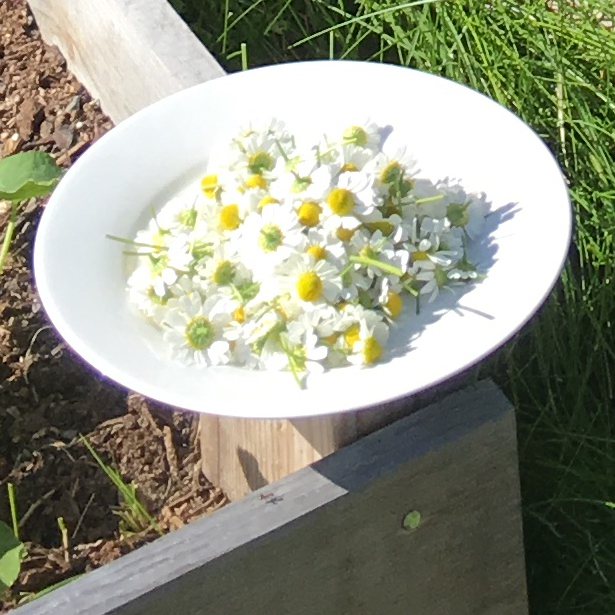
(Photo of German Chamomile flowers, or Matricaria, known in Old English as “Maythen”, harvested from our Covenstead garden one July. Of Chamomile or “Camomile”, Culpeper wrote: “Bathing with a decoction of camomile taketh away weariness, easeth pains to what parts soever they be applied…” Buckland recommends chamomile added to the bath as an “herb of purification” before Witchcraft rituals. Chamomile tea, ruled by the Sun, is also a well-known herbal remedy for anxiety and sleeplessness.)
 Lincoln Green