“After them come the Reudigni, Aviones, Anglii [emphasis mine], Varini, Eudoses, Suarines, and Nuitones, all of them safe behind ramparts of rivers and woods. There is nothing noteworthy about these tribes individually, but they share a common worship of Nerthus, or Mother Earth.” – Tacitus, Germania (trans. Harold Mattingly, 1948)
“The British Llyr or Gaelic Lir corresponds to Poseidon (Neptune) and to the Nordic Aegar, the old king of the sea; and the British Ludd or Nudd—the Gaelic Nuada—to Aides (Pluto), ruler of the Underworld; for although Nudd is to some extent a sea-god, he is more probably the ruler of the Land-under-the-Waves, which is one conception of the Celtic Otherworld…The British Branwen, on the other hand, resembles Aphrodite or Venus, and the northern Freya [emphasis mine], for she, too, is a daughter of the sea-god and a flouter of the marriage law…Lastly we have the British Keridwen, goddess of Nature, who possesses a magic cauldron with three properties—inexhaustibility, inspiration and regeneration—symbolizing the reproductive power of the earth.” – F. Marian McNeill, The Silver Bough (1956)
“To Nuada, our most sacred god of the sun…” – Lord Summerisle (1973)
While it feels somewhat cliché at this point to write on a movie that has been a guilty pleasure for Witches for fifty years—with the Saxon tradition of Witchcraft itself also celebrating its fiftieth Greater Sabbat of Beltane, it feels appropriate to touch on what elements in the film so accurately depict the modern religion of Witchcraft (and the Saxon tradition in particular) rather than the “folk horror” genre of movie-making The Wicker Man helped to inspire.
The first important thing about The Wicker Man is that it is set in Scotland. Not Ireland, not Wales, not England—Scotland. Something to remember about so-called “British Traditional Witchcraft” is that it appears to be so due to the fact that Margaret Murray’s witch cult hypothesis focused predominantly on the historical witchcraft records of countries in the British Isles, an area of Western Europe which has experienced in its history multiple waves of Germanic pagan tribal migrations, followed by a great deal of inter-Christian religious strife of a nature that clearly mark them as Catholic-Protestant conflicts unrelated to anti-semitism—which was undeniably another major component of Western European “witchcraft” history on the continent. For some, the serious religious conflict between Protestantism and Roman Catholicism (one frequent criticism of the latter by the former historically being that it is too “pagan”), is still a living memory. My own paternal grandmother attended an all girls Catholic school run by nuns in Philadelphia, her mother being a devout Roman Catholic of Scottish descent. When my grandfather and grandmother were married, his mother (a Protestant of English descent), was initially none too pleased, as she was very critical of the Catholic Church—but I suspect in her case it had far more to do with a distrust of “celibate” priests than with any lingering Puritan reservations about Midnight Mass on Christmas Eve. As for my grandfather, while he eventually converted to please my grandmother, it was later in life. The Catholic-Protestant divide was still a significant one in 1950s Philadelphia.
In The Witch Cult in Western Europe (1921), Murray did not, however, restrict her study entirely to the United Kingdom of Great Britain and (at that time) Ireland—as French, Flemish, Swedish, and colonial New England records were all incorporated as important sources for Murray in the puzzle of pagan survivals she saw in the cultural phenomenon of people in Christian hegemonic communities being accused of “witchcraft”. And Scotland in particular, with its remote northern isles, and its unique position in British history for a very late open paganism, makes it a particularly appropriate setting for a modern, revived, pagan cult. Which is, after all, what The Wicker Man actually presents, rather than an “unbroken” survival of ancient paganism.
In the original Bricket Wood coven before the influence of High Priestess Doreen Valiente in 1953—although ostensibly worshipping the God and Goddess of the “Wica” (an Anglo-Saxon word), and despite the covenstead residing in an English village—there were initially only four Sabbats, all deriving from the Gaelic Celtic cultures of Ireland and Northern Britain. This was not due to their particularly “British” or even particularly “Celtic” nature however, (see Crafting the Art of Magic by Aidan Kelly for Gardner’s original rituals and deity names), but due to May Eve and November Eve being of particularly marked importance in Margaret Murray’s witch cult hypothesis as corresponding to the even more ancient pre-agricultural period of the early Neolithic, and the fertility of the animals hunted and herded by European pagans.
While Beltane may have an association with an obscure Gaulish Celtic deity associated with healing known as “Belanus”, the word may also simply mean “bright fire”. As there are far more well-documented historical pagan festivals in Britain that we know to be genuinely pre-Christian in origin (namely Yule and Easter)—explicitly associated as they are with pagan Gods outside the Roman pantheon (as are most of the English words for the days of the week), it is clear that Gardner’s personal understanding of Witchcraft was also undoubtedly colored by a general anti-“Saxon” (i.e. German) sentiment, even claiming quite bizarrely in The Meaning of Witchcraft (1959), with absolutely no evidence, that witches were what the “patriarchal” heathen Saxons called in their own language the native Britons, being fearful of magic. This is of course such an obviously false claim to anyone knowledgable about early British history that it almost seems like an intentional joke that no one got, as a significant portion of the historical evidence we have for Anglo-Saxon heathen religion are magical charms to be used in conjunction with herbal healing (see Anglo-Saxon Magic and Medicine by Grattan and Singer, 1952). That the Christianized Anglo-Saxons had become fearful of whatever they believed “elves” specifically to be, (they had been practicing heathens for at least their first five generations in Britain)—and now, after conversion, were turning to Woden/Christ specifically to magically combat them—would have been the far more accurate statement on Gardner’s part. This misrepresentation of the historical record, when Brythonic literature comes hundreds of years after both Anglo-Saxon literature and the Norman invasion, (so well after Christianity first came to Britain and Ireland with the Romans)—combined incongruously with Gardner’s belief that he was the descendent of a Scotswoman executed for witchcraft, were particularly awkward blindspots in Gardner’s vision of a truly Pagan Witchcraft, helping inspire Buckland to write both The Tree (1974) and Scottish Witchcraft (1991).
The tree of note, and the central export around which the fertility cult of The Wicker Man is based, is the “Silver Bough”, or Apple Tree that features so prominently in Germano-Celtic legend and iconography. Associated with the mystical Celtic Otherworld of the Dead or the “Land of Youth”, as it is known in The Charge of the Goddess, it is equally in Old Norse poetry remembered as the Fruit of Life and Youthfulness among the Gods. In many traditions of Wicca this “Land of Youth” or “Summerland” (the latter term originating with 19th century Spiritualism, just as the term “reincarnation” in Wicca originates with 19th century Theosophy) is also explicitly associated with the Brythonic “Cauldron of Cerridwen,” poetically understood as the womb of Nature that is the source of Reincarnation. However, as High Priestess Eleanor Bone attested in an interview she gave to the Sunday Telegraph on May 3, 1964, the Beltane Sabbat is traditionally one of only perhaps two times a year that the Witch’s Cauldron is even used. The second time to which Bone referred being the winter solstice as it was celebrated in the Gardnerian (and presumably Bone’s own “Cumbrian”) tradition at that time—Gardner even quoting directly from this ritual in Witchcraft Today (1954). As for the apple tree, the British practice of “wassailing” the apple trees in winter is likely to be a heathen survival—and for lyricism the “Gower Wassail” of Wales is hard to beat. The pagan Angles, Saxons and Jutes who settled in post-Roman Britain, followed by pagan Danes and Norse, were themselves all predominantly subsistence farmers, for whom the fertility Gods of Lord, Lady and Earth, would have been of supreme importance. (For more about this heathen Earth Mother of the Angles or “Anglii” as they were known by the pagan Tacitus, please see the 11th century Anglo-Saxon Aecerbot, or “Field-Remedy” and Kathleen Herbert’s in-depth discussion of this ritual in Looking for the Lost Gods of England, 1994).
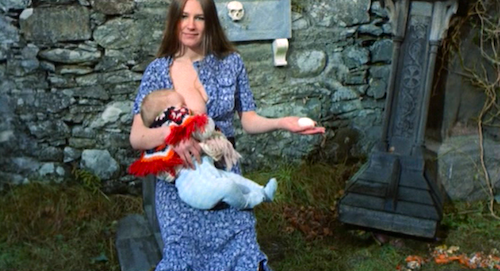
The emphasis on paganism as a fertility cult is an overriding theme of The Wicker Man, and the scene that I think best conveys the real heart of what being a “fertility cult” actually means on a level beyond bawdy songs in a pub, skyclad dancing around a Beltane fire, or making love in the grass—is the brief clip of the mother nursing her baby and holding an egg in the graveyard. The well-meaning Sergeant Howie, considering himself a devout Christian, is horrified to realize that the locals of Summerisle not only no longer consider themselves to be Christians, but actively consider themselves to be religiously Pagans, who have gone so far as to consecrate an Altar in the place where they bury their dead to honor the first fruits of the apple harvest in conscious recognition of their Old Religion. The image of the mother nursing her baby in a place devoted to the certain knowledge that everyone will die is a particularly poignant reminder of the sacredness of human fertility, yet the Sergeant, when faced with the remnants of the poor apple harvest (a sign of hardships to come), in anger makes the sign of the cross (a sign of torture and execution) from a couple pieces of a broken apple crate, while the Madonna and Child right beside him (whom he is oblivious to) slip away.
So as the Wheel turns to Beltane, and we prepare to light the fires that will burn away the last of winter’s chill and welcome the Earth’s fertility, the coven Priestess will weave her crown of flowers, and she, along with many other Witches all over the world will celebrate this sacred night by living to the fullest, “…and ye shall dance, sing, feast, make music and love, all in my praise”, in the certain knowledge of ekstasis and Love.
…and many Witches will also listen to American composer Paul Giovanni’s beautiful soundtrack to The Wicker Man, and ponder the way Life inspires art, and art inspires religion.
 Lincoln Green