“Abuse has been heaped upon her work since her death, even to the extent of students being advised not to read it—a fact which in itself shows that Dr. Murray’s books are worth reading.” – from the entry “Janicot” in An ABC of Witchcraft by Doreen Valiente (1973)
“16. But the High Priestess should ever mind that all power comes from Him. 17. It is only lent, to be used wisely and justly. 18. And the greatest virtue of a High Priestess be that She recognizes that youth is necessary to the representative of the Goddess. 19. So will She gracefully retire in favor of a younger woman, should the Coven so decide in council.” – from “The Laws” in The Book of Shadows (1971)
That any woman would still be interested in Witchcraft after reading that latter quote in the “Holy Book of Wicca” published by Llewellyn is only proof of how desperate many women were (and still are) for any kind of religious experience that incorporates Goddesses and Priestesses at all. Rather magically, Hungarian-born American Zsuzsanna Budapest immediately arrived on the scene, and with her Susan B. Anthony Coven #1 founded in 1971, soon followed by the small press publication of The Feminist Book of Lights and Shadows in 1975 (more widely published in 1979 as part of The Holy Book of Women’s Mysteries), offered a serious alternative for religious Witchcraft history in America—and the role of men in relationship to it. Budapest’s other claim to fame was her 1974 arrest in her own Los Angeles book, herb, and candle shop: The Feminist Wicca for giving a $10 Tarot reading to an undercover policewoman. Budapest not only defended herself as a Wiccan, putting this new Goddess religion in the spotlight, she simultaneously set a precedent in defense of anyone who has ever accepted any monetary compensation for their time spent in giving a reading. Budapest in turn would directly inspire American Miriam Simos (a.k.a. Starhawk), who in 1979 published her own book, The Spiral Dance (a copy of which she would inscribe with gratitude to Raymond Buckland for introducing her to Witchcraft in the first place), and Valiente from “across the pond” would read and praise The Spiral Dance as “in effect” a new “Book of Shadows”. These are facts about modern Witchcraft history that have been in a fairly steady process of “memory-holing” since the 1999 death of Doreen Valiente and it should raise an eyebrow.
1979 also saw the first edition publication of American Patricia Monaghan’s The Book of Goddesses and Heroines, a ground-breaking work in the history of religion, specifically designed for women reclaiming themselves and their traditions from the multitude of male-centered religious traditions that continue to dominate females all over the world. That sex-based selective infanticide (and now, through ultrasound technology, abortion) is still a cultural practice anywhere in the world is in itself evidence of humanity’s need for matriarchal religion, even if this is not currently considered an appropriate topic for polite conversation in more liberal societies. Patriarchal religions and philosophies, pagan or otherwise, in whatever flattering guise they currently seek to manipulate any lingering misdirected maternal instincts of emancipated and literate women in the free world, have at least one fundamental philosophical flaw that the Witch knows in her or his very bones to be absolutely unacceptable: a male’s sovereignty over a female’s body. In matriarchy, by contrast, it is fundamentally understood that no man exists at all but by a Mother’s Will alone. The Love of a Father for his Child, and a Child for their Father need be held no less sacred in matriarchy, but paternity, and the responsibilities thereof, are fundamentally understood to be a Privilege rather than a “right”, and certainly not a right enforceable by state religion in the form of matrimony. For more on the 19th century matriarchal philosophy upon which modern Witchcraft is fundamentally based, see both Woman, Church and State by Matilda Joslyn Gage (1893) and the short essay Sex-Love and Its Place in a Free Society by the utopian philosopher Edward Carpenter (1894).
And for those who weren’t actually there, or never heard about it first-hand from their mother or grandmother—heads up, the 1960s in the U.S. were rife with cult leaders of all kinds of “spiritual” and political persuasions giving “phallic initiations”—and some of them were calling it “witchcraft”. Charles Manson was but one particularly noxious and high-profile example. As Valiente wrote in her entry “Manson, Charles” in An ABC of Witchcraft:
According to Linda Kasabian’s testimony, the men of Manson’s clan called themselves witches, and “Charlie called all the girls witches”. He told them to make “witchy things” to hang in the trees, marking their way to the camp site—signs made of weeds, stones and branches, held together with wire. According to the same witness, before the party of killers set off for Sharon Tate’s house, all of them dressed eerily in black, Manson told them to “leave a sign—something witchy”. He himself did not accompany them, but awaited their return, confident that his orders would be obeyed.
That there was in fact a self-styled “Grandmaster” of a “First Wiccan Church of Minnesota” publishing this in the August 21, 1973 edition of Gnostica should also help give a feel for the era:
…it is our rule that the woman who fills the role of High Priestess in our covens, or as our Great Queen, must express the feminine at its fullness—and thus it is that a woman who passes her time of fruitfulness must retire in favor of a younger woman.
This was unfortunately well-supported by Gerald Gardner’s The Meaning of Witchcraft (1959), where Gardner had written in Chapter IX “Why?”:
Someone asked me the other night, “Why do women take the chief place in witchcraft?” I had to say, “I don’t know.” No one knows. To say that it has always been so is not an answer. The easiest thing to say is that it is a survival of matriarchy. It may well be, but I doubt if it is the true answer; because we do not know exactly what was the origin of matriarchy. I think the best explanation is because women represent the Goddess; and this probably originated when the cult of the Goddess was superimposed on the original cult of the Old Horned God of Hunting and Death. It must be clearly realised that not all women are regarded as representatives of the Goddess. It is only those who are recognized as being young and lovely, loving and generous, motherly and kind. In fact, those who possess all those qualities which can be summed up in one word ‘sweetness’. They should be Man’s Ideal; in that way they may be worthy to have the spirit of the Goddess invoked to descend upon them…Among the virtues she must have is the realisation that youth is among the requisites necessary for the representative of the Goddess, and that she must retire gracefully in favour of a younger woman in time. She will then become one of the Elders, whose decisions are powerful in council.
It wasn’t until 1989, with the publication of her memoir The Rebirth of Witchcraft, that High Priestess Doreen Valiente, an early initiate of Gardner in 1953, was able to explain to the many Americans who had taken “The Laws” seriously, (instead of very sensibly immediately rejecting them outright as the Dianic Witches did), that she felt quite confident that Gardner made them, and their ridiculous “IT BE ARDANE” refrain up as a direct response to conflicts in his own Bricket Wood coven, conflicts which induced her, along with other members of the coven—including men—to leave way back in the mists of 1957.
That this particular “Law” was obviously preposterous and laughable to begin with, given Gardner’s own age, and the ages of his wife and alleged lover “Dafo” when he presented them to a much younger thirty-something Valiente, should also be obvious.
Although Valiente recounted in her memoir that she was happy to have reconciled with Gardner before his death, she never allowed any affection for “good old Gerald” to cloud her judgment—and also to her credit, she never let the cruel gossip of men who never really knew her limit either her own self-expression or her independent research into Gardner’s claims. As worthwhile a read as her memoir, Valiente’s first book, Where Witchcraft Lives (1962), published the year before Raymond Buckland’s own initiation by Monique Wilson, is as much a support of the existence of the Saxon tradition as Buckland’s actual founding of the tradition roughly a decade later was. As Valiente wrote, “The Saxons, too, brought with them their own fertility cult, that of the phallic god Frey and his sister Freyja, the goddess of love and magic.” And in criticism of “witchcraft” cult leaders, Valiente was as scathing as Buckland. Buckland of course criticizing the idea of Wiccan Priests as “altar boys” as early as 1968, and in 1974, criticizing the Gardnerian Priestess who, “initiates anyone who happens to drive slowly past her house”. The three degree system, in Buckland’s belief, was too often fuel for religious abuse, when first and second “degree” initiations could be quite casually dispensed, not as matters of genuine feeling, but as a calculated political way of acquiring “followers” and attempting to secure their loyalty for one’s personal aggrandizement, i.e. “the ego-trip”. And, equally, from a woman’s perspective, it was Valiente who wrote:
Many of the self-styled “High Priests” and “Adepts” are merely silly exhibitionists. Some, however, are as vicious as they are stupid and nasty. What they are really adept at is deluding their followers, and especially their women followers, that they are being initiated into magical secrets, when they are in fact being degraded and exploited to satisfy the “Adept’s” personal desires.
Where Witchcraft Lives was not only included in the bibliography of Buckland’s Witchcraft Ancient & Modern in 1970, he also included it in his general recommended reading list for Witchcraft in Here is the Occult (1974). Buckland would continue to include it in almost every book he wrote on Witchcraft thereafter, including “Big Blue”. It was also included in the bibliography of The Magical Dilemma of Victor Neuburg by Jean Overton Fuller back in 1965.
Wiccan High Priestess Eleanor Bone, who was initiated in 1960, and who gave many interviews to the public, including one in 1964 in which she stated, “I’m 52, old enough to know my own mind and the ‘craft’ is my religion”, is a testament to how little bite there was in Gardner’s bark, and neither she, nor Doreen Valiente nor Lois Bourne (yet another woman, like Bone, Valiente, Wilson, and Crowther—well, Gardner himself hand-fasted the Crowthers—, who was not only already married, but in her case also the mother of two young sons when she was initiated in 1957), could really believe that the “witch cult” originated with him. And an argument could certainly be made that these first High Priestesses of Witchcraft were right—Wicca, beyond Murray’s theories and Gardner’s most ambitious imaginings, really originated with them.
It was also Bone who attested in a 2001 interview shortly before her death that she didn’t believe Gardner had been initiated past the first degree…well, the character Thur in High Magic Aid’s (1949)—which was required reading by all of Gardner’s initiates prior to initiation—certainly doesn’t make it to “third degree” with the character Morven, so perhaps that was the source of her impression.
Ronald Hutton’s The Triumph of the Moon (1999) may have been a major setback for Wicca as a world religion, both with Hutton’s rather flippant dismissal of the Holocaust as a major influence in the creation of the new religion of Witchcraft, and with its intentional avoidance of “the Raymond Buckland question” altogether—but if it did absolutely nothing else of worth, it at least motivated British Wiccans to get their “Matriarch of British Witchcraft”—who quite literally put her “skin in the game” for the religion that brought her joy—a respectful headstone, much as Gardner also now has in Tunis.
Begin High Magic’s Aid Spoiler Alert for Saxon Wiccans…Thur, the Anglo-Saxon magus and obvious stand-in for Gardner in High Magic’s Aid (on the extended reading list for Saxon Witchcraft in Earth Religion News back in 1974), not only does not “get the girl” (feeling himself quite reasonably to be too old for Morven, and noticing her attraction to Jan from the beginning)—he also gets very heroically speared to death while fighting alongside the brothers Jan and Olaf against the Normans who have taken their grandfather’s land. Previous to this final battle, Morven (known as “Vada” to outsiders) initiates all three men through the first and second “degrees” of “Gardnerian” witchcraft (nota bene: I do not use quotation marks or a lower case “w” out of disrespect here, only to indicate that contemporary Gardnerian Wiccans, such as Philip Heselton in his new forward to the recent 2023 republication of High Magic’s Aid, imply that these rituals are no longer meaningfully reflective of Gardnerian Wicca as it is currently practiced, and because Gardner himself did not capitalize “witchcraft” in The Meaning of Witchcraft anyhow). It is only Jan who is (privately) initiated into the third, and subsequently takes as his witch name: Janicot. Janicot is of course one of the names of Murray’s “God of the Witches” associated specifically with the Basque in France and Spain. The novel also explicitly states that the worldly magus Thur first encountered the “witch cult” in Spain, although he was not initiated at that time. It is important to remember that despite what many contemporary Gardnerian Wiccans may now claim about Wicca being indigenously “British” (presumably because the character Morven in High Magic’s Aid is presented as such), this rhetoric is really just a shameless political attempt to marginalize more transparent and democratic Witchcraft traditions founded in America. Gardner, (like Valiente in Where Witchcraft Lives), also stated in no uncertain terms in The Meaning of Witchcraft who he personally perceived the “witch” Goddess of the Germanic tribes to be, if “they” had one:
Like Ishtar, one of Freya’s attributes was her wonderful necklace, and in this she resembles the witch-goddess also. She is, in fact, the aboriginal Great Mother, and Frey is her phallic consort.
And personally, as an already mature woman with children of my own, the concept of an “Old Horned God of Hunting and Death” is far more understandable and approachable to me as a Brother and Lover than as a supposed “father figure” taking a “possessive interest” (as Brian Branston so eloquently put it in The Lost Gods of England, 1957) in my corpse. Your mileage, as the colloquialism goes, may vary. End High Magic’s Aid Spoiler Alert for Saxon Wiccans.
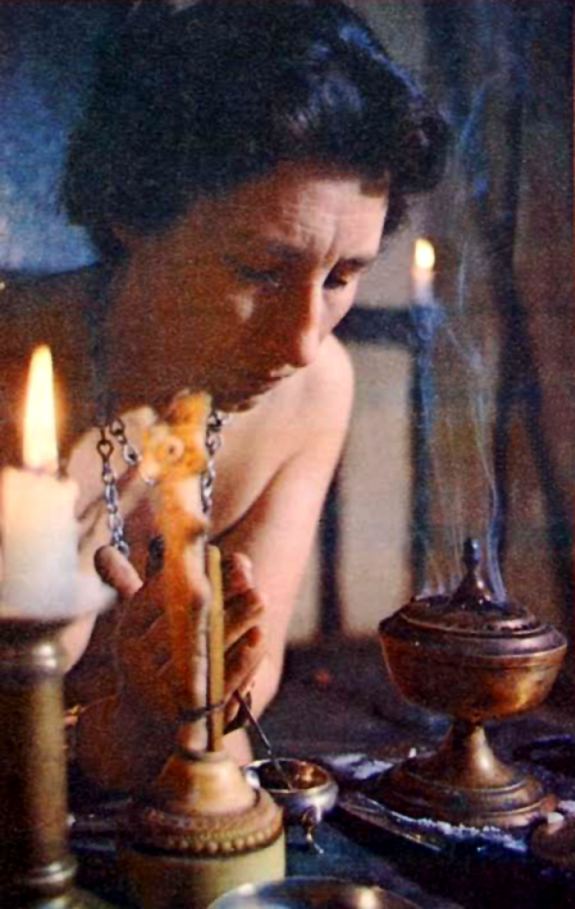
(A lovely photo of Wiccan High Priestess Eleanor Bone, or “Artemis”, consecrating the water and salt circa 1964. If any of our readers happens to know the original source of this image, please leave a comment below.)
 Lincoln Green