“O, gather round now, if you would,
And come with us to the Merry Greenwood,
And we’ll tell you the tale of Robin Hood,
Among the leaves so green-o.” — from “The Summer King and the Winter King” by Gail Duff
Midsummer in the North is more a season than a singular Sabbat. In regions that experience at least six months of Winter, there is nothing in a simple life quite like the beautiful May morning sunlight that from now until the Summer Solstice filters through the unfurling birch leaves and flowering mayday trees, accompanied by the woodland blossoming of cranesbill, aquilegia, and rose. The cheerful dandelion flower of the garden can be picked and made into wine and flower crowns, and every precious moment savoring the early summer sunlight and fresh mountain air is a blessed gift.
Given the simplicity of the traditional Seax Wican Midsummer Sabbat, this is perhaps the one most easily performed outdoors, perhaps at a woodland campsite. Even if the Sabbat ritual cannot be skyclad due to a lack of sufficient privacy, (or the equally likely inclusion of the coven’s children on a family camping trip), it is no real particular loss, as one of the more interesting Midsummer traditions recorded by James Frazer in The Golden Bough was that of the “Brotherhood of the Green Wolf” in Normandy. The Normans of course were Christianized Viking Franks who conquered the Christianized Saxon English in 1066. According to Frazer, this Midsummer (or “Eve of St. John”) tradition featured the wearing of green mantles while a bonfire was lit to the sound of bells rung by a young man and woman bedecked with flowers. After a mock sacrifice of the man chosen to be the “Green Wolf”, there followed at midnight a wild Bacchanal. A homage to this tradition is easily replicated by the coven donning hooded green robes and demarcating the ritual Circle with wildflowers around a central campfire. Instead of a mock sacrifice, for as the Wiccan Goddess says, “Nor do I demand sacrifice; for behold, I am the Mother of all living, and my love is poured out upon the earth”, choose one member of the coven to play Robin Hood “The Summer King”, another Guy of Guisborne “The Winter King”, a third Marian “Lady of the Wood”, and a fourth, the woodland spirit Puck—and accompany the Midsummer Sabbat with a slightly adapted version of Gail Duff’s ritual drama “The Summer King and the Winter King” from The Wheel of the Wiccan Year (2002).
For a proper Northland Midsummer feast, reindeer sausages roasted over a fire and the breaking of a hearty loaf of ale and cheese bread among the coven’s “Merry Men”, are the perfect companions to drinking-horns of sweet mead. Just a few of the many English folk songs that can be sung around the campfire in the “Land of the Midnight Sun” include: “Robin Hood’s Delight”, “Robin Hood and the Scotchman”, and “The Lincolnshire Poacher”…and in some covens even, perhaps, “The Maid Freed from the Gallows”, “Robin Hood and Maid Marian” or “The Raggle Taggle Gypsy”!
If either preference or necessity requires staying at the Covenstead for Midsummer, it is likely to be the warmest Sabbat of the year, so make the most of it. Bake a fresh rhubarb pie, grill, and have the feast outdoors—making sure to stay up late enough to celebrate the Sabbat Rite in the traditional skyclad manner if at all possible. “The Summer King and the Winter King” can also just as easily (and probably more comfortably) be performed back at the Covenstead, with the added benefit of avoiding any curious onlookers gawking at thespians in the woods…but however you may choose to celebrate, with or without a ritual drama, the most important thing is to have fun and enjoy the rest of Summer—she will be gone before you know it!
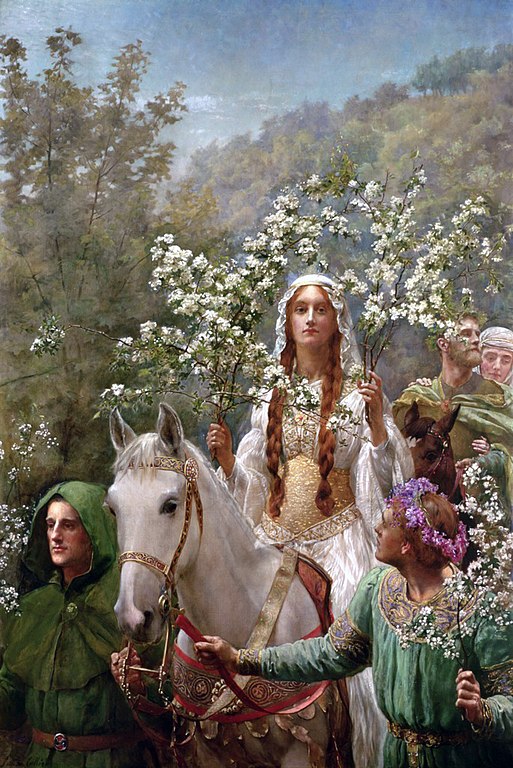
(“Queen Guinevere’s Maying” by British painter John Collier, 1900.)
 Lincoln Green