“The Anglo-Saxon is no linguist; the Celt is. To this day large numbers of Celts, in what would be regarded as comparatively lowly walks of life are bilingual. They have to be. The Anglo-Saxon is too shy to take kindly to foreign tongues and, where he is not too shy, he is too lazy to learn. Those who do business with him must speak his language. He will seldom learn theirs, and so by degrees the countries, in which he settles, come to speak one language—his language. Their ancient names, which he cannot be bothered to pronounce, become Anglo-Saxon in sound and spelling and make nonsense to those who seek to interpret them. I am not complaining of this practice; I am all in favour of it. In it lies the greatest hope of the future peace of the world. All peoples must think in the same language, English, then they may begin to understand each other.” – T.C. Lethbridge, Merlin’s Island (1948)
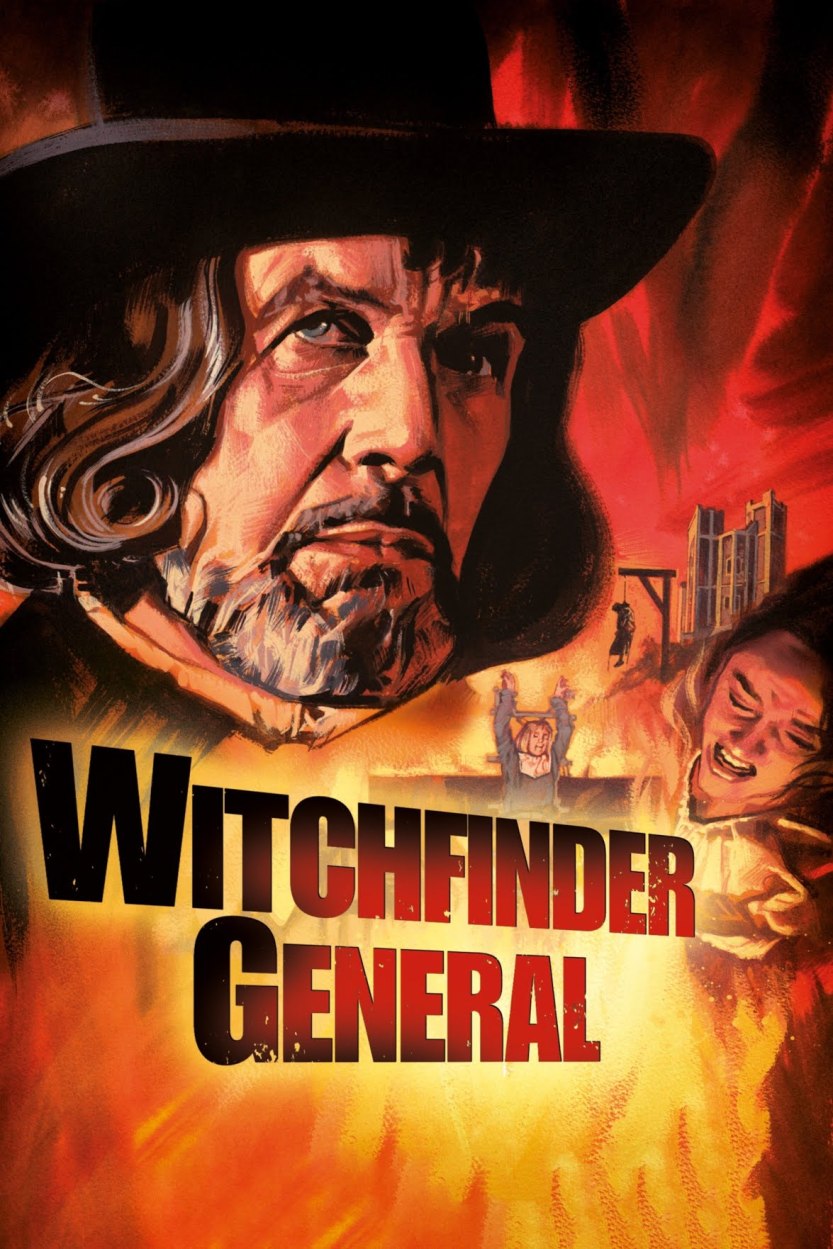
Released in the United States as The Conqueror Worm, the 1968 movie Witchfinder General by Michael Reeves (1943-1969) focuses on the historical figure of Matthew Hopkins (1620-1647), and the tortures and executions of country folk in East Anglia during the English Civil War. As such, it is a grim but culturally important reminder that the religion of Wicca, or Witchcraft, (which was just coming into public view at this time) is based on actual witchcraft history. Not necessarily “witchcraft” history in the ambitiously multi-lingual sense originally imagined by Gerald Gardner (1884-1964), but at least the wicacræft history of the Angles and their multi-ethnic Anglophone descendants.
Putting into stark focus the suffering of a largely illiterate people—people whose lives and deaths were now ruled by a badly translated “holy book” known as the King James Bible (1611), a book that in their own mother-tongue advocated killing their own wise people—the time period in which Nicholas Culpeper (1616-1654), author of The Complete Herbal (1653), was also accused of witchcraft, is brought to life.
While the fake blood effects are mercifully low-budget, the swimming tests, the rapes, and the witch-burning are hard to watch, even by contemporary movie-making standards. And before the pedants object “but witches were always hung in England, never burned!” or “but Matthew Hopkins didn’t torture people, he just used sleep deprivation!” you are seriously missing the point. We don’t know if he was actually raping people either (one way to deprive them of sleep), but there was undoubtedly a deep misogyny and sexual sadism involved in these persecutions. And you don’t have to take my word for it, you can get a look at Hopkin’s mind from his own book, The Discovery of Witches (1647).
Historical inaccuracies in the film that are far more important to address, are the fact that Matthew Hopkins was hardly the mature sadist the casting of Vincent Price (1911-1993) portrays, but a very young man in only his twenties when making his money during the chaos of civil war as a professional witchfinder. Casting a younger man in the role would have given a slightly different energy to his exploitation of a woman closer to his own age. Regardless, there is nothing honorable in Hopkins’ history, so if the movie engages in a little hyperbole to make a stronger point, to my mind that is better than the usual moral cowardice on display when the cultural significance of a man profiting off of the murders of roughly three-hundred people, predominantly widows, their daughters, and few of their sons, is essentially dismissed by pedantically saying “but his victims were Christians too!”—as if they had the freedom to be otherwise.
Who most of these individuals really were (beyond their names), and what each of them really thought, is forever lost to history. Saxon Witchcraft (founded in only 1973/74) makes no claim “to know”. What history has preserved, is that many of those tortured and killed in continental Europe as heretics and sorcerers were not Christian, and we have no reason to classify all these people murdered as witches and wizards, (originally positive words in their own mother-tongue), as such. All we can really say about most of them with any confidence is that they were English. And as a collective, these were English people deprived of their Freedom. The very word “freedom” in their mother-tongue descending from the Names of their ancient Gods. And for some, in the freely chosen Saxon tradition of Witchcraft, the Craft of the Wise—the word has this association again.
The film also unfortunately does not depict that Hopkins, like the witchfinders in New England, had female assistants for the “work” of examining other women’s bodies for the “devil’s mark”. While in some ways this artistic choice may serve to drive home the misogyny involved in these persecutions, the lack of honesty about female participation in historical witchhunting leads to some intellectual disconnects that cause many modern self-identified witches to ignore the fact that a significant number of the first modern people to go on public record as Witches, whether we’re talking Gerald Gardner (1884-1964), Doreen Valiente (1922-1999), Robert Cochrane (1931-1966), Monique Wilson (1923-1982), Raymond Buckland (1934-2017), Maxine Sanders (1946-), Alex Sanders (1926-1988), Eleanor Bone (1911-2001), Patricia Crowther (1927-), or Arnold Crowther (1909-1974), were men. Thus, even a basic familiarity with how these men defended this rather bold and strange claim (hint: it has something to do with Goddess religion—and believe it or not, this was a rather unusual interest for a British or American man in the 1950s and ‘60s—in fact, it still is!) would just be rational self-preservation if one felt they were doing something that might actually cause them to be dragged (and stripped) before hostile men. As for the other quibble, witches were burned in Scotland—also an ancestral homeland of the pagan Angles, so the depiction of one witch-burning given the shifting political boundaries within Britain over time is not particularly inappropriate.
Therefore, we would recommend a Wiccan maybe watch the movie once. Not as entertainment, which the movie doesn’t really provide, but as something more akin to a documentary, and as easily the most serious film of Vincent Price’s horror movie career. Thankfully, it is only 86 minutes.
 Lincoln Green