“Religion honors the gods, superstition wrongs them.” – Seneca (trans. Mary Beard, 1998)
“The devil loves Christmas.” – from the witchcraft trial of Rebecca and Nathaniel Greensmith of Hartford, Connecticut, 1662
The Saxon tradition of Witchcraft may be no older than the original New Hampshire coven of 1973, or the publication of The Tree in 1974, but what does it really mean to be an American “Witch”?
While Buckland spends a good deal of time on the more famous witch hysteria of Salem, Massachusetts in Witchcraft From the Inside (1995), a glimpse of the historical witchcraft trials in colonial Connecticut that preceded it are perhaps even more relevant to the Saxon tradition specifically. For Margaret Murray two things were particularly notable: what vestiges of pre-Christian European religion are preserved in Roman Catholicism, and the way in which these English Puritans turned on one another for “paganism”.
Although modern Witchcraft is a Life-affirming and Joyful religion, it is worth learning a thing or two from the history of our American ancestors who died for the “crime” of witchcraft. The Old English word wicca from which the modern English word witch derives, may be the less-startling name for the religion these days, but Buckland fought against the trend to “tame the name” for very serious reasons. The modern religion of Witchcraft is absolutely based on the realities of historical witchcraft accusations in the English language, as the religion is in part an ethical conviction that superstition and ignorance (and the political leverage of both) are often behind the immense harms human beings perpetrate against one another. Therefore, the Witch, in her religious devotion to the Horned God and the Mother Goddess, by her very name, publicly refuses both the superstitious luxury of any scapegoat (other than herself), and the easy bliss of ignorance, in her pursuit of wisdom.
Particularly unpleasant, but extremely important to realize about these historical witchcraft cases for contemporary American Witches, is the degree to which it was women fueling these trials against other women. Simply blaming “the patriarchy” just doesn’t cut it here, as what may be particularly shocking to modern readers about these trials is the degree to which the men overseeing them really did follow the letter of the law as they knew it, and many of the accused were successfully acquitted or pardoned because of this. Mob rule alone would have easily condemned them all.
The testimony about “the devil” appearing in the form of a deer was particularly notable for Murray, as the practice of assuming the forms of horned and antlered animals is a historically documented aspect of medieval heathen religion in Britain associated with Yule. And yes, that the accused in Connecticut were overwhelmingly women has indeed had a profound impact on the cultural understanding of witchcraft in the United States. In Connecticut, the men accused of witchcraft were, for the most part, effectively being charged with the “crime” of being married to a witch. Here then are just a few examples of testimony from some of the trials of those accused of witchcraft in Connecticut. I have standardized the spelling for clarity, but otherwise, these are excerpts from trial records provided by John Taylor’s The Witchcraft Delusion in Colonial Connecticut, first published in 1908. Taylor’s book was reprinted in 1969, where, on the pumpkin-orange dust jacket of my first re-edition it states: “Today, when it is fashionable to find a rouge or witch in one’s family tree, the index of witches at the end of the book will prove most interesting.”
Hopefully these very serious historical reminders of what witchcraft in America was originally associated with will also help to illustrate where the importance of separation of church and state in the United States of America ultimately comes from:
“…she asked how she knew she was a witch, and she told her she had received Indian gods of an Indian, which are shining things, which shine lighter than the day.” – from the trial of Goodwife Knapp, executed for witchcraft, 1653.
“…on account of a suspicion of witchcraft, and for various other offenses—among them, lying and filthy speeches by the wife…” -Nicholas Bayley and Wife, acquitted of witchcraft but banished from New Haven colony, 1655.
“I saw this woman goodwife Seager in ye woods with three more women and with them I saw two black creatures like two Indians but taller. I saw likewise a kettle there over a fire. I saw the women dance around these black creatures…” – testimony of Robert Stearne against Elizabeth Seager, acquitted of witchcraft 1662, later convicted of adultery and then found guilty of witchcraft in 1665. She escaped hanging due to technicalities of the Law.
“…the devil told her that at Christmas they would have a merry meeting, and that the covenant should be drawn and subscribed…She also declared that the devil first appeared to her in the form of a deer or fawn…”- from the trial of Nathaniel and Rebecca Greensmith, husband and wife, executed for witchcraft, 1662.
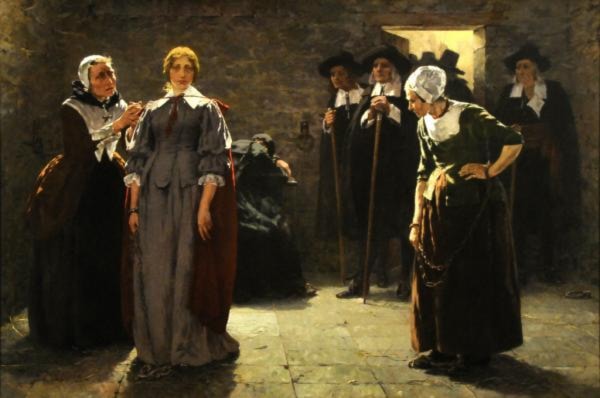
(“The Witches” by American painter Walter MacEwan, 1893.)
 Lincoln Green