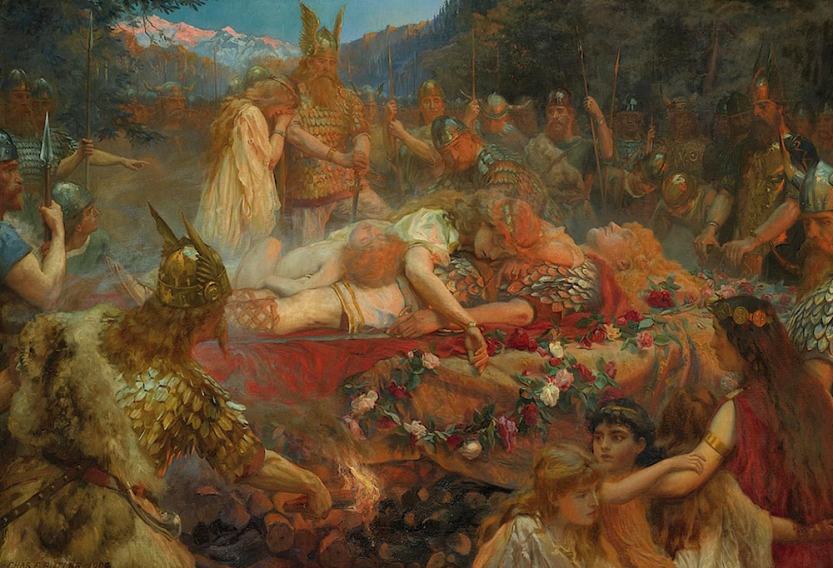
“As Forseti was said to hold his assizes in spring, summer, and autumn, but never in winter, it became customary in all the Northern countries, to dispense justice in those seasons, the people declaring that it was only when the light shone clearly in the heavens that right could become apparent to all, and that it would be utterly impossible to render an equitable verdict during the dark winter season. Forseti is seldom mentioned except in connection with Balder. He apparently had no share in the closing battle in which all the other gods played such prominent parts.” – from “The Story of Heligoland” in Myths of the Norsemen from the Eddas and Sagas by H.A. Guerber, 1909.
“These Anglo-Saxon references [to Iceland] probably owe their origin, ultimately, to Irish sources. In the sixth century the Celtic Church in Ireland was a centre of remarkable missionary activity. Irish missionaries moved relentlessly up the western coasts of Scotland, founding centres like Iona and Applecross. The missionary impetus carried them as far as Orkney and Shetland.” – Magnus Magnusson & Hermann Pálsson, 1963.
The subject of The Vinland Sagas (the collective designation given to the Greenlander’s Saga and Erik the Red’s Saga from the 13th century), is a particularly difficult one from any angle, and from the angle of Saxon Witchcraft no less so. Not only has there been more written about these two short sagas than any of the others due to their unique position as a source of information about pre-Columbian North America and first contact with Europeans, these sagas are also at certain points more akin to the “true crime” and horror genres of storytelling than any other contemporary form of entertainment. And their portrayal of a heathen (as contrasted with a Christian) woman is particularly unflattering. But first, the basics.
The first mention of Vinland, or “Wine Land”, comes not from the sagas themselves, but from Adam of Bremen, the German monk writing in the 11th century who himself heard about it from Danes in the court of King Svein Ulfsson. The central theme of both sagas is the colonization of Greenland by a Norwegian outlaw in Iceland “because of some killings” (as the sagas delicately put it), named Erik the Red, and the subsequent attempted colonization of Vinland by his son Leif dubbed “The Lucky” and his men—some of whom were already converted Christians, and others who are self-admittedly in the sagas still adherents of the old religion. In Greenland the settlers engage in farming and animal husbandry, fishing, and the hunting of large Arctic game including reindeer, seals, walrus, whales, and polar bears. In both Greenland and Vinland, these would-be settlers encounter other peoples with whom they are entirely unfamiliar, and with whom they cannot effectively communicate, and violence is unsurprisingly the result. There is a brief attempt at trading with the strangers in Vinland (already an essential part of Icelandic and Greenlandic life, particularly for grain and iron), who are said to sail in canoes made of moose hide, bringing furs in exchange for the milk and red cloth they are said to have desired from the Vinlanders. This fragile peace is soon shattered however by the behavior of a bull among the Vinlanders’ livestock brought with them over the sea, that according to the saga startles the strangers into an attack. While those exploring Vinland were overwhelmingly men, there were also a few women among them, at least one of whom becomes pregnant, and depending on whether this woman is Gudrid “God Loved” in the Greenlander’s Saga or Freydis in Erik the Red’s Saga, she either gives birth in Vinland to a baby boy, or, is said (while pregnant) to frighten away these now hostile “skrælings” by baring her breasts and brandishing a sword.
The Vinland expeditions are often called, as the subtitle of Magnus Magnusson’s and Hermann Pálsson’s 1965 English translation clearly states “The Norse Discovery of America”, but these explorers are not only presented in these sagas as differing in faiths, but as differing in ethnicities. Vinland, where “Leif’s Houses” were built, was so named by Leif Eriksson in the Greenlander’s Saga due to his bilingual foster-father Tyrkir finding wild grapes—and, being a Southerner (i.e. a German), able to positively identify them. Similarly, in Erik the Red’s Saga it is a Scottish couple, a man named as Haki and a woman named as Hekja, who are able to identify the grapes for Leif. Not only grapes, but wild wheat and other forms of produce and a rich supply of fish and game are said to be abundant in Vinland, making it a far more desirable land for farmers than either Greenland or any of the “worthless” islands of barren rock that they have also encountered in their explorations Westward. In Erik the Red’s Saga this Norse culture is also clearly extended to the “skrælings” in Greenland, when two boys are captured, baptized as Christians, and taught Old Norse. The boys’ mother is named as Vætild and their father named as Ovægir. The land from which their people hail is said to be ruled by two kings named Avaldamon and Valdidida.
The lingering heathenism of the sagas is most explicit in the names of its figures, with men having names such as Thorstein Eriksson (Leif’s brother—a settler in the Western Settlement of Greenland—and Gudrid’s first husband), Thorstein the Black (the kind heathen householder in the Western Settlement, and friend of the widowed Christian Gudrid), Thorvald (Leif’s sister Freydis’ husband whose only stated value in the sagas is that he was rich), and the proud heathen Thorsman, Thorhall the Hunter. The female “witch” of Erik the Red’s Saga likewise has the name Thorbjörg, “Thor’s Help”, although it is notable from the sagas that the Christian Gudrid is also presented as having prophetic powers in the Greenlander’s Saga, and also said to be knowledgeable in what Magnusson and Pálsson translate in Erik the Red’s Saga as “Warlock-Songs”. So, in The Vinland Sagas, and as traditionally taught by modern Witches, natural magic and divination are presented as phenomena that exist independent of religious faith—and Gudrid’s Christian faith is a very significant theme in the sagas, as it is her son Snorri Thorfinnsson, born in Vinland according to the Greenlander’s Saga, from whom early Icelandic bishops are said to descend. The German Tyrkir has already been mentioned, and the heathen heritage of the name Freydis is likewise obvious, with the “dis” part of her name meaning “goddess”, or “ancestress”.
It is Erik’s daughter Freydis (whose eponymous saga tellingly informs us is “illegitimate”—Erik’s wife was a Christian, so perhaps Freydis’ unnamed mother was a heathen) that is the central figure of the Greenlander’s Saga’s most horrific tale—and that is really saying something in a saga that also includes undead revenants. While Erik’s wife Thjodhild was clearly a Christian, for whom he even built a tiny chapel in the Eastern Settlement, Erik’s own heathenism is essentially excused away in both sagas by the statement that Christianity had not yet formally come to Greenland before he died. Erik also never sailed West with his children to Vinland, staying to rule the Eastern Settlement, and taking it as an omen after an accident on his horse that Greenland was as far as he was fated to go. This puts Erik safely in a kind of “virtuous pagan” category not unlike the limbo Dante would describe as the first circle of “hell” in his 14th century Inferno. By contrast, Erik’s son Thorstein (not to be confused with the other Thorstein of the saga—a heathen man named Thorstein the Black) emphasizes the importance of being buried in consecrated ground, and says that many of the Greenlanders were not observing the Christian faith properly. And as an undead revenant—much like the wise-woman Odin raises from her grave in Völuspá—he tells the newly widowed Gudrid her destiny: she will end up a nun after she remarries an Icelander and raises a son—and orders the body of an unpopular man in the community of the Western Settlement (and the first to have died from a sickness that had ravaged it) to be burned on a pyre in the acceptable heathen way to prevent further untimely risings of the dead.
It is hard not to see Erik’s “illegitimate” daughter Freydis as a portrayal of a wicked heathen counterpoint to his good Christian daughter-in-law Gudrid—the author of the Greenlander’s Saga even having Thorstein the Black declare to Gudrid that her religion is superior to his own. Seeing the Norwegian brothers Helgi and Finnbogi as rivals for her brother’s lands in Vinland (Leif is claimed to be an evangelist for King Olaf Tryggvasson of Norway), Freydis sneaks out at night barefoot, convincing Finnbogi to take a walk with her and sit beside her on a felled log. After their conversation she climbs back into bed with her husband Thorvald (who the saga has previously derided), and when her cold feet wake him, she tells how the brothers have used her roughly, and shames Thorvald by saying he is too weak to avenge her humiliation, or his own, and threatens to divorce him. And under Icelandic law at that time—which was remarkably sexually egalitarian—a woman could not only do this, but if her reasons were deemed justified, she could lay claim to half of her ex-husband’s property. This leads Thorvald to order his men to bind in their sleep Helgi, Finnbogi, and all the other men who sailed with them to Vinland (sixty in total)—and murder them. When Thorvald’s men are hesitant to kill the only five remaining Norwegian settlers (the women), Freydis picks up an axe and kills the women herself. This gruesome story is notably lacking from Erik the Red’s Saga, and one of the more obvious narrative inconsistencies between the two sagas.
But now that this delightful little tale is out of the way, it is worth asking what does any of this have to do with the modern religion of Saxon Witchcraft? Well, not a whole lot, necessarily. The basic historical facts of the sagas have been confirmed by the discovery in 1960 of a Viking archaeological site in Newfoundland, but there is ample reason to doubt that this is the primary location of “Leif’s Houses”, as the ecology of Newfoundland is unlike what is described in the sagas, which is a lot more like New England as far south as Long Island, New York. The one really significant link between The Vinland Sagas and modern Saxon Witchcraft is the comparative mythological work done by Charles Godfrey Leland back in 1884 in The Algonquin Legends of New England, where he drew comparisons between Glooskap and Thor, and the “Indian Devil” Lox the “Mischief Maker” and Loki the “Mischief Maker of the Gods”. Leland’s Aradia, or the Gospel of the Witches (1899), was a primary source text in the creation of Gardnerian Witchcraft, and The Algonquin Legends of New England is an equally useful primary source text for Saxon Witchcraft, particularly for those seeking to integrate—through the religion of Witchcraft—their American Indian ancestry with what is often pejoratively called their “white” or “colonial” ancestry.
And while much has been made of the heathen “witch” in Erik the Red’s Saga by those who do not consider themselves Wiccans, the unpopular truth of the matter is that the saga doesn’t say much about this woman’s practice or belief at all, other than that she made her rounds of Greenland in winter, did not perform skyclad, was not a vegetarian, and needed the aid of another woman knowledgeable in certain songs to perform her “witchcraft” (i.e. she could not work “solitary”). Thorbjörg’s eating of animal hearts before the divination may or may not have been significant for the ritual, so just to err on the side of “tradition”, I suppose Wicca-derisive “heathen witches” will need to take it up. The reality is we get far more practical knowledge about ancient heathen religion from Thorhall the Hunter’s shameless praise and poetry for Thor, and Thorstein the Black’s shameless physicality with a woman who is not his wife, than from Thorbjörg’s barely described ritual in which a Christian woman is able to take the active role. The saga does provide the information that Thorbjörg’s role as a “witch” was an important one for a woman, a role that enabled her to communicate with “spirits” and divine the future, and that it afforded her status within the community—but a status entirely dependent on another woman knowing the old songs also. The saga also gives a remarkably detailed account of Thorbjörg’s fashion sense.
(“Death of a Viking Warrior” by Charles Ernest Butler, 1864-1933. In the Eddas, Nanna is said to have died of grief for her husband Balder, and to have traveled with him to the Underworld on his funeral pyre.)
 Lincoln Green