“Salmon of Llyn Llew, I have come to thee with an embassy from Arthur, to ask thee if though knowest aught concerning Mabon the son of Modron, who was taken away at three nights old from his mother. …Then Arthur summoned unto him all the warriors that were in the three Islands of Britain, and in the three Islands adjacent and all that were in France and Armorica, in Normandy, and in the Summer Country, and all that were chosen footmen and valiant horseman. And with all of these he went into Ireland. …The warriors enquired of Arthur what was the origin of that swine; and he told them he was once a king, and that God had transformed him into a swine for his sins.” – from “Kilhwch and Olwen”, The Mabinogion from The Red Book of Hergest and Other Ancient Welsh Manuscripts, trans. by Lady Charlotte Guest, 1849.
“My lover is with me on the way of the slain; There shines the boar with bristles of gold” – The Goddess Freya, Hyndluljod, trans. by Henry Adams Bellows, 1923.
While it is now widely known that the name of “Mabon” for the Wiccan Autumn Sabbat, popularized by American Wiccan Scott Cunningham’s 1988 book Wicca: A Guide for the Solitary Practitioner, ultimately originates with another American Wiccan—namely the author and Covenant of the Goddess co-founder, Aidan Kelly—having only recently learned from Kelly himself the full poetic inspiration behind the choice, it seems appropriate to share his thoughts on the Sabbat as the holiday approaches.
On October 20, 2022, Aidan Kelly gave an interview to the host of the BS-Free Witchcraft Podcast that was released on YouTube on December 30, 2022 in which he stated:
As a poet I was putting out a calendar and I liked that we had the Celtic names for the fire festivals, but there were only three names for solstices and equinoxes that had pretty much a Saxon background. And I didn’t like it. It was an aesthetic imbalance in this calendar I was putting out not to have a name other than “autumn equinox”. And so I started thinking about, well, what was the myth here? And the main cultural association with that, is the mysteries of Eleusis about Persephone, okay? That began at the full moon nearest the fall equinox. And, in Judaism, the story of Abraham and Isaac is read at Rosh Hoshanah which falls on the new moon closest to the fall equinox. So we have these kinds of ancient associations. So I said, well, is there a Northern myth of some sort about the rescue of a child from death that might be attached here? And so, I went looking and there’s not a Saxon one, but there was in the Welsh, in the Mabinogion, that Mabon ap Modron was rescued from the Underworld by King Arthur. And, Mabon ap Modron meaning the “Son of the Mother” is quite parallel to Kore as being “Girl, Daughter of the Mother”, so that fit…You don’t understand the answer if you don’t understand the question…I wasn’t asking where he “belonged”, I was asking what meaning fit with the fall equinox…I like your point that Mabon is our own thing, no one else uses it.
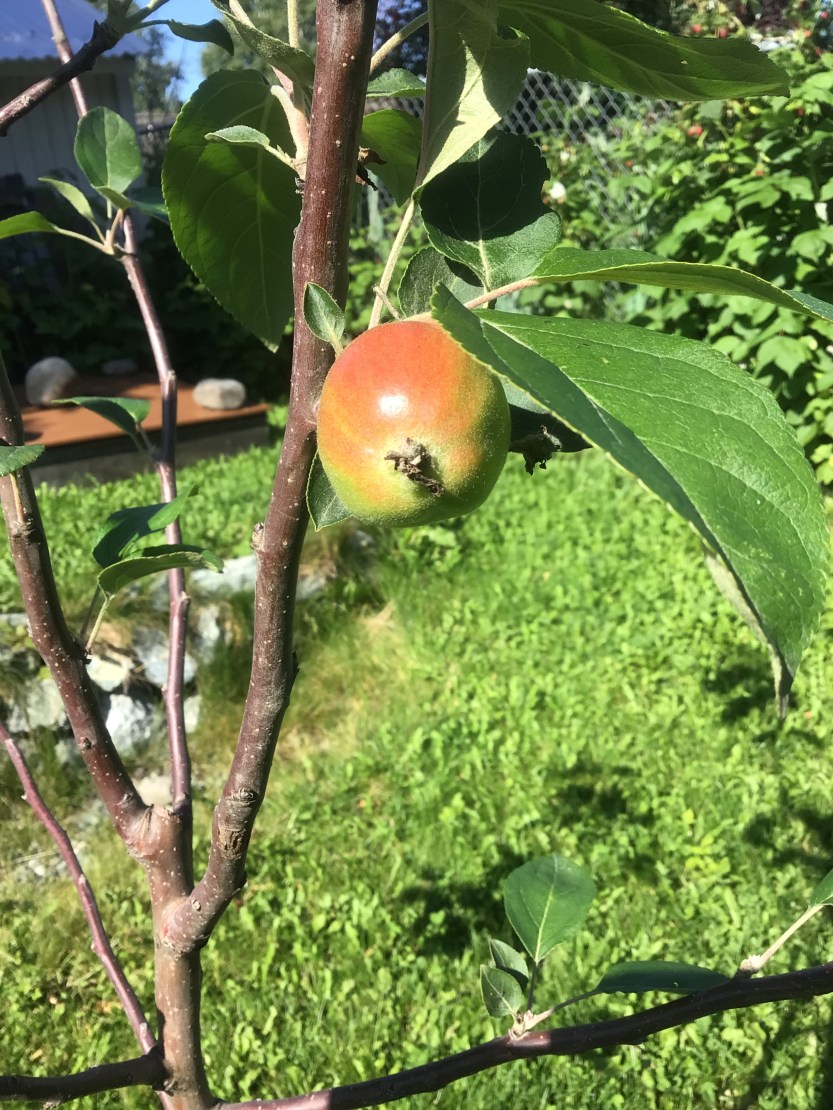
Apples, whose seeds form the pentagram, feature prominently in many Mabon feasts, coinciding as it does with the apple harvest. The Norland apple trees planted this May at our covenstead have only begun to flower and bear fruit, but other very traditional American foods for the Sabbat that are also regularly imported to the Far North include corn (our only local grain industry is barley, and that industry is quite young), and beans (I have successfully grown fava at the covenstead, but not in any quantity). Roast pork is also particularly appropriate for the Sabbat feast, as Mabon in Brythonic literature was not only said to be rescued by Arthur, the legendary king of the Britons, but he was also said to have become a valued member of Arthur’s warband and its greatest hunter, driving a wild boar out of Ireland and into the sea off the coast of Cornwall. This myth from the Mabinogion is reminiscent of the popular myth of the 5th century Briton, the Christian St. Patrick, driving snakes out of Ireland, especially when we consider that the Mabinogion was composed sometime at the end of the Viking Age, and states that the boar had once been human, but had been magically transformed by the Christian God for his sins. So no, it is not a pagan myth, but then neither is the mythology of Rosh Hoshanah. However, there is a heathen myth preserved in the Eddas that fits in very well here, one that involves not only a boar sacrifice, but an ardent worshipper of the Goddess Freya.
In Hyndluljoth, a man named Ottar, who is repeatedly called “foolish” or “simple” by the wise-woman Hyndla or “She-Dog”, cannot, without the magical aid of the Goddess, know and recite his ancestry. This is a problem for Ottar who is in a wager with another man by the name of Angantyr. Fortunately for Ottar, he is beloved of Freya, and so she commands the wise-woman Hyndla to teach him not only his quite impressive divine ancestry, but to brew him a “memory-beer” so that he may remember it. Interpretations of the poem differ, and it is unclear if the Goddess’ intervention occurs after Ottar has been magically transferred into the spirit of a boar he has sacrificed to the Goddess, or if the Goddess has simply magically disguised him as her own boar with whom she travels to where her beloved dead are received. Either way, Ottar does not appear to remain in this heathen Otherworld for long, but returns to his mortal life to win the wager. Keeping in mind that this latter Eddaic poem was composed at around the same time as the Llyfr Coch Hergest, it is worth noting that Ottar was also the name of multiple famous Irish Vikings.
Another notable aspect of this poem is that the God Heimdall is alluded to, not by his own name, but by the names of his nine mothers. This is likely a reference to a matrilineal tradition associated with heathens during the medieval period (see Matriarchy Among the Picts by Heinrich Zimmer, 1898, for another example of this idea), and fits well with the poem’s statement that Ottar was a devout Goddess-worshipper.
Once there was born in the bygone days, Of the race of the gods, and great was his might; Nine giant women, at the world’s edge, Once bore the man so mighty in arms. Gjolp there bore him, Greip there bore him, Eistla bore him, and Eyrgjafa, Ulfrun bore him, and Angeyja, Imth and Atla, and Jarnsaxa. Strong was he made with the strength of earth, With the ice-cold sea, and the blood of swine. One there was born, the best of all, And strong was he made with the strength of earth; The proudest is called the kinsman of men Of the rulers all throughout the world.
The last name, Jarnsaxa, means “Iron Knife” in Old Norse, and a Goddess of this Name was/is, according to Snorri, also a lover of Thor, and the mother of their son Magni “Mighty”—just as Sif is the mother of their daughter Thrud “Strength”. As an aside, this observation by Snorri, when the Poetic Edda clearly states that the Goddess Sif is Thor’s wife, seems to have troubled a number of scholars over the years, despite knowing there is no evidence for compulsory monogamy among the heathen cultures of the Viking Age. It would benefit many students of comparative religion to read the chapter “Polygamy” from Matilda Joslyn Gage’s Woman, Church and State (1893). Monogamy has hardly been a universal law in much of Christianity either.
The boar/pig is not only associated with Frey and Freya, it was also in late antiquity the sacrificial animal of the Goddess Demeter, once known as the Law-giver, whose “sacred and venerable shrine of Eleusis where the most far-flung nations of the earth become initiates” (Cicero), was destroyed by Gothonic Christians at the end of the 4th century. Kelly’s interpretation of the Eleusinian Mysteries as being primarily concerned with the saving of a child from death—while certainly poetic and perhaps what the myth of Abraham and Isaac is about—is not however, to my mind, an accurate distillation of the Eleusinian cult, and why it possessed such emotional and political power in the ancient world. While the Mysteries themselves were secret, we all have access, at least in translation, to the Homeric Hymn to Demeter (which was written at the same time as the Torah), and it is nothing like Arthur’s cheerful rescue of a baby thanks to the aid of a talking salmon. It is a grim myth, although frequently romanticized in modernity, involving a girl’s loss of virginity (by rape) and her symbolic death from eating Underworld pomegranate seeds. The catharsis of the myth comes not from Persephone’s “salvation”, but from the role she receives through this experience, becoming, through close identification with her Mother, a Goddess of Fertility—for the Dead.
Persephone/Demeter was also one of the most direct precursors in the pre-Christian Roman Empire to the sorrowful Mary, as according to Orphic variants of the myth Persephone, (Luna according to Cicero), bore Plouton or “Underworld Zeus”, (Jupiter according to Cicero), a Dionysian savior-son. See the myth of Myrrha and Adonis in Ovid’s Metamorphosis for a more obviously Hellenized-Semetic-Roman myth. Adonis was said to have been a mortal lover of the Goddess Aphrodite-Astarte (and the Goddess Persephone) killed by a wild boar at the behest of the Goddess Artemis-Diana. The Orphics, like modern Wiccans, also taught reincarnation (it is not a concept “appropriated” from the Dharmic religions, although it remained commonplace in the East in a way it did not in the West), but the Orphic understanding of the concept was very different than the modern Wiccan idea of rebirth through the agency of the Goddess and the reverencing of sexual love. Reincarnation was also taught by the Greek philosophers Pythagoras, Empedocles, and Plato. The Goddess’ agency in antiquity recalled by the poet Pindar who wrote:
The souls of them from whom Persephone has accepted atonement for an ancient woe, she restoreth the ninth year to the light of the sun above the earth. And from these souls come glorious kings and such as are strong and swift and excel in wisdom; and throughout all future time they are called holy heroes by mankind.
The joyful reunion of a loving mother and daughter in a patrifocal/patrilocal world, where this was often not likely (let alone promised), was, I suspect, where much of the power of the Mysteries resided—along with its mercy and hope for “holy heroes” and for all those forcibly parted from loved ones by marriage and death.
At the Lesser Mysteries of Eleusis, initiates were expected to sacrifice a pig and then ritually purify in a sacred river to be worthy of the Greater Mysteries. The ritual cry of the Hierophant purportedly having been “To the Sea, Initiates!”. Therefore, the Priestess ritually sprinkling a coven of Saxon Pagans with the altar’s salted water at the Autumn Sabbat is a sympathetic reminder of the Goddess’ consecrating powers of birth and rebirth, and a religiously appropriate precursor to the Greater Sabbat of Samhain and the final harvest of livestock for the Winter. Formally identified with the Roman Venus since the Middle Ages, Freya also has intriguing historical parallels with the Mother Goddesses of Eleusis.
Buckland’s recipe for Apple Beer for the Wiccan Cakes and Ale Ceremony is published in The Tree. Freya’s “Memory-Beer” perhaps?
 Lincoln Green