“Children develop the capacity for symbolic thought—metaphor— somewhere between the ages of eight and eleven. It’s not beyond a child of that age to understand that no, there isn’t a big Lady in the sky, but that the spirit of life is like a mother to everything.” – Ashleen O’Gaea
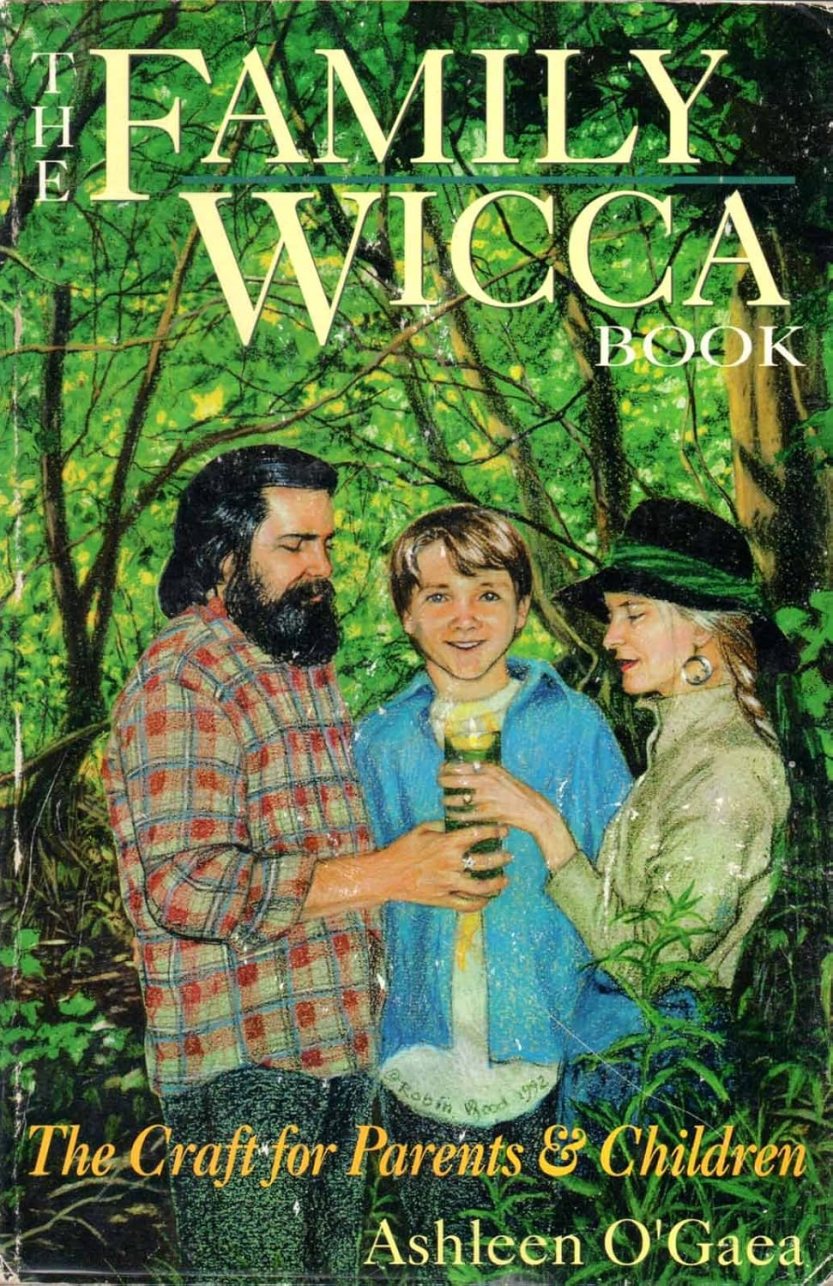
Ashleen O’Gaea’s The Family Wicca Book (1993) is a now over thirty-year-old look at Wiccan culture at the height of its American growth. The book, written by the mother and breadwinner of a single income household in Tucson, Arizona comprised of one son and a stay-at-home dad, shows that the core principles of Wiccan religion in America were once thought to reside quite clearly in The Charge of the Goddess, The Wiccan Rede, and acceptance of Reincarnation. The Family Wicca Book also refers to the Autumn Sabbat as “Mabon” for any of our readers who may have wondered. With another couple, a woman she calls “Faerie Moon”, and her husband “The Norseman”, the small coven of five regularly observed Esbats (they liked to call them “Moons”) under the night sky when possible (barefoot, but quite sensibly robed, especially with the inclusion of a minor—as are ours). I can’t say The Family Wicca Book is particularly representative of our own family, but the book remains historically significant in a religion where so little has been published from the perspectives of the mothers and grandmothers who comprise the vast majority of the religion’s adherents. And while we do not include our children in our Wiccan rituals (and it does sound like it was “forced family fun” for their son), we do observe Yule, Ostara, May Day, Midsummer, Mabon, and, this year, after the death of our closest family friend last September—Samhain with them, in our own way. She was their aunt. She kind of looked like the woman on this book cover. Our Imbolc and Lughnasadh have become more informal over the years, now just a feast. Ostara and Beltane/May Day were more subdued than usual this year (forgot the egg toss at the former and tying ribbons to the tree at the latter), but while we were gazing at the green flames of our Ostara fire and sipping cider this year, the kids asked me to do a reading, and even went back inside the house to find the book with Sigrdrifumal so I could read it by the fire. In June, we had a proper household Midsummer. So the Wheel does keep turning. While Ashleen does not capitalize the word “pagan” in The Family Wicca Book (1993), only a couple of years later D.J. Conway (or her publisher) would do so in Falcon Feather & Valkyrie Sword (1995), the essential follow-up and companion to Norse Magic (1990). Some who are familiar with both Buckland’s and Conway’s books will have noticed that her Autumn Equinox ritual in Norse Magic is nearly word-for-word the Autumn Sabbat of The Tree (1974), and Buckland’s description of Freya in his Seax Wican song “At a Maypole Down in Kent”, gives the Goddess “locks of jet”. An important reminder to not judge a book by its cover. Conway in Norse Magic and Falcon Feather & Valkyrie Sword interpreted the figure of Gullveig, the thrice-burned Vanir witch of the Aesir-Vanir war in the Voluspa, as a form of Freya/Freyja as the ancient Bronze Age Sun Goddess, (“sun” being a female word in the Old English and Old Norse languages), an interpretation also taught by Norwegian scholar Maria Kvilhaug twenty years later, (which was actually my first exposure to this idea, when my husband introduced me to her YouTube channel Ladyofthe Labyrinth when we were first becoming friends fifteen years ago). Parenthood has been quite the adventure, and Nietzsche knew more about women than he knew when he wrote that, “it is not a lack of love, but a lack of friendship that makes unhappy marriages”. While there was little “new” material for our coven in this particular book, as I said, Ashleen’s idea of a Wiccan “advent” calendar that runs from Mabon to Samhain is an interesting idea.
 Lincoln Green