“Bitterness, hatred and resentment between the sexes is as old as history, but witchcraft is the only religion which has as its avowed aim the healing of these wounds.” – Rae Beth
“The two weeks before and after both equinoxes are often times of stress and great tension.” – Rae Beth
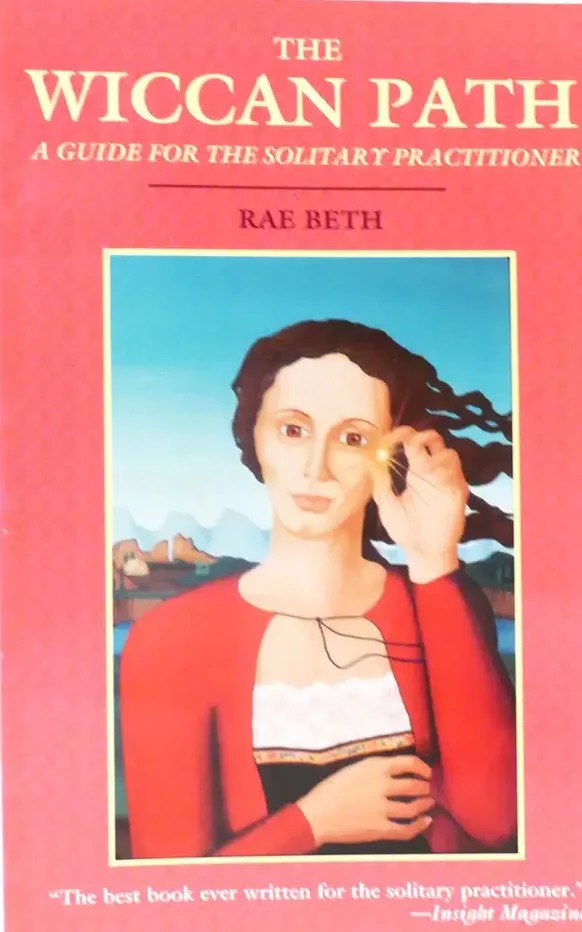
First published in the United States of America in 1995, The Wiccan Path: A Guide for the Solitary Practitioner is a truly enjoyable introduction to the religion of Witchcraft. Written in an informal, conversational style as a series of letters from one Wiccan priestess to two solitary prospective Witches: one woman and one man…the latter of whom also happens to be engaged to a woman who may or may not herself be interested in Witchcraft…over the course of a year and a half…at least for the woman. The book covers the general theology of the Wiccan Goddess and Wiccan God, the significance of the Full Moon Esbats, the Wheel of the Year, the traditional Four Elements of natural Magic, the doctrine of Reincarnation, and the nature of Initiation, in a non-dogmatic way that conveys why this non-proselytizing religion is a source of joy and strength to its adherents. While Rae Beth’s (who passed into the Summerlands last December) magical style is of a more ceremonial bent than Raymond Buckland’s, she does a very good job of bringing Wicca’s unique philosophical duotheism (that is similar to Taoism and very dissimilar to Zoroastrianism) to the fore, making it a good companion read to D.J. Conway’s Norse Magic (1990), which (while very helpful as a guide to mythology, correspondences, and ritualism) in incorporating a larger historical pantheon, somewhat loses focus at times regarding what makes the Witch Goddess and the Witch God, well, the Witch Goddess and the Witch God. Culturally speaking, Rae Beth’s names for the Sabbats are only very slightly different from our own, as she prefers “Imbolg” to “Imbolc”, “Eostar” to “Ostara”, and “Litha” to “Midsummer”. Rae Beth also does a very good job of explaining clearly and frankly the relationship of human sexuality to the Wiccan religion from a heterosexual woman’s viewpoint (the author having had a husband who was, in some of her rites at least, a willing magical partner). And while one may have dearly wished the words “Wiccan” and “Witchcraft” were capitalized throughout the text rather than the word “Pagan”, and while my own door is not open (except on Halloween), Rae Beth’s honesty, frankness, and gift for poetry, make this book my new go-to recommendation for the absolute beginner interested in practicing the Wiccan religion.
 Lincoln Green