One of the things that makes the Saxon tradition of Witchcraft, or Wicca, unique from other traditions is its Myth. The Myth of the Goddess of Saxon Witchcraft is inspired by The Myth of the Goddess as recounted in Chapter III of Witchcraft Today by Gerald Gardner “The Witch Beliefs” (1954), and Chapter Nine “Frey and Freya” in Brian Branston’s The Lost Gods of England (1957):
The Old English must have known myths similar to the one recounted of Frey and Gerda : all the ingredients are there if we link together Ing’s disappearance (the Runic Poem), the marriage of Earth and Sky (Charms) and the name Frea applied (in the Dream of the Rood) to the god who assimilated and displaced Frey and all the others, namely, Christ. They must have known, too, of Frey’s sister Freya although her name is missing from extant remains. We can be sure of their knowledge of Freya from a reference in Beowulf to one of her famous possessions, her necklace or torque called Brisingamen after the Brisings, the dwarfs who made it. At least, that is its name in the Eddas; in Beowulf it is ‘Brosingamen’. (Branston, p. 143.)
The Myth of the Goddess recounted in The Tree (1974), is a seasonal myth of death and rebirth recounting the theft of the Goddess’ “Silver Circlet” named “Brosingamene”, by the “Mischief-Maker of the Gods” Loki, and the battle that ensues with Hearhden “the Mighty Smith of the Gods” for its return to the Goddess and the return of all Life. Both Life to the souls in Drëun who are reborn through the Goddess, and the return of Life to the land at the Springtime flowering of vegetation (or the snow-melt that just precedes it in the North), as the Priestess is crowned at Beltane.
Besides the Goddess-emphasis in the Myth, the two Gods featured (Hearhden and Loki) are Gods specific to the concept of Witchcraft as a religion, one being a Smith God (and thereby patron of the ritual Seax and Sword of the Witch), and the other a Trickster God, whose Mercurial nature (similar to Woden) introduces the Death that is also necessary for the Wheel of the Year to turn.
The magical act of Naming itself is an important part of Witchcraft, particularly in the concept of Initiation. In the Initiation ritual of the Seax Wica, all Ceorls or “Freemen” leave aside the name by which they are known outside the coven, and are given a new name as they become a Gesith or “Companion”, taking the new name with which they will be known within the Circle among their Brothers and Sisters. These are the Names with which they are consecrated at coven meetings by the sacred Pentagram, the five-pointed star formed by the seeds found within the apple (the fruit of the “silver bough”, see The Silver Bough by F. Marian McNeill, 1956) sacred to the Goddess. The Pentagram represents many things in magical tradition, from the five senses (touch, hearing, sight, smell, and taste) to Man and Woman themselves (the Star representing a human body with arms and legs outstretched). But by far the most common symbolism for the Pentagram among Wiccans are the five elements of natural magic. These elements, derived from classical paganism, are Earth (in Seax tradition the Cakes and Salt, the latter also representative of the Life-force of the God); Air (the Incense which carries a Witch’s prayers, typically through magical chanting, known in Seax Craft as “Galdra” up to the Gods); Fire (the illumination provided by the Altar Candle, as Wiccans typically worship the Gods under the Moon at night); Water (the material basis of all Life, and placed on the Altar both as Itself, and – through the magic of brewing – as the Ale, or honey wine, ect., that is shared along with the Cakes during the Cakes and Ale Ceremony); and finally Spirit (the individual, immortal soul of each Witch that will be reborn through the Love of the God, and the Agencies of the Goddess). As a symbol of consecration to the Craft under one’s Witch Name, the Pentagram is a symbol of the Wiccan religion itself. The other symbol specific to the Seax Wica being that of the eight-spoked “Wheel of the Year” superimposed upon an image of the Sun and Moon conjoined.
In a footnote of The Myth of the Goddess, regarding the name Hearhden, unique to the Seax Wica, Buckland states that this God is to be understood as another face of the God Heimdall of whom Branston wrote:
…mention of Brisingamen presupposes its wearer in the background, Freya, ‘most lovely of the goddesses’, while Hama is none other than the Norse Heimdall ‘whitest of the gods’ who ‘lives at Heaven’s Edge close by Bifrost Bridge where he stands sentinel at the end of heaven watching out for the assault of the Hill Giants on the bridge…The story of Hama’s restoration of Brisingamen to Asgard has been almost forgotten even in the Norse sources, though it is limned in a poem called Husdrapa. If we piece the allusions there together, some such tale as the following appears: the Mischief Maker of the gods, stole Brisingamen from Freya, a loss which is mythically equivalent to the death of her lover. The necklace was left on a skerry or rock in the sea where it was discovered by the god Heimdall who swam out to it in the form of a seal, retrieved the necklace after a fight with Loki and carried it back to Asgard to restore to its owner Freya. In this story, the necklace, like the lover, originally represented the spirit of vegetation. It is a theme repeated with other variations in Norse (and no doubt Anglo-Saxon) myth, as for example, when Idunn lost her golden apples and Sif lost her golden tresses. In each case the goddess is the Earth Mother under another name and the apples and hair are emblems of fertility or vegetation. (Branston, p. 145)
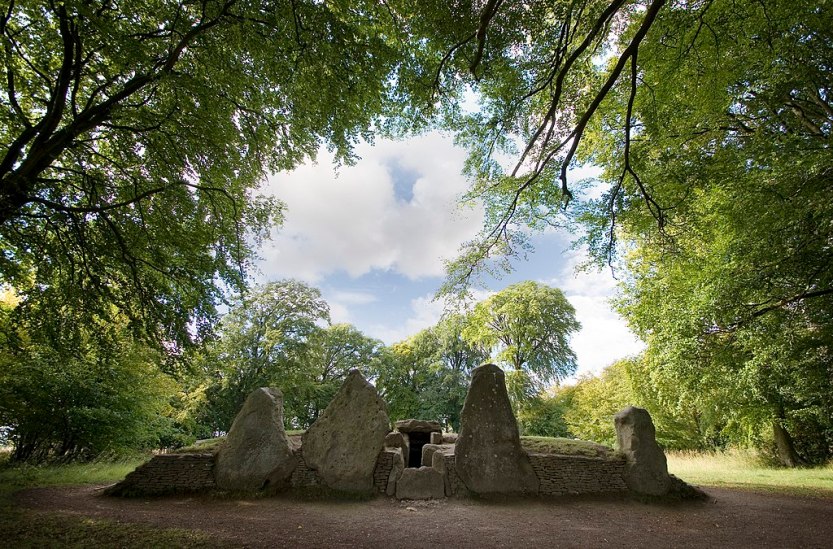
Buckland’s identification of Hearhden as a Smith God, yet one who wields a club he compares to the Migration Era “Hercules’ Clubs” of the Germanic tribes, magically links Hearhden not only to the pre-Saxon history of Britain through the Neolithic Barrow known as “Wayland’s Smithy” near the village of Ashbury in Oxfordshire, England, but to the “aboriginal Great Mother” of the Germanic tribes in continental Europe (Hercules’ Clubs being found in female graves across the Roman Empire, including Roman Britain). Freya is therefore, in the Myth of The Tree the Seax Wica equivalent of Gerald Gardner’s witch-goddess whose name was taboo, (see James Frazer’s The Golden Bough, 1922 about the taboo of revealing the names of the Gods, a taboo that does not exist in the Seax tradition), and her Myth is equated to Gardner’s Myth of the Goddess, and thereby to the Goddess Ishtar of ancient Mesopotamia, and the Dawn of Western Civilization.
Magical metallurgy, whether of swords and knives or jewelry such as the silver or copper torques and circlets that may be worn by Seax Wiccans, and the magical consecration of these sacred objects used in ritual, is a tradition that hearkens to the prehistoric civilizations of all peoples, and is attested to in the earliest Old English literature. In Beowulf, the first epic poem in the Old English language committed to manuscript sometime between 975-1025 C.E., Unferth, Hrothgar’s greatest warrior, bestows upon the hero Beowulf his sword, named Hrunting. In this Old English poem we also receive the name of the Goddess’ magical necklace, Brosingamen, an allusion to the Great Mother, even if she was no longer worshipped by Name.
The primary method of working magic in Witchcraft is through the raising and releasing of energy, and in the coven setting this is primarily done through group singing or chanting, often while dancing in a linked circle until the time the coven leader/s indicate that the energy raised is to be released toward its intended subject. As a religion, the vast majority of magical work done in this way by Wiccans is aimed at healing the sick. As singing and chanting plays such an important role in magic, so too does the idea of the Smith as a Magician. Beyond the various legends of Wayland the Smith, the Greek Haephaestos and Roman Vulcan, we have a 14th century Icelandic manuscript telling the tale of how Freya was a lover of the “King Odin” in “Asialand”, and how she spent four nights with four Dwarves, one night with each (Dwarves being renowned in the ancient myths for their skill as blacksmiths and metalworkers), to receive her beautiful necklace. The British folk song “The Two Magicians” about the magical power of an unnamed Blacksmith who desires the virginity of an equally magically talented unnamed Lady (“Freya” is properly a title rather than a name, simply meaning “Lady”), was popular with many during the 20th century Witchcraft revival for its playful back and forth of sexual innuendos linked to the cycles of death and rebirth (i.e. symbolic “virginity”) combined with a magical battle between evenly-matched shape-shifters, another form of magic with which the Goddess is especially associated, having a cloak of feathers which Loki was also said to have “borrowed” to shape-shift into a falcon.
...

So she became a rose, a rose all in the wood
But he became a bumble bee and kissed her where she stood

Hello, hello, hello, hello you coal blacksmith
You have done me no harm
Though you never shall have my maidenhead
That I have kept so long, I'd rather die a maid

Ah, but then she said, and be buried all in me grave
Then to have such a nasty, husky, dusky, fusky, musky coal blacksmith
A maiden I will die

...

She became a corpse, a corpse all in the ground
And he became the cold clay and smothered her all around

Hello, hello, hello, hello you coal blacksmith
You have done me no harm
Though you never shall have my maidenhead
That I have kept so long, I'd rather die a maid

Ah, but then she said, and be buried all in me grave
Then to have such a nasty, husky, dusky, fusky, musky coal blacksmith
A maiden I will die

-from "The Two Magicians" recorded by Mat Williams on Full English: A Collection of Traditional British Folksongs


Congratulations!
It really is an enormous happiness to have this type of text in the tradition. They enrich our understanding and relationship with the gods and other gesithas.
LikeLike
Thank you!
LikeLike
You were quoted in Jason Mankey’s biography of Raymond Buckland! Worth the price of the book. Congratulations!
LikeLike