“Love to all things on the earth; every life that springs from birth: honour still in deed and truth. To our Silver Queen of Youth.” – from “Diana” by Victor B. Neuburg, Pine Cone, April 1924.
The first coven in the Seax tradition of Witchcraft was established in New Hampshire, and held its meetings in an ell barn attached to Raymond Buckland’s home. In this first coven, the Thegn was the coven officer (in Saxon England a thegn was a title denoting a man who was a retainer of a king), whose role it was to mark out the nine foot diameter Circle with a Spear. As Buckland wrote in The Tree (1974): “This marking may be done before, after, or during the placing of the tools on the Altar. It is, therefore, simply a (physical) designating of the meeting area.”
Most Seax Witches are Solitary Gesiths or “Companions” who have Self-Dedicated to Woden and Freya. For Seax Witches who practice in Covens, our situations are generally nothing like Buckland’s was. For one thing, skyclad covens tend not to have dirt floors on which to mark out the Circle. Instead, for most Covens, the Circle is optimally made by a nine foot round rug. For another thing, Witchcraft is no longer popular the way it was in 1973, and even if it were, the rest of us are not a famous High Priest who also happened to be an insider to 1960s Gardnerian Witchcraft. As the perceived “king” of Saxon Witchcraft in New England, Buckland was perhaps in need of a Thegn in a way most contemporary Seax covens are not.
In Wicca for Life (2001), Buckland noted that for a family-based coven, the first initiations are likely to be conducted by the coven’s Priestess. As Buckland also noted, “It is usual, but not mandatory, for a woman to initiate a man and a man to initiate a woman.” And like the initiation ceremony itself, it is really that simple. Here then is the Initiation Rite of the Seax Wica, as performed by our Coven, with the Priestess officiating. The Priestess wears a silver Moon circlet and silver neck torque while conducting the Initiation of a Ceorl or “Free Man” to a Gesith or “Companion”. Not only does the Full Moon Esbat in The Tree explicitly identify the Mother Goddess of the Seax Wica as a pantheistic deity associated with Diana, Isis, Cerridwen, ect. the Rite of Self-Dedication the founding Priestess of a Coven performs (soon followed by the Consecration of the Coven Sword), contains an obvious allusion to Doreen Valiente’s The Charge of the Goddess, which went from relative secrecy to wide-spread (uncredited) publication in 1971. Buckland dedicated the 1995 edition of Witchcraft From the Inside to his wife, and to Doreen Valiente: “for all her work in establishing the Wica we know today”.
Frey or “Lord” (spelled “Frea” in Anglo-Saxon) Brother of Freya or “Lady”, is the name of the Saxon Witch God in our Coven. As The Tree does not contain a section on Frey as the Horned God of the Seax Wica, we recommend looking first to Buckland’s sources for understanding the God in a Wiccan context. These books include The Lost Gods of England by Brian Branston (1957), The Meaning of Witchcraft by Gerald Gardner (1959), and Witches by T.C. Lethbridge (1962). Particularly note-worthy in Witches is Lethbridge’s discussion of horse sacrifice, and the legendary Germanic conquerors Hengist “stallion” and Horsa “mare”, as religious concepts rather than historical personages. And finally, no study of Frey is complete without the 13th century Old Norse poem (and possible ritual drama) Skirnismal. Whatever the Havamal may be to Woden, the Skirnismal is to the Lord.
For the Seax Wica conception of Freya beyond The Tree, The Lost Gods of England, and The Meaning of Witchcraft — Buckland’s primary sources included The White Goddess by Robert Graves (1948) and The Silver Bough by F. Marian McNeill (1956).
(The Erecting the Temple is performed in the usual manner. The Ceorl stands outside the Circle awaiting his summons.)
Priest: “Now is the Temple erected. Let none leave it but with good reason.”
All: “So be it!”
Priest: “…(Name)…now stands without the Circle, prepared to enter this our Temple.”
Priestess: “Then let him be brought before us.”
(Ceorl walks into the Circle and moves to stand between the Priest and Priestess.)
Priestess: “I am she who speaks for Freya. What is thy name?”
Ceorl: “I am known as…(Name)…”
Priestess: “No more shall this be so.”
(Priestess then takes the salted Water from the Altar and, dipping in her fingers, anoints the Ceorl on the forehead, chest, and just above genitals, saying:)
Priestess: “In the names of Frey and of Freya, may this sacred water cleanse you. Let it drive out all impurities; all sadness and all hate.”
(Priestess replaces Water on the Altar, then kisses Ceorl fully on the lips.)
Priestess: “In the names of Frey and of Freya may you be filled with the Love that should be borne by and for all things.”
(Ceorl kneels and Priestess places her hands on his shoulders.)
Priestess: “Now do I give you a new name. To your Brothers and Sisters of the Craft shall you be known henceforth as…(Name)… You shall meet with us here in this Circle, or some other like spot, to worship Frey and Freya, and to learn and to love in their sight.”
Ceorl: “So be it!”
(Priestess kneels facing him and takes his hands in hers.)
Priestess: “What are the names of the Gods?”
Ceorl: “We know them as Frey and Freya.”
Priestess: “Are these the Gods you wish to worship above all others?”
Ceorl: “They are.”
Priestess: “Do you promise faithfully to attend the Rites held in their honor, so far as you are able?”
Ceorl: “I do.”
Priestess: “Do you promise to defend them from those who would speak them ill?”
Ceorl: “I do.”
Priestess: “Do you promise to love and honor thy Brothers and Sisters of the Craft; to aid them when in distress; to care for them when sick; to protect and defend them from their enemies, so far as you are able?”
Ceorl: “I do.”
Priestess: “Know, then, that in all these things are we equal. In all things do we seek for the good of us all. Love is the Law, and Love is the Bond.”
Ceorl: “Love is the Law, and Love is the Bond.”
(Both rise and kiss.)
Priestess: “Now must you meet your kindred.”
(Priestess leads Ceorl around the Circle and introduces him, by his new name, to each Witch. Each one kisses him in greeting. Priest is last to greet him. Priestess then takes the Drinking-Horn and slowly pours out the wine into the Libation Dish.)
Priestess: “As this wine drains from the Horn, so may the blood drain from your body should you ever do aught to harm the Gods, or those in kinship with their love. Frey and Freya! So be it!”
Ceorl: “So be it!”
(Priestess replaces Horn on the Altar.)
Priestess: “Now are you a Gesith, and fully one of us.”
(Priest gives him a robe and cord. Priestess gives him a Seax. Others may give a silver ring engraved with his Craft Name in the Seax Wica runes, a copper neck torque, or a drinking-horn, if they so desire.)
Priest/Scribe: “As now a member of this Coven must I ask you to place your name within The Tree.”
(Gesith signs his Craft Name in the back of the book. Priest reads The Myth of the Goddess. Then shall follow the Ceremony of the Cakes and Ale, leading to general celebrations, before the Clearing of the Temple.)
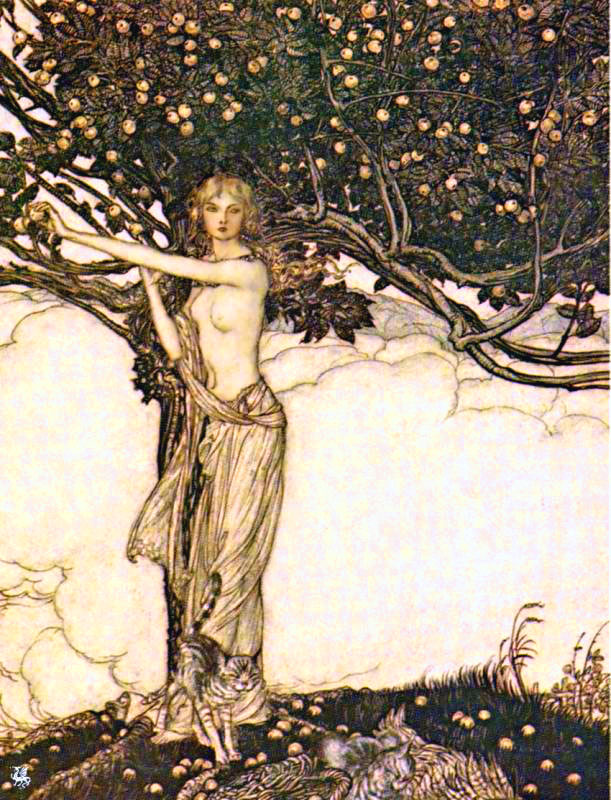
(Image of Freia with her cats and apple tree illustrated by Arthur Rackham, 1910.)


Merry Meet! I was thrilled to see another Seax-Wica blog!
I’ve been tempted, on and off, to use the name ‘Frey’ in place of Woden, but I always stick with Woden. Something about his presence just resonates well with me.
I do love the twist that Frey provides on the typical ‘Horned-God’ archetype of Wicca: Instead of having horns himself, he carries an antler that he uses as a sword.
Blessed Be!
LikeLike
Hello! We have stayed with the Horned God imagery in our Wiccan interpretation of Frey as that iconography is far older than any known names for any Gods. So the idol of Frey in our coven that the Priest sculpted depicts him with an antlered helmet, and still holding a sword. So more Bronze Age than Ragnarok. 🙂
LikeLiked by 1 person
It’s the same here, although honestly how I actually perceive Him varies depending the situation or mood. Sometimes I see the Antlered Hunter very clearly when I need to feel empowered, but other times I see him much more Gandalf-like (but with a great spear) when I’m feeling contemplative. The goddess is the same: sometimes I see Frigg, the wise mother, and other times I see Freya, the rambunctious maiden.
LikeLike
I see Woden as very Gandalf-like also. I have strong feelings about the Frigg/Freya division that will make their way into their own dedicated post here at some point, but thank you for your great comments!
LikeLiked by 1 person
Gandalf was very much meant to be a Woden stand-in, so I suppose it’s more accurate to say Gandalf is very Woden-like, but like you said, that could be an entire post of its own. I also have strong feelings about the Frigg/Freya division, so I’m looking forward to your post!
LikeLiked by 1 person