Gealdor, the Old English word standardized as “Galdra” by Raymond Buckland in The Tree (1974) is the Saxon (i.e. Germanic) conception of Magick. Contrary to popular belief these days, Buckland’s use of the spelling “magick” was not a reference to Aleister Crowley, as Witchcraft (particularly as taught by Buckland) is pretty far removed from what Crowley taught.
Buckland did appreciate Crowley’s extremely broad and inclusive definition of magic however, (and very kindly said so) which has, unfortunately, led more than a few individuals better suited to Witchcraft to get lost in the weeds of reading far more of Aleister Crowley and his solipsism than is really useful to anybody.
In reality, Buckland used the spelling for the same reasons Crowley claimed to: because it was old, and because it was a way of distinguishing the idea of magic as early science from magic as a performing art, (keeping in mind that Witch rituals are traditionally private). A book such as the English translation of Giovanni Batista Della Porta’s Natural Magick, for example, was published in 1658, only five years after Buckland’s main source text for astrological herbalism, Nicholas Culpeper’s Complete Herbal.
Hardly the exclusive cultural property of modern Norwegians and Germans through bands like Wardruna (formed 2003) and Faun (formed 1998), Galdra or “Chant” as it would come to eventually be known in English after the Norman invasion of 1066, was -the- central element (usually in conjunction with the circle dance) of 20th century British and American Witch magic.
In 1971, The Witches’ Chant, also known as The Witches’ Rune—“rune” in this sense meaning “mystery”—(as referenced in the title of Dave and Toni Arthur’s 1970 folk album Hearken to the Witches’ Rune), was published in the United States by Carl Llewellyn Weschcke in The Book of Shadows. Originally written by Doreen Valiente and Gerald Gardner some time between Valiente’s initiation into the Bricket Wood coven in 1953 and her leaving of the coven in 1957, it, like The Charge of the Goddess has proven to be core liturgical material for religious Witchcraft in an operative magical sense (much as The Charge of the Goddess is in a theological sense).
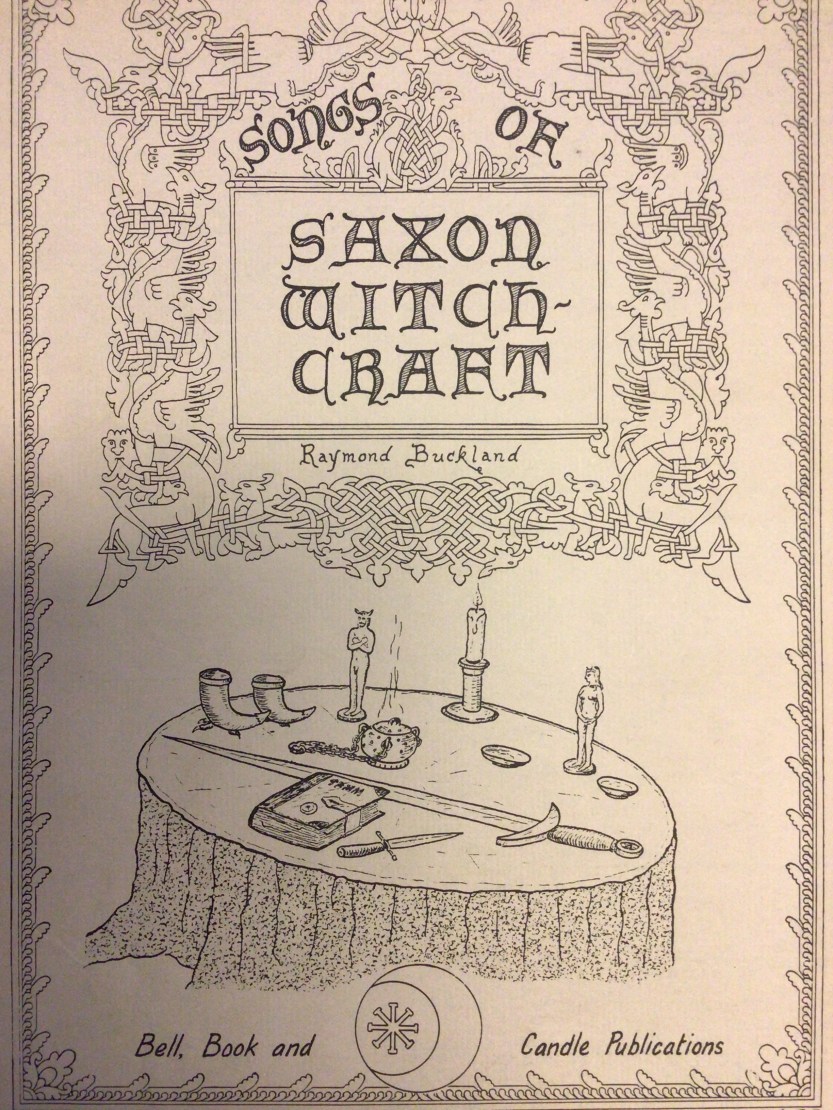
Given in what common, unattributed, use versions of this chant had been for the previous decade, in 1981 when Weiser republished The Tree featuring the beautiful cover art by Alden Cole of a skyclad woman and a skyclad man, Buckland also self-published a second book under his own “Bell, Book and Candle Publications” imprint entitled Songs of Saxon Witchcraft.
While the traditional English and Scottish tunes, as well as the original songs written by Buckland and a few of his friends, are certainly interesting (and some would reappear in Buckland’s Complete Book of Witchcraft, 1986) perhaps the most important contribution he made in this small booklet was a version of The Witches’ Chant for Seax covens to use in power-raising. Here, then, is The Witches’ Chant as adapted by Buckland for Saxon Witchcraft:
Ye dark of night, with shining Moon, Bright of star that shines from North; Hearken to this Witch’s tune — a chant to draw the magick forth. By all the powers of sea and land, By all the might of mind and will, As I command so make it stand. I chant this spell, mine to fulfill. Smoke of censer, blade of knife, Powers in the Witch’s blade; Waken all ye into life. Come ye as the charm is made. Work the magick, work it well, Lord and Lady of the night. Send your aid unto this spell; Work my will this magick rite. By chanting rhyme, by singing song, By all the light of Moon, of Sun; Chanting, dancing, loud and long. As I do say…so be it done!
(Cover art for Songs of Saxon Witchcraft by Raymond Buckland. A photograph of the actual first Seax Wican Altar in New Hampshire, made from a slice of an oak tree by members of the coven, is included in Dan and Pauline Campanelli’s Circles, Groves & Sanctuaries: Sacred Spaces of Today’s Pagans, 1992.)

