“Settle-down, Victory-Women, sink to Earth, never be Wild and fly to the Woods.” – from an Anglo-Saxon magical charm to stop honey bees from swarming
Wicca, or the religion of Witchcraft, derives from Anglo-Saxon paganism. That the first and second languages of a huge portion of planet Earth is English causes many practices called witchcraft to be confused with what is a polytheistic religion originating in Freya-worship. I name Freya here quite intentionally (although the Great Goddess of Witchcraft has many other possible names) as pre-Christian Anglo-Saxon religion was polytheistic (i.e. allowed for the possibility of many Gods known and unknown), and the conversion of the early Anglo-Saxons to Christianity subordinated all other pagan Gods, let alone Goddesses, (past and future) to the English monarchy under Christ-Jesus. The God Woden specifically was to be glossed as a legendary ancestor of the English aristocracy. It is important to remember that Ireland, Wales, and the majority of mainland Europe south of Scandinavia were already under Christian kingdoms at this time. Freya’s necklace is referenced in Beowulf.
Wiccecraeft, or Witchcraft, was in pagan Anglo-Saxon culture a female-dominated profession. We know this due to the gendered nature of the Anglo-Saxon language, and female grave goods in pagan Scandinavia. So female-dominated was ancient Wiccecraeft that the manuscript reference to “wiccraeft” which drops the feminine “e” (keeping in mind the importance of clear hand-writing in the selection of a scribe, along with the fact that there was no standardized spelling in the medieval period), is tentatively interpreted as really intending to mean “wicgcraeft” or “skill with horses” (a male-dominated profession at this time), to account for the irregularity. The word for a “horse” in Anglo-Saxon is the word “wicg”. The etymology here is particularly funny as the word “wicga” (apparently a male noun as opposed to the more gender-neutral “horse”) means “insect” or “beetle”. Well-read Wiccans will get the joke.
As for grave goods, the key way of distinguishing a pagan woman’s Anglo-Saxon grave from a Christian woman’s Anglo-Saxon grave is the jewelry. Pagan Anglo-Saxon graves are in keeping with the graves of pagan women in Scandinavia as they feature colorful glass beads, amber, seashells, and rock crystal. For metals, silver pre-dominates. With Christianity came wealth, and an even wider trade network only equalled in distance by the pagan vikings. As the last outlaws of heathendom, the sacred symbol of these men was notably not a symbol associated with Odin—but a symbol associated with Thor, the friend of the common man—and as evidenced by female grave goods of an earlier pagan period in Europe—the “Hercules”, and friend, of the common woman as well. For the pagan Scandinavian, for a man to practice the woman’s magic of Freyja (whatever it actually entailed—which is lost to history, but appears to have been a form of prophecy) was considered “ergi” or “unmanly”. Among the Gods, only Odin was ever considered to have practiced it. The Christian women’s graves of early England include garnets, cowrie shells, and far more gold. For the Christian, there could be no cremation before internment. For the pagan, there was no such standardization of practice, and the internment of ashes was also a common method for the disposal of a pagan body.
That Wiccecraeft was so strongly female-associated (as was the cultural parallel of seidr in Scandinavia) we know from the gendered nature of the Anglo-Saxon language. The existence of a wicce or “witch” in Anglo-Saxon implies the existence of a wicca or male equivalent, just as the existence of Frea or “Lord” in the Anglo-Saxon poem The Dream of the Rood implies the existence of a “Lady”, or Freyja, as she is known in Old Norse. Effectively, for the early Anglo-Saxon Christian, this Lady was Marian (i.e. Mary). In Jewish tradition she is Miriam, the sister of Moses. Thanks to Gerald Gardner, and his proclamation of the existence of “the Wica”, we now have a term for the pagan Anglo-Saxon equivalent of a “male wizard, magician, soothsayer, astrologer”, and a less easily misunderstood term for the religion of Witchcraft, which is, as it was in pagan Anglo-Saxon days, still far more associated with women than with men.
(Please see The Daughter of the Runes by archeologist Lindsay Badenoch for an accurate illustration of Wiccecraeft. “Victory-Woman” is a poetic term for the honey bee.)
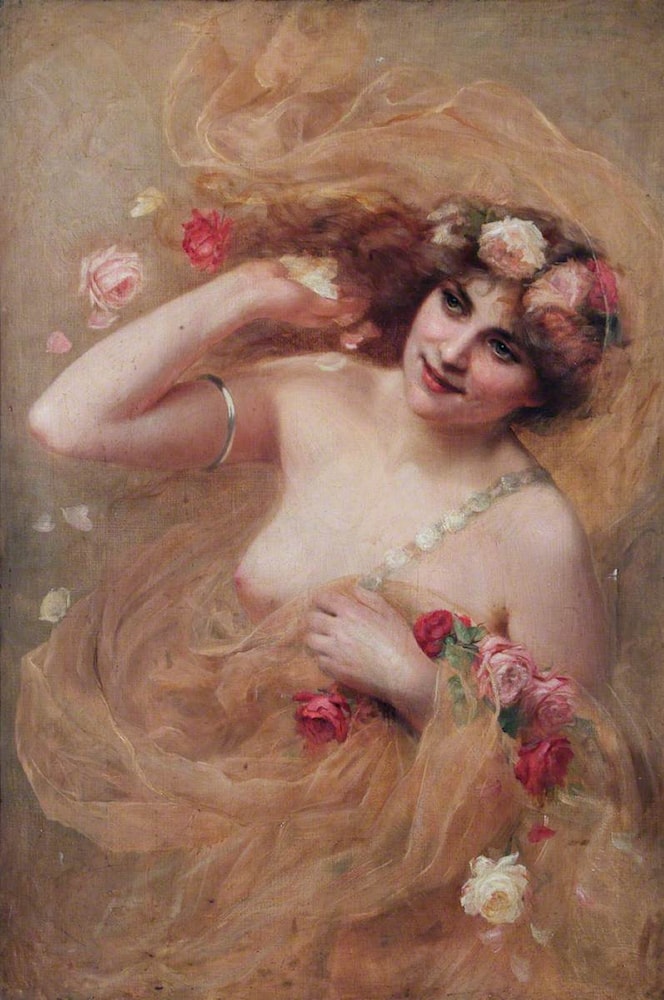
Illustration: Nude with Roses by Beatrice Offor

