“Elf lord’s ring is on my hand, to help with magic from the land. Sometimes I talk with lord and lady in the fern brake, deep and shady—secretly. Is there magic? For me ‘tis so. For when the sun is sinking low, I feel Earth’s power within my heart and know that I shall never part from the lord and lady.” – from “Elves” by D.J. Conway, Celtic Magic, 1991
Happy Women’s Equality Day to our Readers!
A good example of the relative meaning of words in relation to the modern religion of Witchcraft, or Wicca, appears in the extremely popular television series Vikings. While the show, which ran from 2013 to 2020, is full of much silliness, such as the uber-“Gothic” all-male professional priesthood of Kattegat and Uppsala, and an overemphasis on the idea of a rather large percentage of heathen women having served their communities as “shield maidens”, these artistic interpretations are also not particularly surprising given the large creative license made possible when there is simply so much we do not know about the pagan cultures being portrayed. One of the more interesting aspects of the show that managed to garner it critical praise, even among historians, is how closely based on the historical record it actually is. The show’s use of spoken Old English and Old Norse to demonstrate the linguistic divide between Christians and Pagans during this time period was particularly brilliant. Likewise, the character Lagertha is depicted as a historically accurate Gythia of Freyr when founding a Stead in England, so not all of the artistic depictions of Pagan religion are based on the aesthetic of a secular horror movie fan set loose in Spirit Halloween. In fact, if anything, the biggest cultural divide between the Christians and Pagans in the show is neither ethics nor aesthetics (the character Floki is depicted unflatteringly as a religious fanatic of a Pagan kind), and therefore ultimately not the actual behaviors of the show’s individual characters—which are both good and bad in turn and in context—but largely as a divide of language. One man’s martyr (a Christian concept) is another man’s sacrifice, which for the Pagan means “to make sacred”. Without corresponding archeological evidence from pre-literate pagan cultures to either confirm or deny the historical record, there is simply much we do not know, and will never know, about ancient paganism.
What the show depicts particularly well however, is the meaning of the word “Wicca”. While among English speakers the pronunciation of the word has largely become standarized as “Wika”, I am old enough to remember the bulletin board arguments of the early internet in favor of the pronunciation “Wicha”, as it sounds far more akin to the modern word “Witch”, just as “Northman” sounds akin to “Norseman”, which is all, ultimately, that this word actually means. Personally, I still wish this pronunciation had taken off, and perhaps in the ensuing decades, with the popularity of Vikings amongst English speakers globally, it will. The truth is, we do not know to what degree the Angles, Saxons and Jutes in England, Pagan or Christian, were even mutually intelligible to one another, let alone how many individuals were bilingual enough to effectively communicate with the Pagan “Northmen”.
In the Season 3 episode “Wanderer”, a Saxon soldier in Wessex is astonished to see a solitary one-armed Northman (the character Torstein) walk fearlessly alone onto a battlefield and exclaims the man to be “wicha”. The English subtitles translate this word as “shaman”. In Christian English law at this time to be identified as a “wicca” (male witch) or a “wicce” (female witch), i.e. to be associated with the old heathen religion, was illegal (Clark-Hall, A Concise Anglo-Saxon Dictionary).
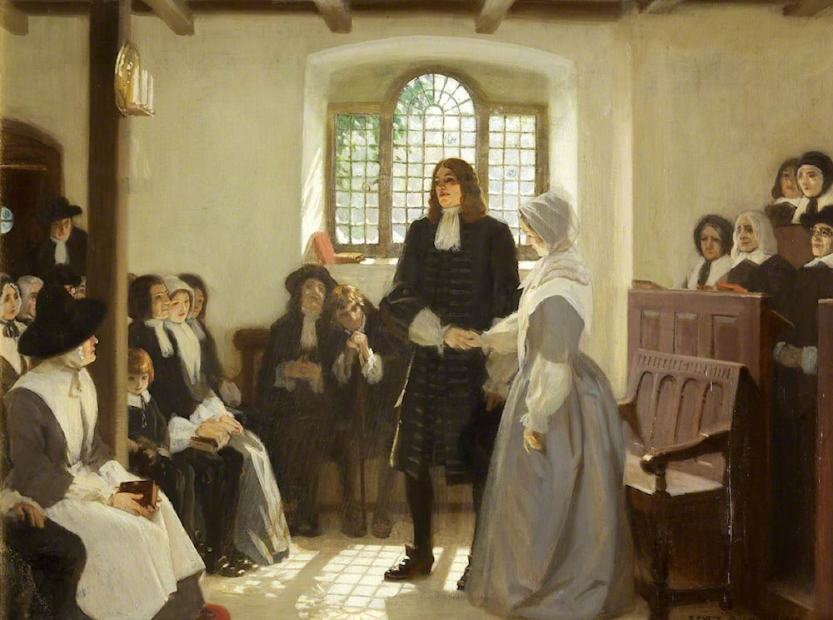
Previously noted on this blog is the etymological origin of the word “Friend” in the Old English words for a Free Man and a Free Woman, and in the historical worship of a God known as “Lord” and a Goddess known as “Lady” rooted in an Indo-European word for “Love”. These concepts are particularly relevant to those of us of colonial Anglo-American ancestry and culture (both Agrafan and Beorccen) as the Puritans (English Protestants) accused the Quakers (also English Protestants), as well as their own community members, of witchcraft. The well-known American novel The Witch of Blackbird Pond by Elizabeth George Speare (1958) was inspired by this history. Intrinsic to the Religious Society of Friends (founded in the 17th Century by George Fox) is the idea of the inherent equality of all Mankind before God, and this is the religious basis for the Friends’ historical commitments both to Abolitionism and to Pacifism, and in recent decades some Friend Meetings have included Pagans. For our own wedding ceremony, a Friend-style, officiant-less dedication to one another with only family as Witnesses seemed the most appropriate, being not only in alignment with our own religious and political beliefs, but with those of an extended family which includes both Protestants and Catholics, and more. The legal business in the eyes of the state was intentionally made separate, and took place at a court house for our protection as a bonded couple. Likewise, modern Witches, who often agree on little, are universally in agreement about the inherent Goodness (i.e. God and Goddess-ness) of the Friends’ values.
Image: The Marriage of William Penn and Hannah Callowhill at the Friends’ Meeting House, The Friary, Bristol 1696 by Ernest Board (Note the woman sitting on the left.)

